


THE SLOW "GIANT"
From a staggering 12,000 state-owned enterprises in the early 1990s, the system has been streamlined to around 800 enterprises today.
The decline in numbers does not reflect weakness but is an inevitable result of the privatization policy that began in the mid-1990s and the strong rise of the private sector along with foreign investment.
In fact, after 40 years of reform, the state-owned economy has always played a leading role, effectively fulfilling its function of guiding and regulating economic activities.
Despite a sharp decline in its contribution to macroeconomic indicators and the number of enterprises, the revenue scale of the state-owned economic sector has increased sevenfold compared to the beginning of the century. National resources remain heavily concentrated in the state-owned economic sector, especially in vital areas such as energy, infrastructure, telecommunications, and banking and finance.
However, despite possessing vast assets, this "giant" still moves with considerable difficulty. The Politburo assessed that the management and utilization of many state resources and assets have not been truly effective, with waste and losses still occurring, and have not clearly demonstrated their leading and dominant role in the national economy.
State-owned enterprises are operating inefficiently, not commensurate with their position and resources; their international competitiveness remains limited; and they have not played a pioneering role in innovation and leadership in some key and essential industries and sectors. As of the end of 2024, 164 state-owned enterprises (20%) still had accumulated losses totaling over 106,000 billion VND.
Despite possessing significant resources, many state-owned enterprises have yet to live up to expectations and fulfill their potential, particularly in terms of management innovation, labor productivity, and international competitiveness.
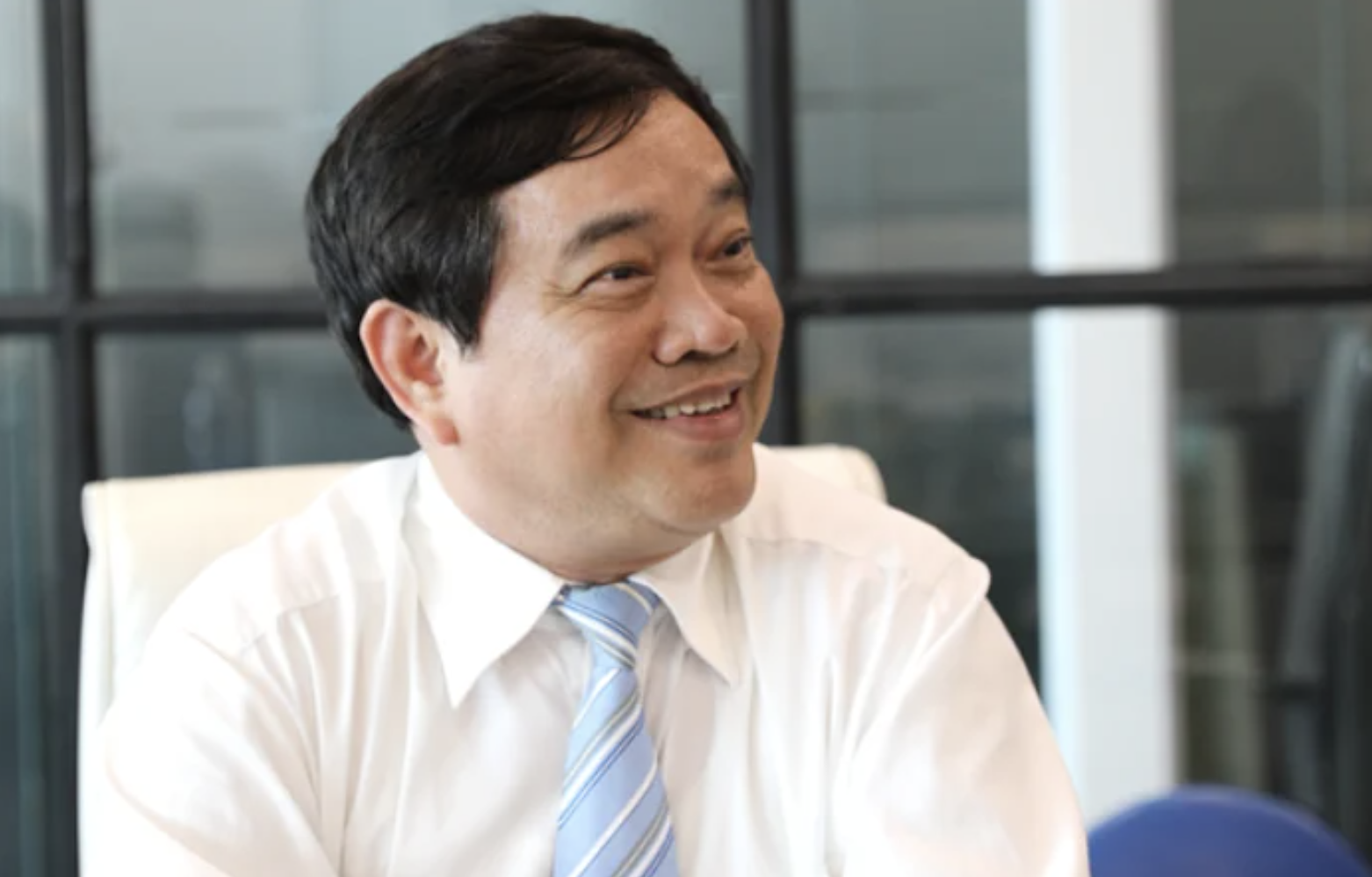 Professor Tran Tho Dat, Chairman of the Science and Training Council, National Economics University.
The past 40 years have clearly shown the fatal "bottlenecks" that have slowed innovation in this sector, resulting in investment efficiency not commensurate with the resources held. These include the lingering influence of the subsidized administrative management mechanism in corporate governance thinking, transforming the state ownership relationship into rigid administrative interventions.
The fear of making mistakes, the fear of responsibility, and the reluctance to "think outside the box and take action" have become invisible obstacles, hindering innovation – a vital element in modern business. Furthermore, the blurring of lines between political objectives and economic goals leaves many state-owned enterprises confused, failing to fulfill their role as "midwives" of the economy while simultaneously falling behind in competitiveness even in their own domestic market…
According to Professor Tran Tho Dat, in the new context of a market economy and deep international integration, as well as the need for internal reform, redefining the role, function, and operating methods of the state economy is becoming an urgent necessity.
LEADING THE WAY, Paving the way
Resolution 79 of the Politburo on the development of the state-owned economy emerged as a solution to the thorny problem of the efficiency of public resources, overcoming the biggest bottleneck: the mindset and perception regarding the position, role, and scope of the state-owned economy. In a recent seminar, economist Pham Chi Lan said she was pleased that Resolution 79 of the Politburo emphasized the management of public assets rather than focusing solely on state-owned enterprises.
"The fact that assets are owned by the entire population does not mean that only the state sector is given priority in their use, but rather that they must be allocated effectively to the entire society, including the private sector and the community," Ms. Pham Chi Lan analyzed.
In Resolution 79, the Politburo defined the state economy as encompassing all resources managed by the State, such as land, natural resources, budget, national reserves, and financial funds. This change in "identification" led to a revolutionary shift in "positioning."
While the role of the state-owned economy was previously often mentioned as "maintaining macroeconomic stability and regulating the economy," Resolution 79 now places a pioneering mission on this sector: "creating development, leading, paving the way, restructuring the economy, and establishing a new growth model."
This way of thinking has established a completely new position: the State does not replace the market, nor encroach on the private sector where it excels, but instead focuses resources on exploring new, challenging fields that require large capital investments and involve high risks, which the private sector is unable or unwilling to undertake.
To realize its leading and pioneering role, Resolution 79 has defined the viewpoint that the state-owned economy must operate according to market principles; be equal before the law with other economic sectors, develop together in the long term, cooperate and compete healthily; and at the same time, have fair, open, and transparent access to resources, markets and development opportunities.
This is an urgent practical requirement to eliminate subsidies and dependence. State-owned enterprises must compete on a level playing field, bear the profits and losses themselves, and eliminate the "favorite" mentality of being given preferential access to resources but being "spoiled" in terms of efficiency.
“Resolution 79 has re-established a more balanced mindset: that the state economy plays a leading role, but that role must be affirmed by efficiency, competitiveness, and substantial contributions to development, not by privileges or subsidies,” Professor Tran Tho Dat emphasized.
"THE INSTITUTIONAL SKY" IS WIDE ENOUGH
In Resolution 79, the Politburo set very specific and ambitious goals for state-owned enterprises. Specifically, by 2030, the goal is to have approximately 50 large-scale state-owned enterprises among the top 500 largest enterprises in the region, including 1-3 enterprises in the top 500 largest enterprises in the world. Further ahead, by 2045, the goal is to have approximately 60 enterprises in the top 500 largest enterprises in the region and about 5 enterprises in the top 500 largest enterprises globally.
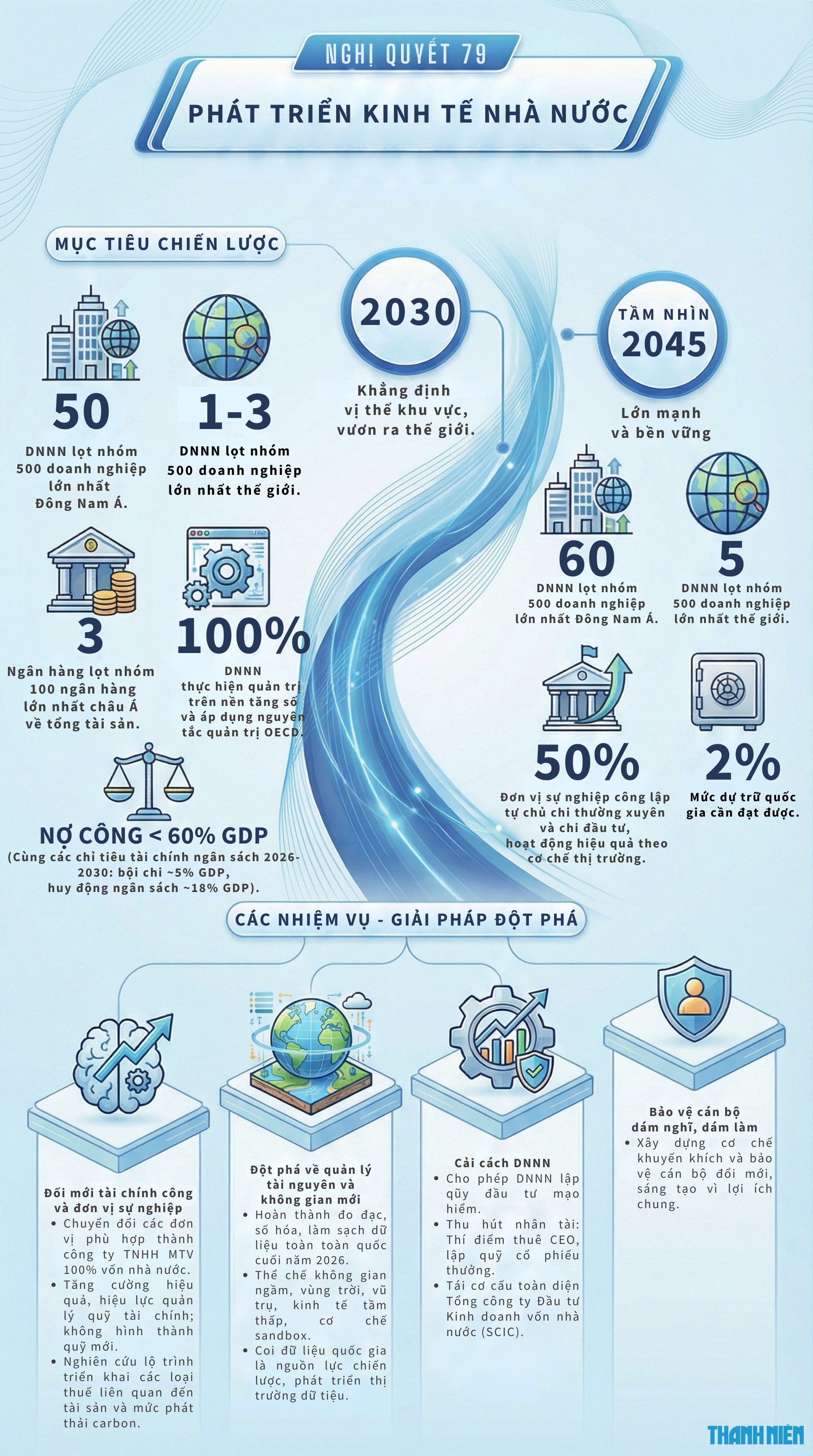
The goals and strategic tasks for the development of the state economy as outlined in Resolution 79 of the Politburo.
Despite high expectations, the state-owned economy, especially state-owned enterprises, is currently hampered by the "bottleneck of bottlenecks"—the institutional framework. State-owned enterprises are caught between the dual tasks of conducting profitable business and being subject to administrative management and a supervisory mechanism heavily reliant on approvals through multiple layers, yet weak in evaluating ultimate effectiveness. The consequence is that instead of innovating, these enterprises choose to remain stagnant for safety.
To cultivate leading companies that can reach global prominence, as envisioned, experts believe that the State's role should not be to micromanage, but rather to create a sufficiently broad, transparent, and secure institutional framework.
Resolution 79 of the Politburo introduced solutions considered a step forward in thinking by separating political tasks from business activities. The State will ensure capital for enterprises to carry out assigned political projects and tasks. Production and business tasks will be accounted for separately and evaluated within the overall context of assigned goals and tasks.
Resolution 79 also shifts from "pre-audit" to "post-audit" and governance according to OECD standards, stating that it is necessary to end overlapping, redundant, prolonged, and unnecessary inspections, examinations, and audits, moving from pre-audit to post-audit based on risk management principles; and promoting the application of science and technology to serve inspections and audits on digital platforms. This helps reduce inconvenience and harassment while also linking accountability so that the operations of state-owned enterprises and economic units remain within the framework and discipline.
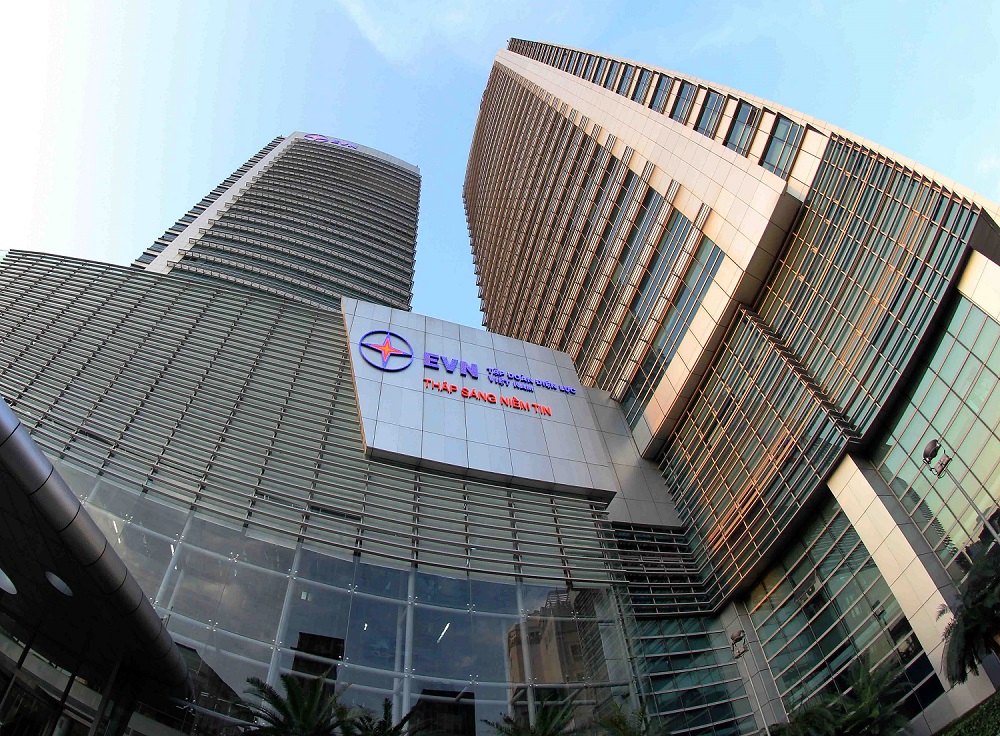
Resolution 79 outlines several solutions to create a new phase of development for the state-owned economy.
In particular, Resolution 79 emphasizes the need to build a sufficiently strong mechanism to protect those who dare to think, dare to act, and dare to take responsibility for the common good in cases where there are no elements of corruption or self-serving behavior. At the same time, it establishes an independent, comprehensive, and transparent review process to assess whether the nature of the incident is an objective error or a violation of the law, in order to properly punish the guilty. This is seen as a shield to protect officials when making innovative and creative decisions as the mindset shifts from "management to control" to "governance to development."
At the same time, Resolution 79 also sets out substantive restructuring solutions. Enterprises holding key positions will be retained and heavily invested in; enterprises engaged in purely commercial activities will be boldly divested.
For the first time, the concept of a "National Investment Fund" was clearly defined in a Politburo resolution. Resolution 79 called for a comprehensive restructuring of the State Capital Investment and Business Corporation (SCIC) to form a National Investment Fund model similar to Singapore's Temasek model – a national investment fund operating on market principles. Accordingly, the State would take the lead in investing in strategic sectors, creating an initial foundation, and then gradually hand over control to the market when the private sector is capable of taking over.
THE "5 CHEMICALS" FORMULA
At the first meeting of the National Steering Committee for the implementation of Resolution 79, Prime Minister Pham Minh Chinh summarized the resolution's action plan with a formula of "5 transformations" of state resources: institutionalization, marketization of resources, corporatization of governance, socialization of investment, and digitalization of management.
General Secretary To Lam and Prime Minister Pham Minh Chinh at the groundbreaking ceremony for Vietnam's first semiconductor chip manufacturing plant at the end of January.
PHOTO: VGP
In this context, "marketization of resources" and "corporatization of governance" are key strategies to break through the stagnation. The state will manage the economy through laws, strategies, and planning, rather than interfering with business operations through administrative orders. A modern corporate governance model will be applied, clearly separating ownership and management rights. Capital investment institutions like SCIC will play a crucial role, shifting from an administrative management mindset to a professional investor mindset, focusing on the efficiency of invested capital…
However, the biggest challenge in implementing Resolution 79 lies not only in its objectives or the lack of legal regulations. Professor Tran Tho Dat argues that the greatest challenge in institutionalizing Resolution 79 lies in changing the approach and mindset for policy implementation. The biggest difficulty currently is how to translate the reform spirit of the resolution into legal regulations that are clear and strong enough, yet still create flexibility for the market to operate.
"In reality, we still tend to design policies in a safe, risk-heavy way, leading to overlapping regulations, complex procedures, and a reluctance to take responsibility among implementers. If this point is not addressed, the institutionalization risks being 'correct in form but not in spirit' of the resolution," Mr. Dat analyzed.
Professor Hoang Van Cuong, from the National Assembly's Finance and Budget Committee, also stated at a recent seminar on Resolution 79 that the action program for Resolution 79 needs to clearly define the path for the state-owned and private economic sectors to fulfill their missions.
He suggested that the State should assume the role of defining the playing field between the public and private sectors. In some key areas, the State needs to maintain control, such as aviation and maritime management related to sovereignty and security. But in other areas, such as energy, the private sector also participates, and the State needs to clearly define the roles of each sector.
"Within the state sector itself, it is necessary to clearly define the tasks of each enterprise and focus investment capital. Investment allocation must have a strategic implementation plan, avoiding a situation where everything requires investment resources," Mr. Cuong stated.
Professor Tran Tho Dat believes that the success of Resolution 79 should be measured by the establishment of a modern, transparent, and highly accountable state-owned economic model, in which the State effectively utilizes public resources to serve the goals of sustainable, equitable, and prosperous development.
"If the solutions are implemented synchronously, the state-owned economy will not only be a 'pillar' of the national economy, but also become a driving force for long-term development, accompanying Vietnam on its path to becoming a developed, high-income country by the middle of the 21st century," Mr. Dat affirmed.
Thanhnien.vn
Source: https://thanhnien.vn/tai-dinh-vi-kinh-te-nha-nuoc-185260218165846339.htm




![[Photo] National Assembly Chairman Tran Thanh Man attends the policy seminar to promote Vietnam-Türkiye cooperation.](https://vphoto.vietnam.vn/thumb/1200x675/vietnam/resource/IMAGE/2026/04/16/1776351415367_vna-potal-chu-tich-quoc-hoi-tran-thanh-man-du-toa-dam-chinh-sach-thuc-day-hop-tac-viet-nam-tho-nhi-ky-8705791-jpg.webp)










![[Photo] National Assembly Chairman Tran Thanh Man meets with the Speaker of the Georgian Parliament](https://vphoto.vietnam.vn/thumb/402x226/vietnam/resource/IMAGE/2026/04/16/1776338494029_anh-man-hinh-2026-04-16-luc-18-21-21.png)













![[Image] Bridges and roads connecting the eastern part of Ho Chi Minh City](https://vphoto.vietnam.vn/thumb/1200x675/vietnam/resource/IMAGE/2026/04/16/1776328595108_ndo_br_bh-vt5-jpg.webp)
































![[Infographic] Details of the Hanoi-Quang Ninh High-Speed Railway Project](https://vphoto.vietnam.vn/thumb/402x226/vietnam/resource/IMAGE/2026/04/16/1776338188424_anh-man-hinh-2026-04-16-luc-18-16-10.png)





















Comment (0)