

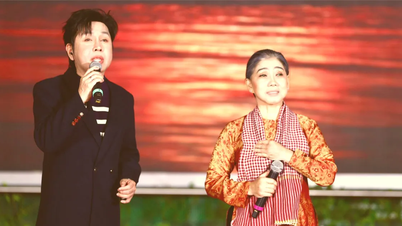
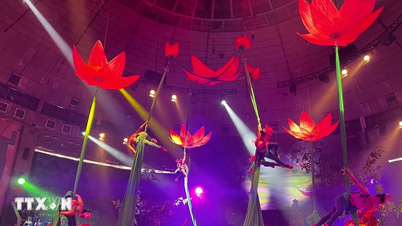
The event took place on the 80th anniversary of the National Congress, serving as a bridge connecting the present with the historical autumn, from which the call for a general uprising echoed throughout the country, ushering in an era of independence and freedom for the nation.
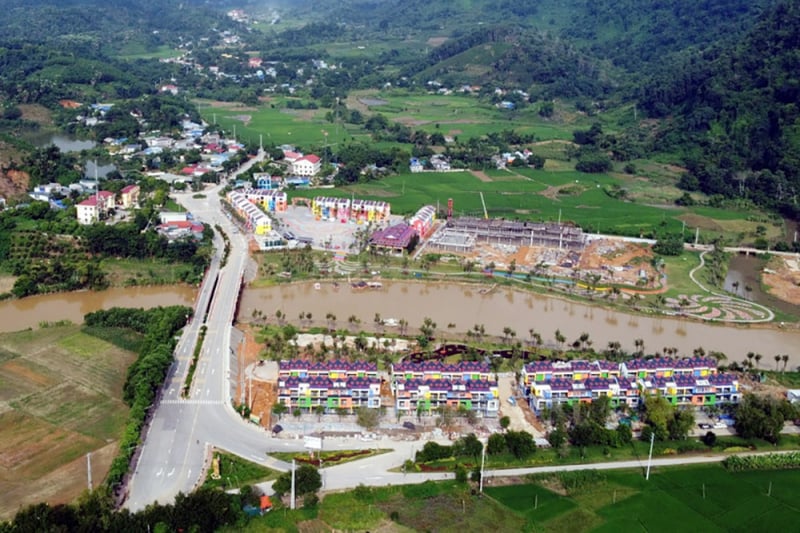
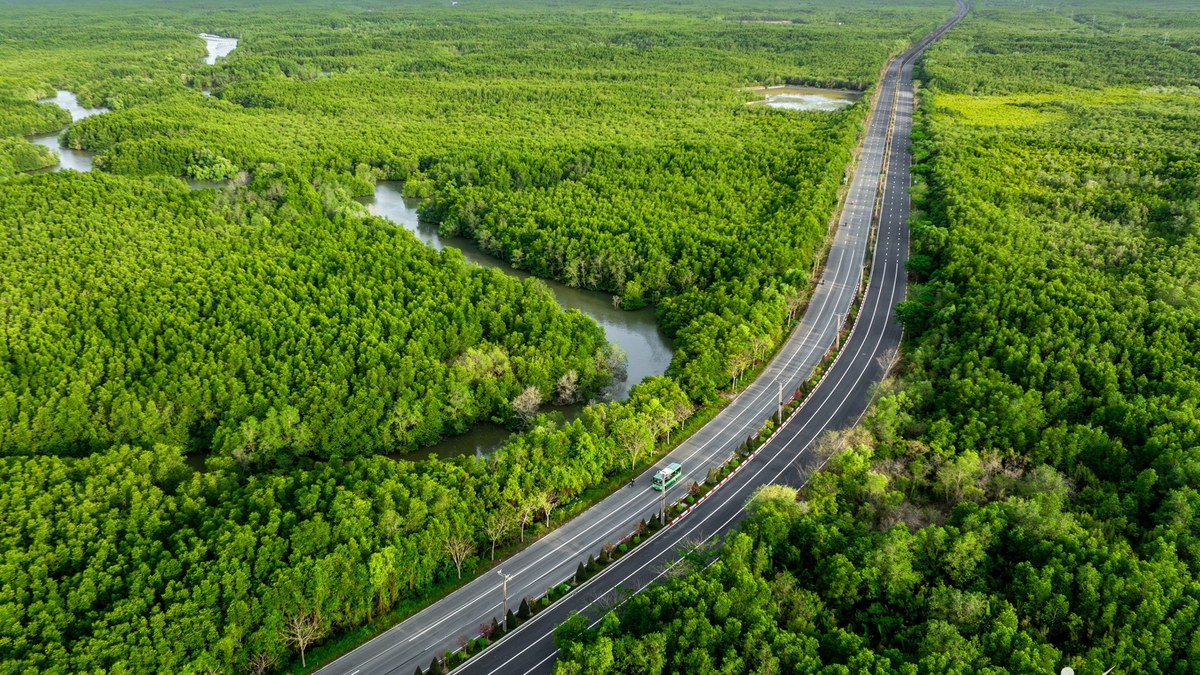
Tan Trao commune, Tuyen Quang province. Photo: Contributor.
Tan Trao is located in the valley of the Viet Bac war zone, a name coined since 1945 when the two communes of Tan Lap and Hong Thai (formerly Kim Long and Kim Chau) were merged. This area is characterized by dense forests and mountains, with hills and mountains occupying 90% of the land and covered by a thick tropical rainforest. Its strategically important location acts as a natural fortress: the interwoven mountain ranges form a "curtain" shielding the base, providing both protection and a supply of wood, bamboo, rattan, and other materials for constructing camps, tunnels, and trenches for the resistance.
Although the roads were treacherous, they were flexible, allowing for secret communication with the northern mountainous provinces as well as access to the lowlands. Thanks to the interwoven network of roads through the mountains and forests, and trails cleared by the local people, our forces could secretly move and communicate with the people in the highlands, and descend to the lowlands whenever necessary. The people of Tuyen Quang once described this land with the verse: " Kim Long is a land of treacherous terrain on all sides / If the enemy wants to die, they should come to Kim Long ."
Not only does Tan Trao possess favorable geographical conditions, but it also enjoys both opportune timing and harmonious human relations. It is home to ethnic minority groups such as the Tay, Dao, and Nung, who have a rich tradition of patriotism. From the late 19th century, the people of Tuyen Quang rose up against the oppressive rule of colonial feudalism. During the 1930s and 1940s, the revolutionary movement and the National Salvation guerrilla units in Tuyen Quang flourished; Viet Minh bases were formed in many villages, including Kim Long – Tan Trao.
Before the Revolution, the guerrilla units here secretly forged spears and machetes, practiced martial arts, organized speeches and distributed leaflets, preparing the masses for the day of uprising. The people secretly took oaths, practiced weapons, and waited for the opportunity to revolt. The people were self-sufficient in food, growing rice, corn, and cassava, and raising livestock, both to sustain themselves and to contribute to the army.
Thanks to the convergence of favorable circumstances – opportune timing, geographical advantages, and human resources – President Ho Chi Minh and the Central Committee of the Party chose Tan Trao as the base for directing the revolution during a decisive moment in history. From May 1945, Tan Trao became a safe haven sheltering the Party's headquarters and national salvation forces from all over the country.
As World War II entered its final stages, the Japanese fascists overthrew the French (March 1945), creating a power vacuum in Indochina. Recognizing that the opportunity for independence had arrived, President Ho Chi Minh and the Central Committee moved from Pac Bo (Cao Bang) to Tuyen Quang to be closer to the Central Committee and directly lead the movement.
On May 4, 1945, President Ho Chi Minh departed from Cao Bang, and on the evening of May 21, 1945, he arrived in Kim Long. The entire village, with only about twenty stilt houses, suddenly became lively as it welcomed the delegation of cadres returning from Pac Bo. Seeing a slender, sun-tanned old man, the villagers, not knowing he was President Ho Chi Minh, affectionately called him "Uncle Ke." His companions respectfully called him "Comrade Gia."
Uncle Ho temporarily stayed at the stilt house of Mr. Nguyen Tien Su, the head of the Viet Minh in Kim Long commune, where he worked during his early days in Tan Trao (May 21–31, 1945). General Vo Nguyen Giap stayed at the nearby house of Mr. Hoang Trung Dan. It was at Mr. Dan's house that Military Order No. 1 calling for a general uprising was drafted and typed.
In the historic final days of May, Kim Long became the "capital" of the revolution. The villagers sheltered many cadres and secretly welcomed delegates from the South, North, Laos, Cambodia, and other regions who were preparing for the National Congress. Night after night, amidst the mountains and forests of Tan Trao, groups of people and the national salvation army rehearsed marches, "rumbling as if the earth were shaking," as the elderly recounted.
The revolutionary atmosphere was fervent throughout the villages, "Kim Long was seething like a cauldron," every household eagerly contributed rice to feed the troops, forged rudimentary weapons, and prepared for the General Uprising. During the nights of preparation, the flickering campfires around the village square illuminated the determined faces of the young men and women of Tan Trao; everyone believed that tomorrow would bring independence.
In early June 1945, a conference of cadres in Tan Trao decided to establish a Liberation Zone comprising six provinces: Cao Bang, Bac Kan, Lang Son, Ha Giang, Tuyen Quang, and Thai Nguyen. Tan Trao was chosen as the capital of the Liberation Zone – the central base for leading the revolution nationwide. To facilitate leadership, President Ho Chi Minh moved from Mr. Su's house to the slopes of Na Lua mountain, in Tan Lap village, where he built a small wooden hut with a palm leaf roof, nestled under the canopy of the old forest.
The hut was divided into two sections: the inner section was for resting, and the outer section was for working and receiving guests. The location of the hut was carefully chosen: near a water source, close to the village, far from the highway, convenient for both advance and retreat. The Na Nua hut was not far from the village, at its foot lay the Na Nua stream providing cool water, and it was also secluded.
It was here, on June 4, 1945, that President Ho Chi Minh chaired the revolutionary military conference, deciding to unify the armed forces into the Vietnam Liberation Army and prepare for the General Uprising. These crucial decisions were conceived from a small hut under the dim light of an oil lamp and over a cup of green tea brought by the locals.
The three months in the Tan Trao revolutionary base were a period when President Ho Chi Minh and the Central Committee raced against time. From his hut in Na Nua, he closely followed domestic and international developments. When he heard the news that the Soviet Union had declared war on fascist Japan and that the Japanese army had suffered a rapid defeat in Manchuria (August 8, 1945), and then on August 13, 1945, Japan surrendered unconditionally to the Allies, President Ho Chi Minh assessed: "The opportune moment has arrived!" and demanded immediate action.
At this time, due to spending a long time in the forest enduring meager meals, Uncle Ho fell seriously ill with malaria. He suffered from a high fever and delirium for many days, and the medicine, consisting only of a small amount of quinine, was ineffective. Waking up from his delirium, the leader struggled to sit up and called General Vo Nguyen Giap to him, his voice weak but resolute: "Now the opportune moment has arrived. Even if we have to burn down the entire Truong Son mountain range, we must resolutely fight to achieve independence!"
Those words further spurred the entire resistance zone to fight to the death. Fortunately, thanks to a Tay ethnic healer who visited and gave Uncle Ho a secret herbal remedy and hot porridge, his fever gradually subsided. He recovered in time to lead the General Uprising, leading many to believe that the sacred land had protected him.
From August 13-15, 1945, the Central Committee of the Party held a national conference at the Na Nua hut, affirming: "A very good opportunity for us to gain independence has arrived," and issued the order for a general uprising to seize power throughout the country. Immediately afterwards, on the afternoon of August 16, the National Congress – the national delegate congress – opened at Tan Trao communal house. More than 60 delegates representing various parties, national salvation organizations, ethnic groups, religions, and overseas Vietnamese gathered under the small thatched roof of the communal house.
Throughout the two working days (August 16-17), the Congress unanimously approved the General Uprising policy, adopted 10 major policies of the Viet Minh, decided on the national flag (red background with a yellow star) and the national anthem "Tiến quân ca" (Marching Song). The Congress also elected the Vietnam National Liberation Committee (i.e., the Provisional Government) with leader Ho Chi Minh as Chairman - the predecessor of the later Provisional Revolutionary Government. The delegates felt "a surge of emotion from the entire nation; when the order for the General Uprising was given, the Congress felt as if it were fighting alongside the people."
On the morning of August 17, 1945, in front of Tan Trao communal house, the solemn oath-taking ceremony of the Provisional Government took place under the red flag with a yellow star. President Ho Chi Minh boldly proclaimed the oath of independence: “Before the sacred flag of the Fatherland, we pledge to resolutely lead the people forward, to fight vigorously against the enemy, and to regain independence for the Fatherland. Even if we have to sacrifice to the last drop of blood, we will not retreat. We swear!” That oath quickly translated into action throughout the country.
On the same day, August 18, 1945, President Ho Chi Minh wrote the "Letter Calling for a General Uprising" to the people, urging them to rise up: "The decisive moment for the destiny of our nation has arrived… We cannot delay. Forward! Forward! Under the banner of the Viet Minh, let our compatriots bravely advance!"
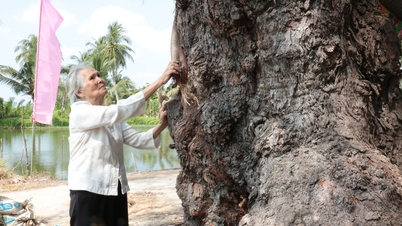
On the afternoon of August 16, 1945, at the base of the Tan Trao banyan tree, General Vo Nguyen Giap read Military Order No. 1, launching the troop deployment ceremony. After the shout "Advance towards Hanoi!", rows of Liberation Army soldiers, dressed in brown uniforms, with red and yellow star-emblazoned headscarves and rifles firmly in hand, left the banyan tree and marched towards the plains.
The General Uprising erupted like a storm. In just ten days, power was in the hands of the people throughout the country. On August 25, 1945, the liberation army entered Hanoi. At noon on September 2, 1945, at Ba Dinh Square, President Ho Chi Minh read the Declaration of Independence, giving birth to the Democratic Republic of Vietnam.
The swift victory of the August Revolution owed a great deal to the Tan Trao revolutionary base – the provisional capital of the Liberation Zone. This base provided safe shelter for the Viet Minh General Headquarters, served as the central command center for the general uprising, and was also the "furnace" of revolution that forged the will of the entire people. The people of Tuyen Quang, especially the ethnic groups of Tan Trao, wholeheartedly protected President Ho Chi Minh and the Central Committee, dedicating their resources and manpower to the revolution. Elderly people and young children pounded rice to feed the troops, guarded and reported news, and sheltered cadres as if they were precious treasures.
Uncle Ho once instructed the people: "Making revolution is more precious than money, so it must be kept secret and carefully guarded!" Thanks to maintaining secrecy and a solid rear base, the Tan Trao base withstood all enemy searches. The French colonialists and their collaborators repeatedly launched surprise attacks on Tan Trao from various directions, but were always repelled. Tan Trao deserves to be considered a sacred land, embodying the spiritual essence of the mountains and forests and the revolutionary spirit of the entire nation. After the August Revolution, the resistance war against the French broke out (December 19, 1946). Once again, Tuyen Quang was chosen as the capital of the resistance, and Tan Trao continued to be the center of the Viet Bac base area.
For nine long years, President Ho Chi Minh and the central agencies returned to Tan Trao many times to lead the resistance until victory. Tan Trao communal house, Na Nua hut, Hong Thai communal house, Bong cave… became immortal landmarks associated with the names of President Ho Chi Minh, General Vo Nguyen Giap, comrades Truong Chinh, Pham Van Dong, Ton Duc Thang… On March 20, 1961, President Ho Chi Minh revisited his revolutionary homeland, deeply moved to meet the people who had sheltered him.
Today, Tan Trao has become a Special National Historical Site, a sacred "return to the roots" destination attracting numerous domestic and international tourists. The Tan Trao banyan tree still flourishes, its branches reaching out in the square of Tan Lap village – a vibrant symbol of national pride. Tan Trao communal house, Hong Thai communal house, Na Nua hut… have been restored to their original state, welcoming visitors to listen to stories of the glorious past. Many historical witnesses remain lucid, preserving memories of the autumn of 1945 and passing them on to future generations. It is this gratitude for the past and the education of tradition that creates the enduring strength of this revolutionary homeland.
This August, on the occasion of the 80th anniversary of the Tan Trao National Congress (1945–2025), the Party Committee and people of Tuyen Quang solemnly inaugurated the "Ho Chi Minh in Tan Trao" Monument in Tan Trao Square. This majestic structure, standing tall in this sacred land, is a heartfelt expression of respect and gratitude to the Father of the Nation – the man who chose this place as a base to shelter and guide the revolution to glorious victory. The echoes of that revolutionary autumn still resonate in this heroic homeland, reminding today's generation of the arduous yet heroic struggle of our ancestors to win independence and freedom for the Fatherland.
Source: https://cand.com.vn/Tieu-diem-van-hoa/tan-trao-va-ban-hung-ca-lich-su-i778080/
















































Comment (0)