

In addition to strategic policies and decisions on education and training such as implementing a nationwide tuition waiver for students from preschool to high school; unifying the policy on building a National Target Program for modernization and improvement of education and training quality for the period 2026-2035; and unifying the policy on investing in the construction of 248 boarding schools for primary and secondary levels in border communes..., the determination of a minimum professional incentive allowance of 70% for preschool and general education teachers, as stipulated in Resolution No. 71/NQ-TW of the Politburo on breakthroughs in education and training development, is a breakthrough demonstrating the Party's priority for the teaching staff – a key force in the fundamental and comprehensive reform of education and training.
Raising teachers' salaries is an investment in the future, because behind every student's success lies the dedication and trust of their teacher. Therefore, this is considered a concrete action to realize the view that "teachers' salaries should be prioritized and ranked highest in the administrative and public service salary scale"; it is an important spiritual and material remedy to encourage dedication and retain talented individuals committed to teaching.
 |
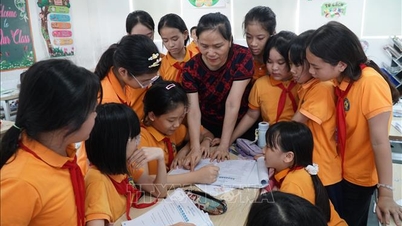
| Increasing remuneration is not only a well-deserved recognition but also a way to keep the passion for teaching alive. In the photo: A lesson taught by a teacher at Dinh Nup Ethnic Boarding School (Phu Mo commune). |
The 2025-2026 school year marks the first year that the entire education and training sector will implement management and operation under a two-tiered local government model. This is also the year when the education and training sector in Dak Lak province will have the largest number of schools and classes ever, with 1,379 educational institutions at all levels, including 453 kindergartens, 456 primary schools, 349 lower secondary schools, and 94 upper secondary schools, with a total of over 38,000 staff, teachers, and employees. Entering the new school year 2025-2026, the province still lacks 700 teachers and staff in schools. Meanwhile, teacher recruitment is becoming increasingly difficult, with many localities in the province having vacancies but failing to recruit.
The increasingly severe teacher shortage is not unique to our province, but is occurring in most provinces and cities nationwide. This is partly due to students' lack of interest in the teaching profession because of low income, unattractive benefits, difficult working conditions (especially in remote areas), and high work pressure, leading many education graduates to choose other careers. Meanwhile, training and recruitment have not kept pace with actual needs, resulting in a situation of "local shortages and surpluses" and difficulty in attracting high-quality human resources.
Therefore, increased benefits are not only a well-deserved recognition but also a way to keep the passion for teaching alive. When their livelihoods are secure, teachers can wholeheartedly dedicate themselves to the classroom, be creative in their lessons, and persevere through professional pressures, so that every day at school is a day of complete joy and dedication. The whole society is anticipating a major transformation in the education sector. And educators hope that these benefits will bring concrete advantages in terms of income and enhance their professional status.
There remains a significant gap between a groundbreaking policy and its implementation to achieve its goals. Education experts believe that setting a minimum professional incentive allowance of 70% represents a turning point in thinking. However, the most important aspect of implementation is ensuring it aligns with personnel restructuring. If we increase salaries without streamlining the system, the pressure on the budget will be immense. A mechanism is needed to ensure that truly talented individuals receive even higher salaries, instead of a uniform approach.
Source: https://baodaklak.vn/xa-hoi/202601/tang-dai-ngo-giu-lua-nghe-4122201/
![[Photo] National Assembly Chairman Tran Thanh Man working with the Standing Committee of the National Assembly's Delegation Affairs Committee.](https://vphoto.vietnam.vn/thumb/1200x675/vietnam/resource/IMAGE/2026/05/20/1779294340023_ndo_br_1-1691-jpg.webp)
![[Image] "Journey of Hope" promotes the organ and tissue donation movement in Vietnam.](https://vphoto.vietnam.vn/thumb/1200x675/vietnam/resource/IMAGE/2026/05/20/1779294400833_1-8910-jpg.webp)

![[Photo] General Secretary and President To Lam works with the Party Committee of the Ministry of Health on the work of Vietnamese traditional medicine.](https://vphoto.vietnam.vn/thumb/1200x675/vietnam/resource/IMAGE/2026/05/20/1779294323718_a1-bnd-2978-3319-jpg.webp)

































































Comment (0)