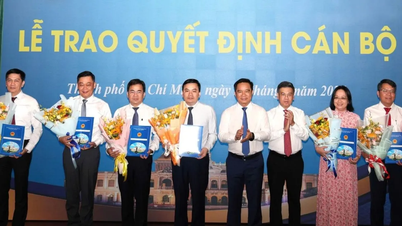
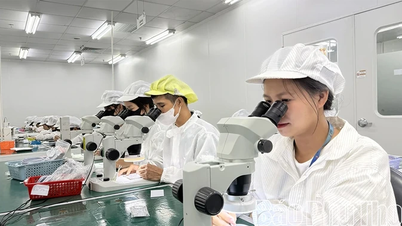
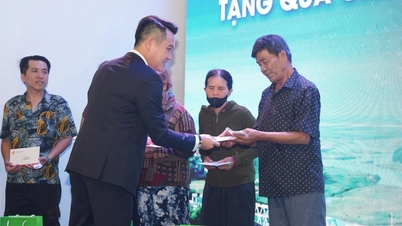
Strengthening human resources is contributing to improved management and administration efficiency at the grassroots level. A prime example is Phong Chau ward, which leads the entire province in the rate of disbursement of public investment capital.
Strengthening forces at the grassroots level.
To address this issue, the province has implemented a comprehensive set of solutions to strengthen human resources at the grassroots level. By May 2026, the entire province will have 6,249 officials and civil servants working in communes and wards; at the same time, 1,046 officials, civil servants, and public employees will be seconded or assigned to grassroots levels to support localities in meeting new task requirements. Of these, 513 officials, civil servants, and public employees will be seconded from various departments and agencies to communes, focusing on areas with high demand such as finance and planning, information technology, construction, agriculture , natural resources and environment, justice, and culture and social affairs.
In addition to mechanically supplementing the workforce, the province also focuses on strengthening the team with in-depth expertise in areas that are urgently needed during the digital transformation and administrative reform period. Following this policy, many provincial-level officials and civil servants have proactively taken on assignments at the grassroots level, bringing with them practical experience to support localities in overcoming difficulties in operating the new administrative apparatus.
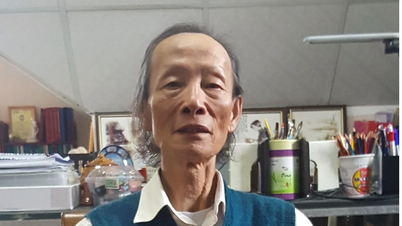
Mr. Tran Duy Van, a specialist in the Press and Publishing Management Department of the Department of Culture, Sports and Tourism, is one of the officials seconded to work at the People's Committee of Muong Dong commune. During his time at the local level, he directly assisted the Culture and Social Affairs Department in advising on state management of culture, information, press, and publishing; and also participated in promoting digital transformation, administrative reform, the operation of the two-tiered government, guiding the standardization of data in the local information system, and deploying digital platforms to serve management work.
Sharing his experience working at the grassroots level, Mr. Van said that working directly in the commune helped him better understand the difficulties and obstacles of the locality, thereby enabling him to utilize his professional knowledge to more effectively support the local officials. Although his initial assignment only lasted three months, he proactively proposed to stay for another six months to work alongside the locality in completing the ongoing tasks.
![[Infographic] Many new policies take effect from July 1st](https://vphoto.vietnam.vn/thumb/192x108/vietnam/resource/IMAGE/2026/06/29/1782688947907_cac-quy-inh-chinh-sach-moi-co-hieu-luc-tu-ngay-172026-1-63225357694097902767392-69828806835403898710899.webp)

Not only in Muong Dong commune, but the policy of deploying and seconding officials to grassroots levels is proving effective in many localities throughout the province. Comrade Nguyen Khac Long, Chairman of the People's Committee of Muong Dong commune, assessed: "This is a timely solution that helps localities overcome difficulties in administration and public service implementation. Officials assigned to grassroots levels are effectively utilizing their expertise, while also directly guiding, mentoring, and supporting commune officials in areas where they are still lacking."
Along with the deployment and secondment of officials, the province is also implementing the restructuring of the commune-level administrative apparatus to enhance governance capacity. Accordingly, 74 communes and wards have been allocated an additional Vice Chairman of the People's Committee to reduce administrative pressure and improve the effectiveness of direction and management in areas with large populations or specific characteristics. In addition, the province has recruited 147 civil servants into commune-level positions, contributing to supplementing the workforce with qualified and experienced personnel for the grassroots administrative apparatus.
Synchronized solutions ranging from deployment, secondment, recruitment, to strengthening the workforce are gradually helping communes gain more resources to effectively fulfill their role as the closest level of government to the people, directly addressing issues arising from real-life situations. This is also an important foundation for the smooth and efficient operation of the grassroots government apparatus in the new era.
Improving the quality of the workforce
In the context of communes directly carrying out many tasks previously under the district level, the requirements for each official and civil servant extend beyond professional expertise to include technological proficiency, rapid adaptation to digital transformation, and increasingly professional service skills for the people.
According to statistics from the Department of Internal Affairs, after the restructuring, the team of commune-level officials and civil servants in the province has a relatively high level of professional expertise, with 12 PhDs, 1,429 Master's degrees, and 4,767 people with university degrees; the number of officials with college degrees or lower has decreased to only 41. This is an important foundation for localities to improve the quality of governance and gradually meet the requirements of a modern administrative system.
However, in the face of the new demands of the two-tiered local government model, professional qualifications alone are insufficient. Many areas, such as digital transformation, online administrative procedures, digital data management, artificial intelligence applications, and the provision of public services electronically, require local officials to continuously update their knowledge and skills. Recognizing this, the province has placed special emphasis on training and developing officials and civil servants in a way that aligns with practical needs. Training content focuses on knowledge of state management in a system without intermediate levels; operational and work-handling skills; application of information technology and digital transformation; and communication and service skills for citizens and businesses. Training methods have been innovated to be more flexible, combining in-person, online, and on-the-job training.
In the first year of implementing the new model alone, the province organized 11 training courses with 812 officials and civil servants participating. Of these, 148 civil servants specializing in or assigned IT tasks at the commune and ward levels received training on cybersecurity to enhance their capacity in operating digital government and ensuring data security in the digital environment. According to Mr. Tran Van Hoa, Deputy Director of the Department of Internal Affairs, the assignment and placement of officials after the restructuring is generally consistent with their professional qualifications, experience, and job requirements; most officials are assigned to positions within their trained specialties and are gradually adapting to the new organizational model. Although there are still cases of officials having to take on additional responsibilities or transfer to other areas of work, overall, the grassroots officials are demonstrating initiative, responsibility, and determination to adapt to the demands of innovation.



From increasing quantity to improving quality, from supplementing human resources to fostering digital capabilities, these synchronized solutions are gradually building a team of commune-level officials with sufficient dedication, vision, and competence to meet the development requirements of the new era. This is not only a condition for more effective operation of local governments, but also an important foundation for building a service-oriented administration, putting the people at the center, and quickly bringing the policies and guidelines of the Party and State into practice.
Nguyen Yen
Source: https://baophutho.vn/tang-suc-manh-cho-nhan-luc-cap-xa-256199.htm
![[Image] Building an elevated road through the Ma Da forest.](https://vphoto.vietnam.vn/thumb/1200x675/vietnam/resource/IMAGE/2026/06/29/1782721937402_ndo_br_z7987962650670-9f8b4b8ae18c0c03cb87a49d57f076e8-5087-jpg.webp)


![[Photo] National Assembly Chairman Tran Thanh Man attends the Conference to announce the Master Plan for Hanoi Capital City with a 100-year vision.](https://vphoto.vietnam.vn/thumb/1200x675/vietnam/resource/IMAGE/2026/06/29/1782709639728_ndo_br_1-jpg.webp)