

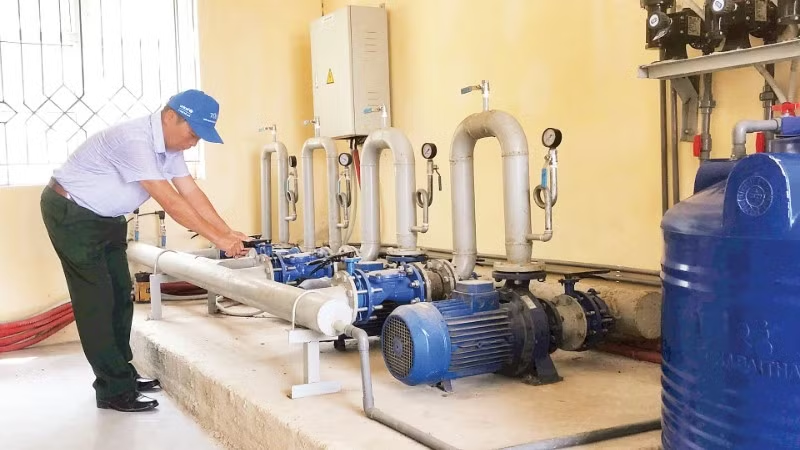
According to the Department of Water Resources Management and Construction ( Ministry of Agriculture and Environment ), significant achievements have been made in providing clean water and sanitation in rural areas over the past years. The policy and legal system has been increasingly improved, and many large-scale programs and projects have been implemented synchronously and effectively.
By the end of 2025, the whole country will have built more than 18,000 centralized clean water supply systems, with approximately 95% of rural residents having access to hygienic water, of which more than 74% have access to water meeting standards. At the same time, 96% of schools and health stations will be equipped with standard water supply and sanitation facilities.
Tuyen Quang province has achieved positive results with over 97% of its population having access to safe water, including 51.7% with clean water. Furthermore, many centralized water supply systems have been invested in, upgraded, and equipped with digital technology, enabling close monitoring of water quality; optimizing system operation, reducing losses, and improving the ability to respond to emergencies.
For example, the water supply project in Nhữ Khê commune, thanks to the application of digital technology in management and operation, has ensured water supply for nearly 1,100 households, agencies, and schools in the area.
According to Tran Trung Bac, Deputy Director of the Rural Water Supply Center of Tuyen Quang province: “Currently, all secondary and tertiary pumps of the project are equipped with frequency converters, allowing the system to automatically adjust power according to actual usage needs, saving electricity, protecting pipeline lifespan, and reducing malfunctions. In addition, the automatic filtration system backwashes when blockages occur, saving labor and electricity in the management and operation of the project.”
Mr. Tran Van Tuyen from Nhu Khe commune shared: “Previously, before the water supply project was built, during the dry season, our people always faced a shortage of water for daily use. Since 2023, when the project became operational, households have had access to water of guaranteed quality. Currently, my family of six uses an average of about 4-5 cubic meters of water per month.”
Although improvements have been made, experts in this field assess that providing water to rural residents still faces difficulties due to limited investment resources, technology application, and water resource management. Furthermore, the impact of climate change and environmental pollution increases the risk of water contamination and raises the cost of water quality control. In addition, the deterioration of water supply infrastructure, limitations in management and operation, and a lack of awareness regarding water conservation have negatively affected water supply to the population.
On the other hand, there are significant disparities in water access rates between regions, with the Red River Delta region having the highest rate of access to clean water meeting standards at 89.73%, and the northern midland and mountainous region having the lowest rate at 46.51%. These challenges directly affect access to clean water, especially in remote and rural areas.
To ensure that people in rural areas have access to clean water, Nguyen Tung Phong, Director of the Department of Water Resources Management and Construction, said: “In the coming time, localities need to proactively develop appropriate water supply solutions and plans, ensuring that people do not lack water for daily life; promote investment in the construction, upgrading, and modernization of water supply facilities, prioritizing disadvantaged areas and areas frequently affected by natural disasters.”
At the same time, localities need to strengthen the application of science, technology and digital transformation in the management and operation of water supply systems; build databases and water source monitoring systems; develop sustainable management models with the participation of the community and the private sector; and promote public awareness of water conservation, safe use, and environmental protection.
Source: https://nhandan.vn/tang-ty-le-nguoi-dan-su-dung-nuoc-sach-post962529.html










































































Comment (0)