However, this reality also raises a question: How can thousands of rural workers find sustainable and stable livelihoods after their agricultural land is confiscated? This is also one of the issues that Hanoi city is particularly concerned about.

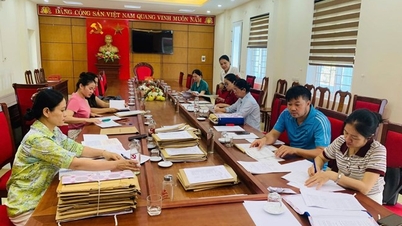
Workers participate in a job fair in Thien Loc commune. Photo: Hien Phuong
Desire to change to a more suitable career.
Tam Hung commune has over 1,900 hectares of agricultural land reclaimed for the implementation of many key projects of Hanoi city. The changes in the local landscape are easily noticeable, but along with that comes the concern of the people as the means of production that they have been attached to for many years are gone.
According to a local survey, Tam Hung currently has over 800 working-age people in need of vocational training to change jobs. Mr. Phan Thanh Binh (53 years old, Tam Hung commune), representing one of the households whose entire agricultural land was confiscated, said: “We are not afraid of change. Our greatest wish is to learn trades suitable for our age so that we can continue working and have a stable income.”
You may also like

24 households in Phu Quoc voluntarily handed over their land before the forced eviction.On June 29th, the People's Committee of Phu Quoc Special Economic Zone, An Giang province, implemented a plan to enforce land reclamation decisions against those who had not complied with the regulations on handing over the land in Ward 7, An Thoi commune. Prior to the enforcement, 24 out of 31 households had agreed to sign the land handover agreement... Not only older people, but many young workers are also facing the need to change their career mindset. Nguyen Van Thanh (30 years old, from Thien Loc commune) believes that the land reclamation process is both a challenge and an opportunity. “Having agricultural land reclaimed doesn't mean losing your future. The important thing is that workers receive career guidance and proper training. With the right skills, we can absolutely work in new fields such as mechanics, electrical engineering, or information technology,” Nguyen Van Thanh expressed.
These concerns are also present in many other localities throughout the city, where numerous transportation, urban, and industrial projects are being implemented. In Phuc Thinh commune, approximately 90 projects will require land clearance in 2026. This means that the number of workers needing to change professions is increasing. “My family’s agricultural land was confiscated for the project, so I decided I had to learn a new trade. Participating in the job fair organized by the local authorities, I registered for a car repair course. I hope there will be more training courses that are closely linked to the actual needs of businesses, so that graduates can find jobs immediately,” said Mr. Ngo Dang Khoi (Phuc Thinh commune).
Government, training institutions, and businesses work together.
According to Bui The Chuyen, Vice Chairman of the People's Committee of Phuc Thinh commune: “The locality has identified job creation for people whose land has been confiscated as an important task, closely linked to the socio-economic development process. The 2026 Job Fair recently organized by the commune attracted 35 units and businesses participating in recruitment with 1,506 job positions. This helps people access recruitment information right in their locality and find suitable jobs after their land is confiscated.”
Besides the proactive efforts of local authorities, Hanoi city has identified the issue of employment for rural workers during the transition period as one of its key priorities. The City People's Committee has been implementing numerous solutions to ensure that people whose land has been expropriated are not left behind in the development process. One of the important policies is Plan No. 193/KH-UBND dated May 16, 2026, of the City People's Committee on supporting vocational training, retraining, and job placement for various groups of workers, including rural workers and workers whose land has been expropriated, during the 2026-2030 period. According to the plan, workers will be supported in accessing vocational training programs, retraining programs, job counseling, job placement, and preferential credit sources to create their own jobs and develop production and business. Notably, the city requires communes and wards to specifically review the vocational training and employment needs of each target group; Simultaneously, develop career transition plans that are aligned with the economic development characteristics of each locality…
Distinguished educator Pham Xuan Khanh, Principal of Hanoi High-Tech College, said: “The school is ready to cooperate with localities to train human resources on-site so that people can directly participate in projects being implemented in the area or train in professions suitable for urban development and the digital economy. There is a huge demand for jobs in logistics, trade and services, industrial electricity, mechatronics, digital technology, and equipment operation engineering.” In addition, many businesses are also proactively participating in providing employment for workers whose land has been expropriated.
According to Nguyen Truong Son, Project Director of the Hanoi International Sports City, starting in 2027, the company will continue to recruit a large number of workers for positions in landscaping, electrical and water engineering, environmental sanitation, and other urban services. In particular, the company plans to open short-term vocational training courses locally to enable residents to quickly access employment.

Vietnam encourages US businesses to expand investment in high technology.On the morning of June 26th, at the Government Headquarters, Deputy Prime Minister Ho Quoc Dung received Mr. Jeff Place, Supply Chain Director of Coherent Group (USA). During the meeting, the Deputy Prime Minister affirmed that Vietnam encourages US businesses to expand investment, especially in high-tech, innovation, and semiconductor industries. As of the end of May 2026, the Hanoi Employment Service Center (under the Hanoi Department of Internal Affairs) had organized 24 job fairs, with hundreds of workers having their applications accepted or being directly recruited through these fairs. In addition, the city successfully provided employment for 21,900 workers through entrusted capital, labor export, and service provision.
Land acquisition for urban development, industrial zones, infrastructure, etc., is an inevitable trend in the development process of the capital city. When the government, training institutions, and businesses work together, the problem of employment for workers affected by land acquisition will gradually be resolved, contributing to ensuring social security and creating consensus in the development process.
Source: https://hanoimoi.vn/tao-sinh-ke-ben-vung-sau-thu-hoi-dat-1208974.html







![[Photo] Strengthening character and expertise: Intense training for artillery soldiers.](https://vphoto.vietnam.vn/thumb/1200x675/vietnam/resource/IMAGE/2026/06/30/1782815602541_lu-368-1875-4571-jpg.webp)