

In the Vietnamese psyche, village names are the most enduring cultural layer. They precede all administrative designations and last longer than any political institution. Ly Vien is an ancient place name composed of two elements: "Ly" - a stable residential area, where people had settled and cultivated the land for a long time; and "Vien" - suggesting the prosperity, gardens, and abundance of an ancient agricultural community. This name is not simply for distinguishing geographical boundaries, but is an "invisible archive" preserving memories, customs, kinship relationships, instances of defending the village against invaders, and countless stories passed down from ancestors.
|
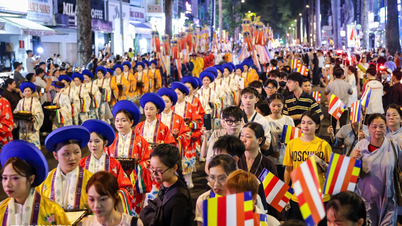
The procession of the sacred statue at the Ly Vien village festival. |

In 1975, at Mu Hill in Ly Vien village, a valuable bronze drum was discovered. When included in the scientific catalog, the drum was named after the village at that time as "Bac Ly Bronze Drum". However, from a cultural and archaeological perspective, this bronze drum is directly associated with the Ly Vien settlement area. The multi-pointed star patterns, geometric patterns, flying birds, toad statues, etc., all indicate that this is a typical Dong Son artifact, dating back more than 2,000 years. This confirms that the Ly Vien area was an early settlement of ancient Vietnamese people, belonging to the long-standing rice-farming civilization of the Northern Midlands.
The discovery of the bronze drum in Ly Vien, but bearing the then-administrative name of Bac Ly, represents a loss in recognizing the cultural sovereignty of the community. A region possessing a bronze drum not only gains another artifact but also a deeper layer of identity – something that fosters pride and a sense of origin for the local people. Therefore, in cultural records and publications disseminating knowledge, it is necessary to clearly state: The bronze drum was discovered at Mu Hill, Ly Vien village. This is a way to restore scientific accuracy and return the rightful status of the place name Ly Vien.
Not only bearing traces of the Dong Son culture, Ly Vien is also the space of a long-standing religious institution: the village communal house dedicated to the two heroes Truong Hong and Truong Hat, belonging to the Tam Giang Saint system. These two deities are associated with the history of resistance against foreign invaders and the protection of the borders, and are revered as guardian deities of the waterways, especially in riverside villages in the Kinh Bac region. Therefore, the Ly Vien communal house is not only a place of worship but also the soul of the community. Festivals, rituals, village customs, disciplinary actions, and dispute resolution take place here.
The name Ly Vien is not just an old place name on a map. It is a heritage code, a memory, a source of pride, and the soul of the community that once lived on the land where the Dong Son bronze drums were discovered, where the temple dedicated to Saint Tam Giang was built, and where, over generations, the unique cultural characteristics of the Kinh Bac region were created.
The name of the communal house has always been associated with the name of the village. When Ly Vien was transferred to the Xuan Cam administrative unit, the name of the communal house had to be kept the same, because it was a symbol of cultural and religious continuity.
Oral traditions and people's memories reveal that the two major Ngo clans – Ngo Van and Ngo Dinh – were among the earliest settlers, playing a key role in opening up the land, establishing the village, and building the Ly Vien communal house. The role of these original clans in the structure of Vietnamese villages is particularly important, as they are the ones who created the initial socio-cultural foundation, shaped village customs, preserved traditions, and passed on knowledge to future generations.
The Ngo family in Ly Vien has a tradition of studiousness and righteousness. A prime example is Mr. Ngo Van Phung (also known as Mr. Xuat Phung) - a scholar during the feudal era who played a role in composing funeral orations, educating the people, and recording village events. People like him were pillars of the cultural and administrative life of the ancient Kinh Bac village.
From archaeology to beliefs, from village communal house institutions to the original clan system, Ly Vien fully embodies the elements that constitute the identity of an ancient Northern Vietnamese village. Therefore, when administrative divisions change, the most important thing is to prevent the identity from being diluted.
In reality, if village names are completely changed to reflect the new administrative names, community memory will be fragmented; new residents will find it difficult to integrate; original clans will lose their foundation for continuing traditions; festivals, rituals, and royal decrees risk losing consistency; and archaeological heritage such as bronze drums will be difficult to place back in their proper cultural context.
In the context of the upcoming administrative merger, the most suitable model is to maintain two levels of designation: an administrative level to meet the requirements of modern management; and a cultural level that retains the original village name "Ly Vien," used for historical sites, festivals, genealogies, family histories, and community activities.
This approach ensures effective governance while preserving the unique cultural identity of the ancient village. It also serves as a foundation for connecting new and old residents, maintaining social stability, and harnessing the strength of the community in the development process.
The name Ly Vien is not just an old place name on a map. It is a heritage code, a memory, a source of pride, and the soul of the community that once lived on the land where the Dong Son bronze drums were discovered, where the temple dedicated to Saint Tam Giang was built, and where, over generations, a unique cultural feature of the Kinh Bac region was created. Amidst all the changes of the present and future, the name of that village deserves to be preserved as if it were its very roots.
According to Baobacninhtv.vn
Source: https://baoangiang.com.vn/ten-lang-nhin-tu-lang-co-ly-vien-a471733.html




































































































Comment (0)