

Belief in worshipping water deities
The seven-headed Naga serpent is a symbol of the primordial water god in the creation of the universe, representing the Ocean with nine rings encircling the world sphere, the tenth ring serving as the base. It is the god of all water, on land or in the air, symbolized as the Mother River - the Divine River.
The water deity worship of rice-farming communities is prominent, featuring snakes, turtles, and water dragons, culminating in the Golden Turtle deity, followed by dragons with many incarnations (giao, cù, nghê, bồ lao...). Influenced by Indianization from the South, Naga is a mythical serpent deity, with many bizarre forms: human-snake, or human-god.
In Tibetan Buddhism, Nagas help protect Buddhist scriptures so that people can receive them. Seven-headed Nagas are commonly seen at Angkor Thom. For the Khmer people, Nagas are symbols of the rainbow – a miraculous bridge, the gateway to the realm of the gods. In India, snakes always protected the Buddha until his Parinirvana, allowing Buddhists to venerate him.
In Hinduism, Naga is considered the spirit of nature, the patron deity of water—a treasure that brings rain for all living things as well as floods and droughts.
According to Tantric Buddhism, the Kundalini serpent coils itself at the base of the spine, above the chakra of the sleeping state, using its mouth to clamp down on the head of the penis; upon awakening, the serpent hisses and its body stiffens, continuously climbing the chakras, sexual energy surges, and life is reborn.
In terms of the macrocosm, Kundalini's embodiment is the serpent Ananta, coiled around the base of the world axis. Associated with Vishnu and Shiva, Ananta symbolizes growth, the cyclical depletion of energy, but also serves to protect the celestial beings, uplift and ensure the stability of the world.
The house is the center, so when building a house, Indians drive stakes into the ground at the head of the Naga serpent, in a location determined by a geomancer. The serpent's function of carrying the world was later replaced by elephants, bulls, turtles, crocodiles, etc., so in Sanskrit, Naga means both elephant and serpent.
Often, it is simply represented by its snout, at the head of a snake's body, or lifted up by a snake..., to express the earthly aspect, commonly characterized by the ferocity and manifested power of the great god of darkness.
In Hindu art, the Naga pair is often depicted with their tails intertwined in a knot-like gesture, culminating in the swastika symbol in Buddhist art. More than just an embodiment of Shiva or the protector of Buddha, the Naga is also a symbol and guardian deity of the sacred Mount Meru, protecting it from intruders and disturbances.
Connecting cultural and spiritual life
In the system of odd-numbered multi-headed serpent deities, the seven-headed Naga is a symbol of immense power and strength, bringing happiness and life, and protecting people from floods.
Common in Khmer culture is the image of a deity coiled to form a throne for the Buddha meditating by the river, with its seven heads raised high as a protective canopy against demons. This form may originate from Brahmanical mythology, where the god Vishnu sleeps on the body of the serpent god Naga. Thanks to this divine power, the seven-headed Naga is a powerful protector of Siddhartha Gautama Buddha.
The three Water Generals help connect the sacred axis of Mount Chua - Thu Bon River - Cu Lao Cham. According to the "Dai Nam Nhat Thong Chi" of the Nguyen Dynasty, along the Thu Bon River there is An Son (Mount Chua) due to the overarching presence of Lady Ngoc; Cu Lao Cham has the temples of General Phuc Ba, Tu Duong Hau and Bich Tien; there is also a theory that says there are the temples of Cao Cac Dai Vuong, General Phuc Ba and Bo Bo Dai Vuong...
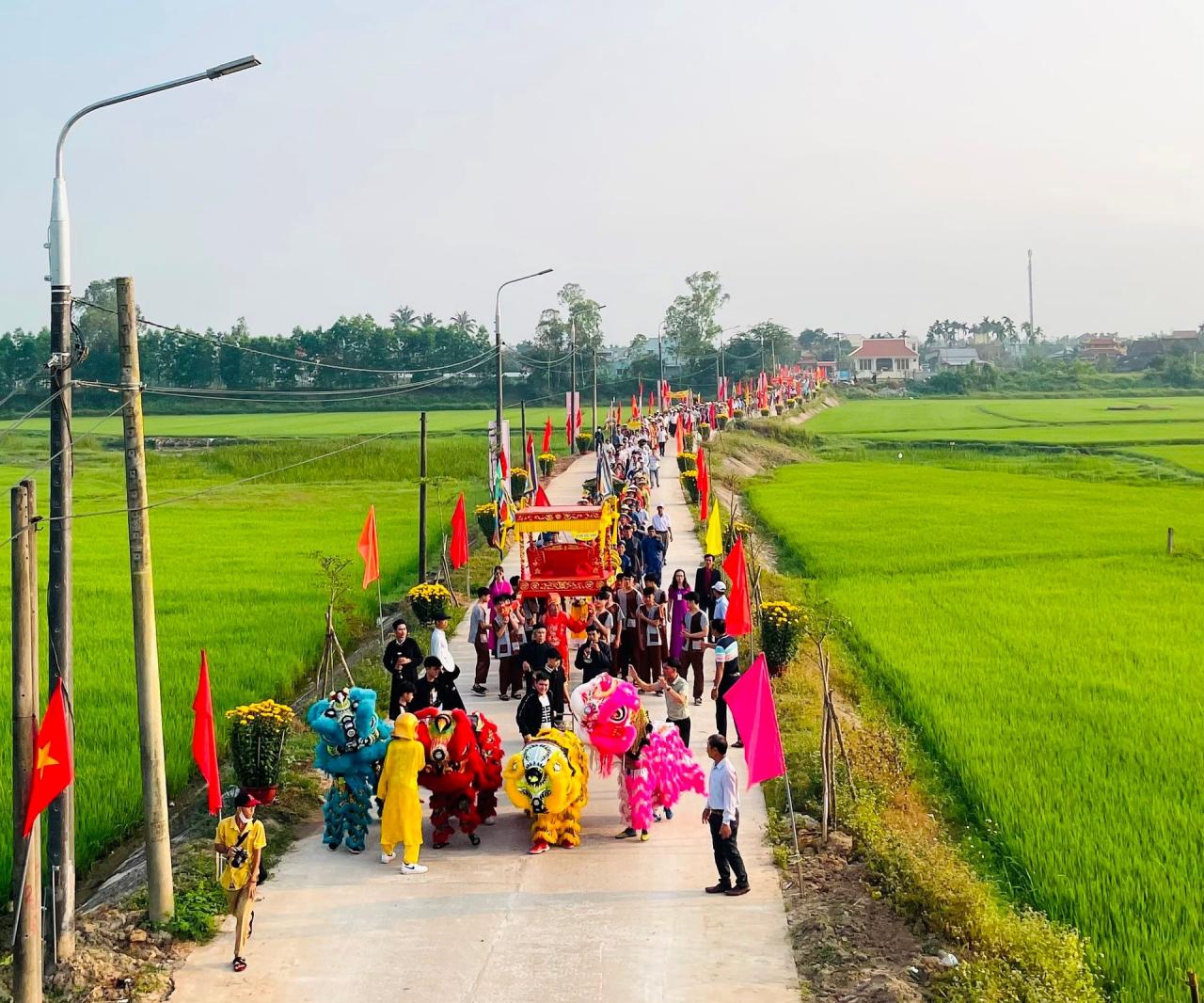
The worship of water deities is a vital link connecting the cultural and spiritual life of Quang Nam province. Following the Thu Bon River, from Ai Nghia to Thanh Ha and then to Cu Lao Cham, there are the Three Water Generals, three snake gods, who are sanctified and personified in a very distinctive way.
The custom of worshipping snakes in Thu Bon was Vietnamized through the document "Declaration of the Legend of the Three Water Generals during the reign of Tu Duc" (1867), in " Quang Nam Province Miscellaneous Compilation". In Co Na area, at Chau Lan pond, Ai Nghia commune, there is a sacred temple, a temple dedicated to the Three Water Generals, whose function is to control the sea waves. Phuc Ba is actually the snake god, not necessarily the god Ma Vien.
The serpent deity, within the aquatic pantheon, is crucial for ensuring the well-being of the people before venturing out to sea, perfectly aligning with the message and mission of the Phuc Ba movement. The seven-headed Naga serpent is a clear vestige of a Champa Buddhist temple that was Việt hóa (Vietnamese-ized) into the Ba Chiem Son temple, with many distinctive features in its worship design, rituals, and offerings, contributing to the sacred Ba Chiem Son festival (Duy Xuyen). The process of cultural contact and exchange between communities in Central Vietnam has created unique cultural legacies, highlighting the profound and practical thoughts and needs for the well-being of our ancestors.
Source: https://baoquangnam.vn/than-ran-tren-song-me-thu-bon-3148352.html
![[Photo] General Secretary and President To Lam meets with National Assembly delegates from ethnic minorities.](https://vphoto.vietnam.vn/thumb/1200x675/vietnam/resource/IMAGE/2026/04/20/1776696701056_a1-bnd-8331-3342-jpg.webp)
![[Image] National Assembly discusses the implementation of the socio-economic development plan.](https://vphoto.vietnam.vn/thumb/1200x675/vietnam/resource/IMAGE/2026/04/20/1776696707422_ndo_br_img-20260420-185419-jpg.webp)





















![[Infographic Series] Historical Sites in Dong Nai: Long Khanh Provincial Administrative Building, Long Khanh Town Party Committee Base, Xuan Loc Temple - Xuan Hoa Pagoda Complex](https://vphoto.vietnam.vn/thumb/402x226/vietnam/resource/IMAGE/2025/9/26/1331532306fb4ad18e4a849e5c64202a)





















































Comment (0)