

Doi Pagoda was the center of spiritual and cultural activities for the entire Son Nam region in the past. Therefore, the Doi Pagoda festival was not only a festival for the people of Tien Son but also a major festival of the region and was widely known. The Doi Pagoda festival traditionally began with a ceremony to announce the opening of the festival on the morning of the 19th day of the third lunar month. Immediately following this was the water procession, with the water being requested from Ham Long well, one of nine wells located at the foot of Doi Mountain. The water obtained was used for the "moc duc" ceremony (cleaning the statues of gods and Buddhas) and as offerings throughout the three days of the festival. The 21st was the main day of the festival, with many important rituals performed. Early in the morning, from the courtyards of the villages of Doi Tam, Doi Trung, Doi Linh, and Doi Tin, the palanquins were ready. At the appointed time, the palanquin processions proceeded to the main gate of Doi Pagoda, where they merged into a single procession. Upon arriving at the temple, palanquins carrying the ancestral tablets of the deities enter the main hall to listen to Buddhist scriptures and witness the incense offering ceremony and the grand ritual of praying for blessings and peace.
According to ancient tradition, Doi Pagoda worships "Buddha in the front, deities in the back." Therefore, the first ritual on the main day of the festival is offering incense to Buddha, with vegetarian offerings. The presiding monk, acting as the chief officiant, recites scriptures, dances, and performs a counter-clockwise procession. Buddhist followers believe that each counter-clockwise rotation brings more blessings and good fortune, dispelling bad luck and misfortune. After the incense offering and the procession, there is a ceremony to worship heaven and earth and a ceremony to thank Empress Dowager Linh Nhan (Nguyen Phi Y Lan) and King Ly Nhan Tong – who contributed to the construction of the pagoda.
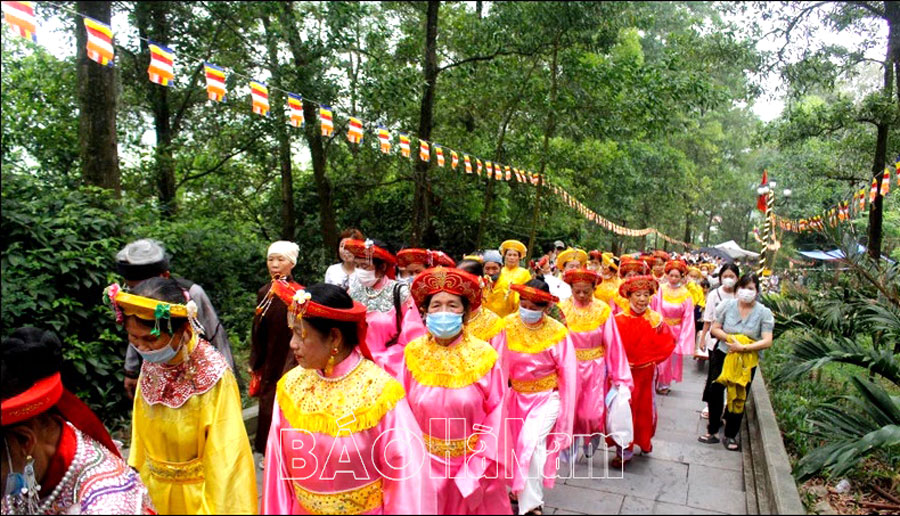
The Doi Pagoda Festival is still held from the 19th to the 21st of the third lunar month. However, the water procession has already been performed at the Tich Dien Festival (the 5th to 7th of the first lunar month), so this ritual is no longer performed at the Doi Pagoda Festival. The procession has also changed. On the morning of the 19th, at the Tien Son Commune People's Committee courtyard, a group offering incense includes commune and village leaders, representatives of various associations, elderly people, and Buddhist followers. A palanquin has been prepared, carrying not an incense burner or altar of any deity, but a portrait of President Ho Chi Minh . This is a new ritual recently introduced to the festival, reflecting the tradition of remembering one's roots and the boundless love and respect for Uncle Ho. The people welcome Uncle Ho to participate in the festival in their hometown and hope that he will witness the changes and the ever-increasing development of Tien Son commune today.
Leading the procession to offer incense is a lion and dragon dance troupe accompanied by drums, followed by a procession carrying the divine and Buddhist flags, and a procession of offering trays carried by women. Next come the male and female ritual teams, Buddhists, local people, and visitors from all over. The procession stops at the ceremonial grounds at the foot of Doi Pagoda for the opening ceremony. After the opening rituals and a drum performance by the Doi Tam village women's drum team, the procession offers incense and prayers to the gods and Buddhas. The ritual teams then perform the ceremonial rites under the guidance of the presiding monk.
In the past, besides the ceremonial part, the festival was incredibly rich with many fun activities such as: rice cooking competitions, weaving competitions, traditional opera performances, love songs, call-and-response singing, cockfighting, card games, the Four Sacred Animals dance, wrestling, human chess, and Chinese chess... Among them, the human chess competition was the most lively and attractive, especially to elderly chess players from all over who came to participate in the festival. The human chess competition was held continuously for three days during the festival. When a match began, each side had a person holding a drum and beating it repeatedly to make it difficult for the opponent to concentrate on their moves. However, everyone was happy because the competition was not affected by the psychology of winning or losing; the main purpose was to have fun, so the drumming added to the excitement.
Besides human chess, Chinese chess also attracts many participants. Chinese chess pieces are attached to a stick about 1.5 meters high and are moved during play, being inserted into pre-drilled holes on the ground. A game of Chinese chess consists of two players, two assistants (who remove and place the pieces in place when the players are controlling the pieces), and a referee. People watching Chinese chess are usually quiet, only expressing admiration when the two sides display skillful and beautiful moves…
At the Doi Pagoda festival, in addition to performing spiritual and religious rituals, visitors can also enjoy the pagoda's scenery in the spring colors, and learn about the historical and cultural values of the pagoda through precious artifacts from the Ly Dynasty that are still preserved today, such as the Diamond statues, the bird-headed human-body statues, terracotta carvings, and especially the Sung Thien Dien Linh stele – a national treasure, placed in the stele house in front of the main hall of Doi Pagoda.
Chu Binh
Source: https://baohanam.com.vn/van-hoa/le-hoi/thang-ba-tray-hoi-chua-doi-156031.html
![[Photo] Standing Committee member of the Party Central Committee Tran Cam Tu presents the Decision appointing the Secretary of the Party Committee of the Ho Chi Minh National Academy of Politics.](/_next/image?url=https%3A%2F%2Fvphoto.vietnam.vn%2Fthumb%2F1200x675%2Fvietnam%2Fresource%2FIMAGE%2F2026%2F02%2F02%2F1770039902160_le-cong-bo-bt-hvctqg-11-7880-jpg.webp&w=3840&q=75)


![OCOP during Tet season: [Part 3] Ultra-thin rice paper takes off.](/_next/image?url=https%3A%2F%2Fvphoto.vietnam.vn%2Fthumb%2F402x226%2Fvietnam%2Fresource%2FIMAGE%2F2026%2F01%2F28%2F1769562783429_004-194121_651-081010.jpeg&w=3840&q=75)




Comment (0)