
October
 Báo Đại Đoàn Kết•14/11/2024
Oh, how I miss those plump green grasshoppers! But the wood-like grasshoppers, with their dry, straw-colored, silvery-white wings, were also incredibly fat and round. When the last stubble in the rice field was cut down, leaving no place to hide, they frantically and laboriously twisted their bulky bodies to find shelter, but their efforts were in vain. I wonder what they ate when the rice in the field was so dry, with withered grains and leaves, yet they were still so plump?
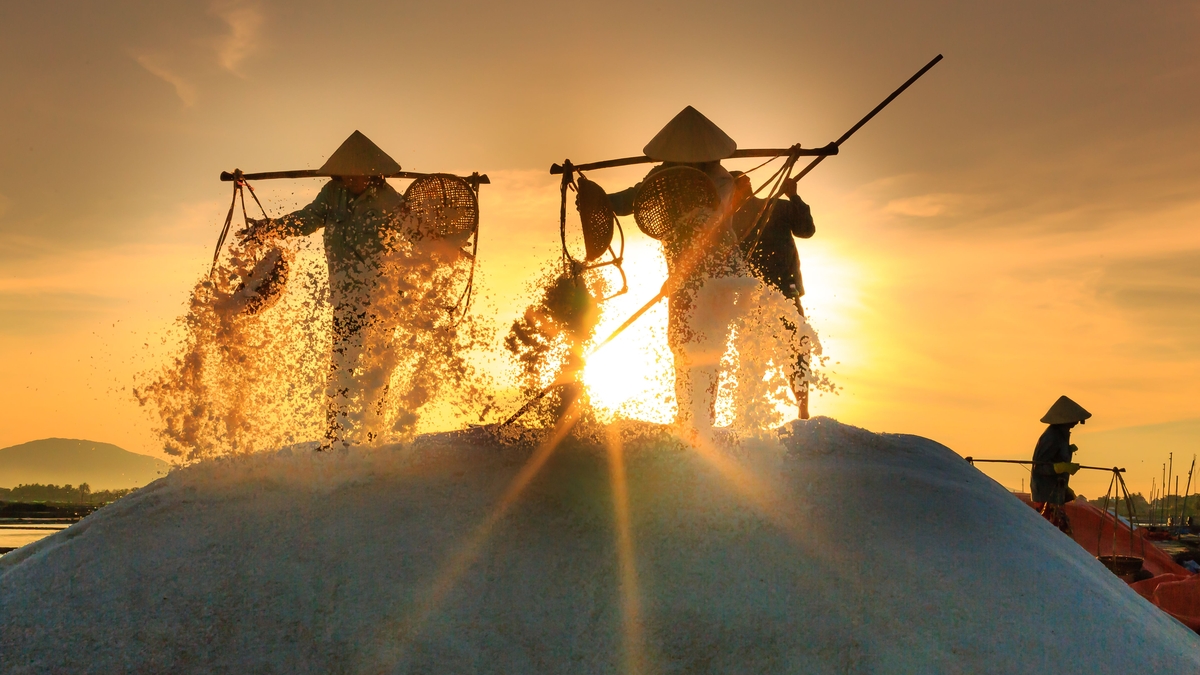
I remember October because I used to harvest rice, doing all these things during the harvest season when I was twenty. The sickle was twice as big as the cutting sickle. Its curved shape widened like the beak of a stork. When the rice stalks were cut and arranged in rows on the dry, cracked field, the harvesters began their work. Their left hand would push aside the rice stalks, their right hand would hold the sickle, gathering the rice into a bundle pressed against their left foot. Then the sickle would sweep downwards, and with a swift pull, the bundle of rice would be neatly held in their hands. Three harvesters would make a large bundle.

In October, the left legs of rice harvesters were completely hairless from friction with the rice stalks, the hairs falling out completely. My skin was thin, and my legs were chafed, bright red, my ankles like those of a fighting rooster. I can never forget those days working as a rice harvester. At twenty, I would come home with aching backs, lying in bed all night before feeling better. In October, after a day in the fields, in the evenings, every household would arrange the rice in a circle in front of the yard and stand inside, leading four buffaloes to thresh the rice. To get a buffalo to thresh the rice, you had to ask to borrow one the day before. Children like me were assigned to be on duty, clutching a basket covered with straw, ready to catch the dung. After a day of eating and drinking, the buffaloes would often stand and defecate when they needed to. You had to quickly grab the basket to catch the dung so it wouldn't fall onto the rice.
Threshing rice on moonlit nights was even more enjoyable. If it was the first day of the month, they had to light three-stringed lamps hanging in front of the door to use the dim light to guide the buffalo and thresh the straw afterward. Luckily, the October rice crop wasn't as prone to rain as the May crop. After threshing the rice, the next day was Mom and my sister's day to rake and pick out all the debris, leaving only the rice grains on the yard. It took a few more days of sun drying until the grains were crisp and crunchy. That's when the straw was piled up and the rice stored in the granary. The process sounded simple, but one year I heard Mom complain that the harvested rice was affected by the westerly wind, the grains were broken, and the rice tasted bad. At the time, I didn't understand why, what kind of wind was it, and when it blew. There are some farming experiences that I still don't understand to this day.
In October, a month after the harvest, plowing begins. The soil is tilled and left to dry in the dry sun for about a month until the water evaporates, leaving the land parched. During this time, every household prepares for the Lunar New Year. After the New Year celebrations, water is brought into the fields. When the soil is dry, the water loosens the soil as it flows. Just a few harrowing strokes are enough to soften the soil, along with the well-rotted manure and green fertilizer spread on the field before the water is added. In October, sometimes after the harvest, a few households would quickly plow and make furrows for a few plots of short-cropping sweet potatoes, both for green vegetables and to get some extra tubers, and to improve the soil's fertility. However, in those days, few households did this, for reasons unknown, but perhaps because farmers were less proactive.
You may also like

Short Vietnamese Rap song and singer Olew have a child.Short Rap Viet and singer Olew have just shared the news that they are welcoming a new member to their family. The two publicly revealed their relationship in 2024.
My hometown, Bản Ngoại, has two rice harvests a year. However, the spring rice crop is short, and harvesting often has to be rushed due to rain, or the fields become muddy and waterlogged, lacking the excitement of harvesting the summer rice crop. For me, remembering my hometown means remembering October, remembering the harvest season, and anticipating the most joyful traditional Tet (Lunar New Year) celebration with its traditional sticky rice cakes!
Source: https://daidoanket.vn/thang-muoi-10294433.html
Tag: October









































![[Video] Sunset at Lap An Lagoon – Where the sun sets over the fishing nets](https://vphoto.vietnam.vn/thumb/1200x675/vietnam/resource/IMAGE/2026/05/31/1780192137701_beach-landscape-sea-water-nature-grass-745871-pxhere-com.jpeg)

























Comment (0)