

Located by the Ma River, the Chu Van Luong temple in Nam Ngan village (now part of Nam Ngan ward, Thanh Hoa city) is a place of worship for the village's patron deity who founded the village. Chu Van Luong, the village's patron deity, was also a historical figure who participated in the Dien Hong conference, rallying the determination to fight against the Mongol invaders.
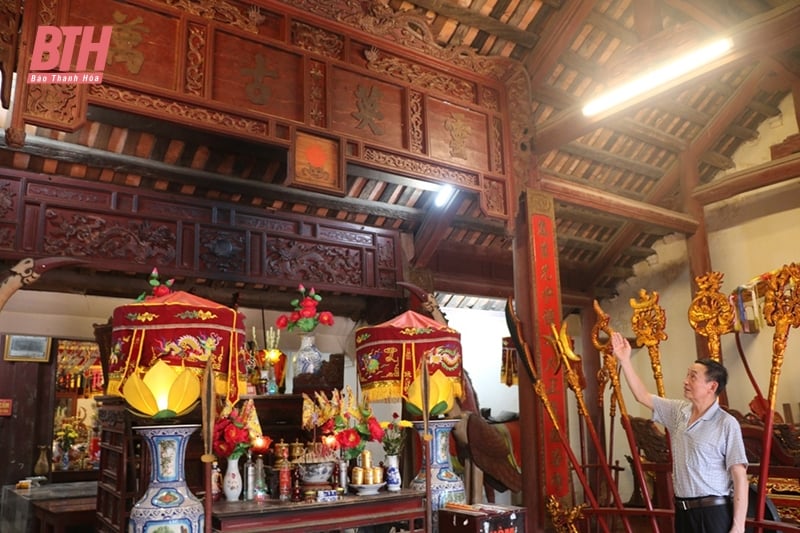
According to historical records, the tutelary deity of Nam Ngạn village, Chu Văn Lương, originally came from the northern region (believed to be present-day Hải Dương province). His grandfather, Chu Văn Huy, was instrumental in founding the Trần dynasty and was highly regarded by the Trần king, who bestowed upon him the title of Marquis. Later, his son, Chu Văn Bình (Chu Văn Lương's father), inherited the title and was married to a woman from the royal family by the Trần king. Chu Văn Bình was known as a skilled physician and a compassionate man, but he was childless. After a long period of waiting, his wife, Trần Thị Lan, had a strange dream one night and soon after became pregnant, later giving birth to Chu Văn Lương.
“At the age of seven, Van Luong began his studies, and by thirteen he had mastered classical literature and martial arts. Everyone revered him as a child prodigy. At eighteen, his parents passed away, and he chose a good plot of land and prepared all the necessary offerings for their burial. After three years of mourning, he devoted himself to studying and reading many books, and to teaching, thus continuing his father's legacy... At that time, living near Long Bien, education was not yet widespread, and the three cardinal principles and five constant virtues were not yet mentioned. He knew how to gently comfort and educate people. Gradually, everyone learned about etiquette and morality” (Thanh Hoa City Gazetteer).
Being a virtuous man with profound knowledge, many students sought him out to study. King Tran, admiring his talent and virtue, summoned him to the court and bestowed upon him the title of Marquis and Minister of State. At the same time, he assigned him to Thanh Hoa (present-day Thanh Hoa province) to govern. When Chu Van Luong arrived in the southern bank of the Ma River, he found the scenery and feng shui beautiful, and although the population was sparse and uneducated, they were simple and kind-hearted. He decided to settle there, build a house, and open a school. Gradually, this created a densely populated area.
In 1257, facing the threat of invasion from the North, responding to King Tran's call to help the country, the scholar Chu Van Luong invited his uncle, Chu Van Chan, who was then an official in Thanh Hoa, and other trusted followers with similar ideals, totaling over 500 people, to forge weapons and practice martial arts to fight the invaders.
At the end of January 1258, the Tran dynasty army repelled the Mongol forces at Dong Bo Dau (a bank on the Red River east of Thang Long), bringing the first resistance war against the Yuan-Mongol invaders to an early end. Because the war unfolded so quickly, Chu Van Luong's army did not have time to participate. Nevertheless, it was a spirited and significant preparation, ready for the subsequent resistance war against the Yuan-Mongol invaders.
After the Mongol army defeated the Song dynasty and established the Yuan dynasty, with their expansionist ambitions, Dai Viet became a target of invasion by the Mongol Yuan army. Understanding the enemy's ambitions, the Tran dynasty's king and his officials actively prepared for a fierce resistance war.
In 1284, in Thang Long, Emperor Emeritus Tran Thanh Tong summoned the elders of the entire country to a meeting at Dien Hong Palace to discuss strategies for fighting the invaders. The second resistance war against the Mongol invaders was a formidable test for the people and army of Dai Viet. But a unified will was unanimously shouted: "Fight!" Chu Van Luong was invited to participate in that Dien Hong conference.
After the Dien Hong Conference, upon returning to Thanh Hoa province, Chu Van Luong, along with his trusted associates, servants, and the patriotic people of Thanh Hoa, rallied to train and prepare for the confrontation against foreign invaders.
In early 1285, invading forces under the command of Prince Thoat Hoan advanced into the borders of Dai Viet. A contingent led by the enemy general Toa Do marched from the south to Nghe An , intending to conspire with the northern army to create a pincer attack against the Tran dynasty's forces. At this time, General Tran Quang Khai confronted Toa Do in Nghe An, while the brave generals Chu Van Chan (uncle of Chu Van Luong) and Chu Van Luyen brought troops from Thanh Hoa to provide support. Faced with the overwhelming enemy forces, General Tran Quang Khai ordered a retreat to Thanh Hoa, pursued by the enemy, resulting in numerous major battles in Thanh Hoa.
In April 1285, King Tran retreated to Thanh Hoa. Toa Do's troops, reinforced by O Ma Nhi, returned to Thanh Hoa to pursue the king. Faced with this situation, the people of Thanh Hoa joined forces with the Tran army to fight the invaders.
Legend has it that, faced with the imminent danger to the nation's fate, Chu Van Luong temporarily set aside his teaching duties, selecting over five hundred people from his family and trusted subordinates. He also sent out appeals throughout the district, urging the people to join him in defending the king and the country. Hearing of his call, more and more people flocked to him each day, reaching thousands. He rewarded his troops, summoned the elders of Nam Ngan to give them instructions, and then led his army into battle. According to the Chu family genealogy: "The court retreated to Thanh Hoa, and the eunuch Chu Van Nhi remained with Chu Van Luong to command the army against the enemy."
According to the book "Famous People of Thanh Hoa": "After more than a month of marching to find the two Tran kings and their main army, Toa Do and O Ma Nhi were exhausted and their forces were depleted by ambushes and attacks by militia forces commanded by local generals, causing their defeat. The Tran kings and their main army were safely protected in Thanh Hoa."
In May 1285, Prince Tran Quoc Tuan (Hung Dao King) marched his army from Thanh Hoa north, joining forces with other armies to inflict a crushing defeat on the Mongol invaders, forcing them to retreat back to their country. After the victory in the second resistance war against the Mongols, during the awarding of honors, Chu Van Luong was among those honored. Legend says that the Tran dynasty king invited him to stay in Thang Long to serve in the court, but he requested to return to his homeland in the South to continue his teaching career, living a peaceful life.
In the year Quy Ty (1293), Chu Van Luong passed away. Mourning the loss of his loyal servant who had devoted himself to the nation, King Tran bestowed upon him the title of "Upper-Class Blessed Deity," so that the people of Nam Ngan could build a temple to worship him. In gratitude for his merits, subsequent dynasties repeatedly granted him titles, such as: Duong Canh Thanh Hoang, accompanied by the honorary title "Great King Who Saves the World and Protects the Nation"; and then "Great King, Supreme Deity." The temple dedicated to Chu Van Luong in Nam Ngan has been classified as a national historical and cultural relic.
According to Le Ngoc Thang, Secretary of the Party Branch of Nam Ngan 1 Street and Head of the Management Board of the Chu Van Luong Temple relic site: “The revered spirit Chu Van Luong is the village's patron saint who contributed to the country, the people, and the Nam Ngan region. Every year, on his birthday and death anniversaries (February 18th and September 12th of the lunar calendar), the villagers gather at the temple to respectfully offer incense and pay their respects.”
Khanh Loc
(This article uses material from the books: Thanh Hoa City Gazetteer; Famous People of Thanh Hoa; and documents preserved at historical sites.)
Source: https://baothanhhoa.vn/thanh-hoang-lang-chu-van-luong-231049.htm
![[Image] National Assembly discusses the implementation of the socio-economic development plan.](https://vphoto.vietnam.vn/thumb/1200x675/vietnam/resource/IMAGE/2026/04/20/1776696707422_ndo_br_img-20260420-185419-jpg.webp)


![[Photo] General Secretary and President To Lam meets with National Assembly delegates from ethnic minorities.](https://vphoto.vietnam.vn/thumb/1200x675/vietnam/resource/IMAGE/2026/04/20/1776696701056_a1-bnd-8331-3342-jpg.webp)








![[Infographics] Hai Tien Beach Tourism Festival 2026 and celebratory activities](https://vphoto.vietnam.vn/thumb/402x226/vietnam/resource/IMAGE/2026/04/20/1776687221715_infographics-le-w1200t0-di2616d199d1165828t11358l1-2026-029.webp)





















































Comment (0)