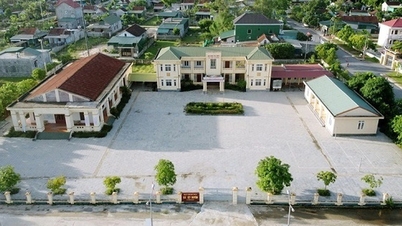
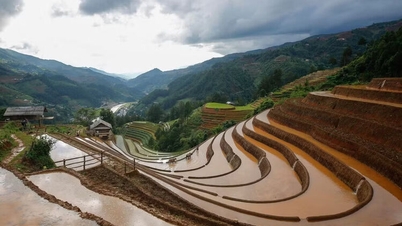
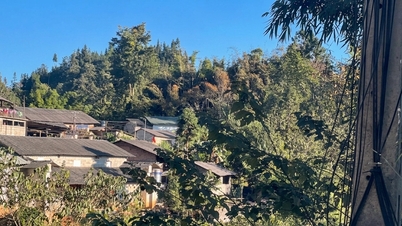
In 2010, Ta Ngai Cho Primary School in Ta Ngai Cho commune (Muong Khuong district) was recognized as a national standard school. Level 1. To achieve that result, teachers and students here have continuously strived in their teaching and learning. In addition to the main school located in the center of the commune, there are 5 branch schools in villages such as Thang Chu Penh, Sa Khai Tung, Si Ma Tung 1 and 2, but the most remote and difficult to access is the school in Ban Pho village.
 |
| This is the lesson time for 4th and 5th graders. |


Speaking with us, Ms. Nguyen Thi Hien, Deputy Principal of Ta Ngai Cho School, said: "Ban Pho is the most difficult school location, far from the center, and the roads are very difficult to travel on. Previously, teachers often had to sleep in the village. Now that the roads have been widened, motorbikes can reach the school, so teachers can go to school in the morning and return in the evening. On rainy days, the roads are slippery, and the biting cold drops to 2-3°C, making it even colder than riding a motorbike, even under blankets. Nevertheless, the teachers still wake up early every day, leaving their homes while the sky is still covered in mist, to bring literacy to the children."
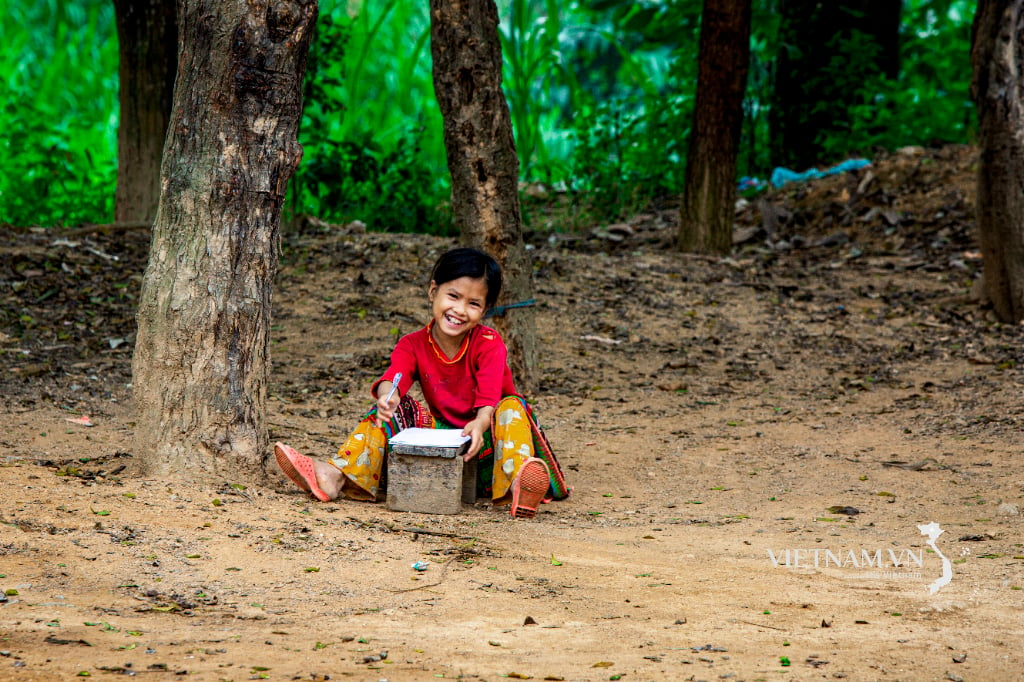
Upon arriving at Ban Pho school, we were greeted by innocent children, though still a little shy. Seeing strangers, they didn't dare approach to talk, instead standing at a distance, smiling and pointing at each other.
The teachers' office was very simple, with an old wooden desk and a set of antique teapots, and lunchboxes hanging in the corner. Seeing me staring intently, Teacher Khuong seemed apologetic and explained, "That's the teachers' lunch. We used to cook meals ourselves, but now that classes have resumed after Tet, we haven't been able to cook yet, so we have to bring our own lunch."
The Bản Phố school has 5 classrooms with 28 students. Rain or shine, the students never miss school; most are very well-behaved and eager to learn. Due to the small number of students and the lack of facilities, each teacher has to teach two classes. Each classroom has two students sitting back-to-back, yet the students remain orderly and attentive. On average, each teacher has to teach up to four classes a day – two in the morning and two in the afternoon – but the teachers here still manage to do their teaching job well.
Most of the students here are children of the Hmong ethnic group, who are only familiar with hoes and plows, so their education is not as prioritized as in other regions. On some cold days, after traveling 20 kilometers to school, the teachers find no students and have to go into the villages to persuade and bring each child to class. According to Mr. Khuong, the biggest difficulty they face is the language barrier; since the students are all elementary school children, communicating with them in standard Vietnamese is very challenging. He said, "To make them understand what we say, we must first understand what they think." Therefore, the teachers have learned the local dialect to communicate with the students during breaks, fostering a closer and more friendly teacher-student relationship. As a long-time teacher, he also affirmed, "To ensure students attend school regularly, we must do a good job of engaging with the community, starting with building a good relationship between teachers and parents."
Overcoming all difficulties to bring literacy to children in the highlands, I secretly believe that there is no greater strength than a love for the profession. Goodbye to Ban Pho school, goodbye to the blazing fire that dispels the biting cold in the highlands. I hope that the teachers here will always steer their boats steadily, continuing to guide these children across the river to a bright future in the Muong Khuong highlands.


Source: http://laocai.edu.vn/tin-noi-bo/6cde8a53ab99558755cf8427632332c1-142673


![[Photo] General Secretary and President To Lam attends the 13th National Congress of the Ho Chi Minh Communist Youth Union](https://vphoto.vietnam.vn/thumb/1200x675/vietnam/resource/IMAGE/2026/06/25/1782356968989_ndo_br_1-jpg.webp)


























![[Photo] General Secretary and President To Lam attends the Central Public Security Party Committee Conference](https://vphoto.vietnam.vn/thumb/1200x675/vietnam/resource/IMAGE/2026/06/24/1782302063612_a1-bnd-9302-9166-jpg.webp)