


Ho Chi Minh City has an advantage with its logistics-manufacturing-export ecosystem converging within a "megacity" - Photo: QUANG DINH
To maintain its leading position and achieve high growth targets, the city must solve the problem of green transformation.
Speaking to Tuoi Tre newspaper, John Campbell, Director of Industrial Real Estate Services at Savills Vietnam, said that the shift from labor-intensive industries to high-tech and green manufacturing is no longer an option, but a survival requirement for Ho Chi Minh City.
He said: Relocating inner-city industrial parks to take advantage of a connected "megacity" and changing the investment attraction portfolio are urgent requirements for the city's sustainable development and for industry to contribute more significantly to Ho Chi Minh City's growth.
Focus on high-value industries.
* What are the new competitive advantages of Ho Chi Minh City's industrial real estate when it is part of a "megacity" that includes the former industrial hub of Binh Duong and the industrial, port, logistics, and free trade zone (FTZ) ecosystem from the former Ba Ria - Vung Tau?

Mr. John Campbell
- The formation of an expanded administrative unit of Ho Chi Minh City creates a distinctly complementary industrial and service cluster. Ho Chi Minh City continues to play a central role in the region for services, high technology, R&D, and as a regional financial center. Binh Duong (formerly) contributes one of the most developed manufacturing clusters in the country, with a stable flow of FDI and long-term experience in industrial park development.
Ba Ria - Vung Tau (formerly) is completing its overall system with the capacity of the Cai Mep - Thi Vai deep-water port, FTZ, petrochemical and heavy industry industrial parks, and new LNG power plant projects. From an investor's perspective, these advantages create a more unified and efficient industrial and logistics ecosystem. High-tech and supporting industries can be located near the high-quality workforce of Ho Chi Minh City.
Medium and high-end manufacturing can be expanded in the former Binh Duong province, and large-volume goods can be conveniently transported through the former Ba Ria - Vung Tau province. The fact that seaports, airports, and highway networks are located within the same expanding urban area enhances the reliability of the supply chain, a factor that manufacturers are particularly prioritizing when diversifying their operations in Asia.
* How should Ho Chi Minh City change its investment attraction "list" to continue industrial development, transforming industry into one of the new growth drivers, while still ensuring green development, reducing labor use, and enhancing high technology...?
- To maintain industrial growth while simultaneously reducing labor dependence, improving environmental efficiency, and moving towards high technology, Ho Chi Minh City could consider adjusting its investment attraction strategy to align with emerging national trends.
Vietnam is strongly shifting towards high-tech industries, digital manufacturing, and green industries. This presents an opportunity for the city to prioritize projects with higher technological content, linked to R&D, and with high productivity.
This requires support from readily available infrastructure – a stable power supply, high-quality wastewater treatment systems, and a well-connected transportation network – along with human resource development through collaboration with universities and vocational training institutions.
Simultaneously, relocating labor-intensive industries to more suitable areas outside the urban core will optimize land use and allow the city to focus on high-value industries.
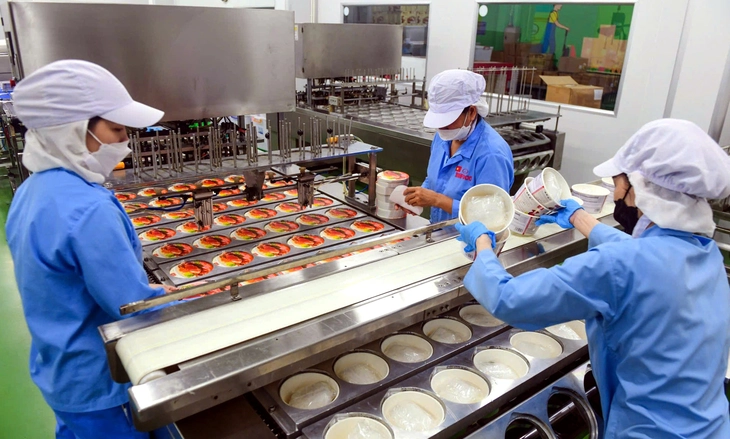
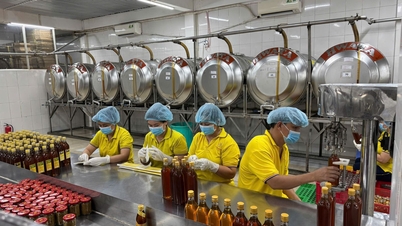
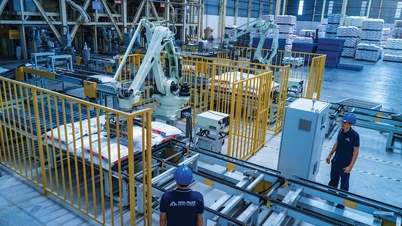
Workers producing goods inside an industrial park in Ho Chi Minh City - Photo: QUANG DINH
New opportunities for Ho Chi Minh City's industry.
* In the current highly competitive environment, what opportunities does Ho Chi Minh City have to attract new-generation industries, industrial real estate investors, and FDI?
- Despite the uncertain global landscape, the southern region continues to strongly attract FDI into the manufacturing and processing sectors thanks to a stable macroeconomic environment and increasingly improved infrastructure. Ho Chi Minh City's synergistic industrial advantages create a favorable foundation for the new administrative region to access the next generation of FDI.
Opportunities are emerging in sectors such as semiconductors, electronics, AI-related manufacturing, precision engineering, pharmaceuticals, clean energy, and modern logistics. Investors value the region for its deep-water port connectivity, large workforce, and concentrated network of suppliers and supporting industries.
As long as the supply of industrial land, the stability of infrastructure and utilities, and environmental standards continue to improve, this "megacity" will remain one of Vietnam's most attractive destinations for advanced manufacturing and high-tech industrial investment.
* Ho Chi Minh City has industrial parks that have been developed for many years, some of which are about to expire. In your opinion, what solutions are needed for these old industrial parks?
- Many industrial parks in Ho Chi Minh City in particular, and other localities in general, have been operating for several decades, leading to common challenges such as deteriorating technical infrastructure, limited land availability, and outdated factory buildings. Solutions need to be considered depending on the location and feasibility.
For areas within highly urbanized zones, redevelopment towards higher value-added industrial functions may be appropriate – such as multi-story factory buildings, R&D centers, clean manufacturing, or service-industrial facilities. For areas with remaining land and stable industrial demand, on-site renovation and upgrading is feasible, following the eco-industrial park model that Vietnam has piloted with international partners.
This includes upgrading wastewater treatment systems, improving energy efficiency, strengthening digital management systems, and promoting circular economy linkages between businesses within the zone. These solutions help extend the operational lifespan of existing industrial parks while bringing them closer to the new standards set out in Decree 35.
* How have developed countries handled old industrial parks, and what lessons are relevant to applying to Ho Chi Minh City in transforming the function of industrial parks, sir?
- Developed economies have addressed the issue of degraded inner-city industrial land through a combination of environmental remediation, phased relocation, and redevelopment towards cleaner, higher-value-added products.
Examples from Europe and East Asia show that success is often based on three principles: clear guidance on pollution control, investment in modern infrastructure, and clearly defining the new role of the land, whether it be for clean industry, R&D, logistics, or a multi-functional model.
For Ho Chi Minh City, the most relevant lessons are practical. Environmental management needs to be planned early, and transportation and technical infrastructure must be upgraded before attracting new industries. Furthermore, the repurposing strategy should reflect market demand, rather than applying a uniform model to all areas. These approaches help ensure that the transformation of old industrial parks is both commercially viable and environmentally responsible.
Modernizing infrastructure to attract investors.
According to John Campbell, for Ho Chi Minh City, ensuring a stable power supply, a modern wastewater treatment system that meets environmental requirements, and increased flood resistance are urgent requirements when transforming industry. Selecting and attracting the right sectors is also crucial.
The shift towards electronics, semiconductors, pharmaceuticals, clean manufacturing, and supporting services will depend on the level of connectivity between these zones and the Ho Chi Minh City High-Tech Park and the city's innovation ecosystem. With proper planning, infrastructure upgrades, and practical implementation progress, inner-city industrial parks can fully transform into more sustainable functions and generate higher economic value, contributing more positively to Ho Chi Minh City's economic growth.
Mr. Hardy Diec (CEO of Vietnam Industrial Park Group):
Solving the growth problem with a "green key"

Mr. Hardy Diec
The three most important manufacturing, service, and port centers in the South are located within the unified structure of the "megacity" of Ho Chi Minh City, creating an economic scale and depth that was previously difficult to achieve. From an industrial perspective, Ho Chi Minh City's new competitive advantage is clearly evident in its ability to attract large-scale FDI projects, especially in electronics, semiconductors, and data centers. Furthermore, creating new opportunities will help the city maintain its FDI appeal in the long term, instead of being limited by its old spatial constraints.
In particular, institutional unity allows the city to coordinate regional planning more effectively. When all policies, infrastructure, and procedures are guided by a single point of contact, the speed and quality of decision-making will be significantly improved. This is a factor that investors highly value. The new Ho Chi Minh City is forming a "megacity" structure strong enough to compete directly with regional centers such as Bangkok or Kuala Lumpur in attracting next-generation FDI; this is an advantage that the city needs to leverage from the very beginning.
A large-scale city that wants to maintain its competitiveness cannot continue to rely on a land-intensive and labor-intensive industrial model. In fact, Ho Chi Minh City recognized this quite early on and is proactively shifting towards higher-value, lower-emission industries that require a high level of intellectual input, such as electronics, medical equipment, semiconductors, data centers, modern logistics, and biotechnology. This aligns perfectly with the general trend of megacities in the region.
From the perspective of an industrial developer, we believe this is a necessary step for Ho Chi Minh City to attract a new generation of investors. Besides industry factors, the criteria for selecting investors must also change. Businesses with strong technological capabilities, high environmental standards, a commitment to long-term investment, and a willingness to participate in the city's innovation ecosystem should be prioritized. This is how Ho Chi Minh City can build a sustainable, low-emission industrial base with a strong ripple effect on other economic sectors.
Source: https://tuoitre.vn/thay-ao-xanh-cho-cong-nghiep-20260225080515507.htm

![[Photo] National Assembly Chairman Tran Thanh Man attends the policy seminar to promote Vietnam-Türkiye cooperation.](https://vphoto.vietnam.vn/thumb/1200x675/vietnam/resource/IMAGE/2026/04/16/1776351415367_vna-potal-chu-tich-quoc-hoi-tran-thanh-man-du-toa-dam-chinh-sach-thuc-day-hop-tac-viet-nam-tho-nhi-ky-8705791-jpg.webp)


















![[Image] Bridges and roads connecting the eastern part of Ho Chi Minh City](https://vphoto.vietnam.vn/thumb/1200x675/vietnam/resource/IMAGE/2026/04/16/1776328595108_ndo_br_bh-vt5-jpg.webp)






















![[Infographic] Details of the Hanoi-Quang Ninh High-Speed Railway Project](https://vphoto.vietnam.vn/thumb/402x226/vietnam/resource/IMAGE/2026/04/16/1776338188424_anh-man-hinh-2026-04-16-luc-18-16-10.png)

![[Photo] National Assembly Chairman Tran Thanh Man meets with the Speaker of the Georgian Parliament](https://vphoto.vietnam.vn/thumb/402x226/vietnam/resource/IMAGE/2026/04/16/1776338494029_anh-man-hinh-2026-04-16-luc-18-21-21.png)










Comment (0)