

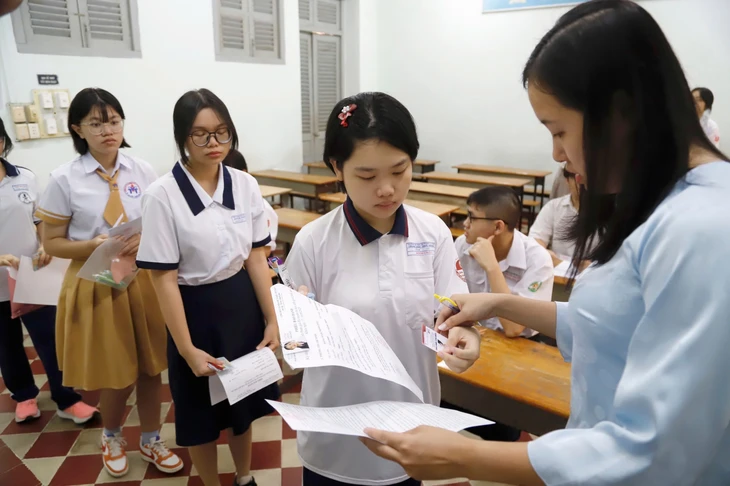
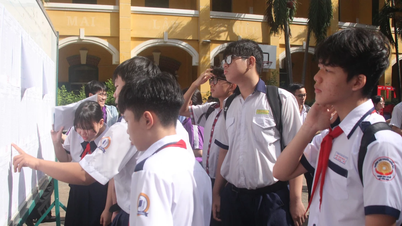
High school students in Ho Chi Minh City participate in the 2025 national excellent student competition team selection exam - Photo: NHU HUNG
While global education is shifting strongly towards developing competencies, creative thinking, and collaborative spirit, academic competitions should adopt a new approach.
From "learning to pass exams" to "learning to develop competencies"
For decades, the gifted student competition has been seen as an "intellectual arena," a place to discover and nurture outstanding students for specialized schools and national teams.
However, with the 2018 General Education Program, the educational philosophy has shifted from "learning to pass exams" to "learning to develop competencies and qualities." Along with this, Circular 22/2021/TT-BGDĐT adjusts the assessment mechanism to encourage individual progress rather than simply celebrating results.
Resolution 71/NQ-CP also emphasizes the need for equitable, creative, and comprehensive development for learners. In this context, the student excellence competition, which heavily relies on memorization and test-taking tricks, reveals many limitations as it is no longer suitable for the competency-based development goals that the current education system is pursuing.
In developed countries, no single exam is used to identify talented students. In the US, competitions like MathCounts or Science Olympiad are held at multiple levels, combining individual and group competitions and research projects to help students demonstrate creative thinking and collaborative skills.
Singapore was once renowned for its highly selective gifted education program, but has recently adjusted it to reduce pressure and broaden opportunities for students with diverse talents. China and South Korea still maintain academic competitions, but the trend has shifted towards evaluating research abilities, artistic creativity, and practical scientific applications.
Nurturing talent
In Vietnam, the gifted student competition used to play a positive role in creating a pool of talented students for specialized schools, fostering a spirit of learning and a desire to excel. However, in the context of educational reform, this competition needs to be seriously re-evaluated.
Many schools begin training their teams as early as grade 6, focusing resources on a small group of students. The achievement of high-achieving students becomes the "measure of the school's prestige," causing the goal of developing students' well-rounded abilities to be misdirected.
From a management perspective, this is also a cost-benefit analysis. Local authorities have to mobilize significant budgets and human resources for an exam that only benefits a small percentage of students. These resources could be fully reallocated to improve the quality of mass education, especially in disadvantaged areas.
However, if the exam is completely abolished without a replacement mechanism, Vietnamese education may lose a channel for early talent identification and nurturing, which is a crucial element in the strategy for developing high-quality human resources.
One of the biggest problems with the gifted student competition is fairness. Students in urban areas have access to extra tutoring, guidance from excellent teachers, and abundant learning materials, while students in rural and mountainous areas have fewer opportunities. The competition therefore easily becomes a "biased playing field," recreating inequality in educational opportunities.
This goes against the spirit of the Education Development Strategy 2021-2030, which emphasizes equity and learning opportunities for all.
From a teacher's perspective, the gifted student competition is both an opportunity to showcase expertise and a burden of competition. In many places, the achievement of gifted students remains an important criterion for evaluating performance and awarding commendations, leading many teachers to focus their efforts on "training" gifted students instead of emphasizing the overall development of students' abilities.
Talent discovery ecosystem
The student excellence competition will only be meaningful when it shifts from testing memorization to evaluating critical thinking, creativity, and problem-solving skills linked to real-world situations. The exam structure needs to be designed to be open-ended, requiring students to apply interdisciplinary knowledge and express their personal viewpoints.
In addition, localities should diversify the methods of identifying gifted students through academic clubs, STEM playgrounds, community projects, or creative scholarships, helping students develop their natural abilities more naturally and fairly.
Instead of organizing exams at the administrative level, an open academic network or online platform could be built where students are assessed through their portfolios, research projects, or practical products.
At the management level, the Ministry of Education and Training plays the role of creating a unified competency framework and guiding its implementation. Local authorities can flexibly choose models that suit their regional conditions, ensuring fairness in participation opportunities.
Teachers should be recognized not only through the number of awards they win, but also through the holistic development of their students. Then, the student excellence competition will become part of an ecosystem for discovering and nurturing talent, rather than a race for achievement.
The specialized school has changed.
From October 2025, specialized high schools will implement their own curriculum based on the 2018 General Education Program framework, focusing on research skills, critical thinking, and creativity.
Natural science subjects will incorporate content on technology and artificial intelligence; literature will enhance social debate skills and linguistic creativity. As the training philosophy of advanced education has transformed in this way, the admission methods also need to be reformed accordingly.
A competitive exam focused on memorization and simple test-taking strategies is clearly no longer sufficient to identify students with critical thinking, problem-solving, and creative abilities—core qualities of citizens in the digital age.
Source: https://tuoitre.vn/thay-doi-thi-hoc-sinh-gioi-20251018223529452.htm

![[Photo] National Assembly Chairman Tran Thanh Man working with the Standing Committee of the National Assembly's Ethnic Council](https://vphoto.vietnam.vn/thumb/1200x675/vietnam/resource/IMAGE/2026/05/21/1779337435930_ndo_br_1-jpg.webp)

![[Image] "Journey of Hope" promotes the organ and tissue donation movement in Vietnam.](https://vphoto.vietnam.vn/thumb/1200x675/vietnam/resource/IMAGE/2026/05/20/1779294400833_1-8910-jpg.webp)




































































Comment (0)