



Endoscopic surgery for treating sports injuries. Currently, over 160 hospitals are using electronic medical records - Photo: Hospital provided.
Will adding the cost of applying information technology to the price lead to an increase in hospital fees?
Accelerate the completion of electronic medical records.
Since March 2019, the Ministry of Health has implemented regulations on electronic medical records in healthcare facilities. This regulation is expected to facilitate the sharing of test results between hospitals, eliminating the need for patients to undergo retesting when transferring between hospitals, thereby reducing the time spent by both patients and medical staff, and lowering healthcare costs.
However, after more than 6 years of implementation, as of April 4-5, only 169 public and private medical facilities nationwide have announced the successful deployment of electronic medical records. The Ministry of Health has requested that all hospitals nationwide complete this task by September 30th.
According to Deputy Minister of Health Nguyen Tri Thuc, the implementation of electronic medical records must be substantive, yielding concrete results, improving the productivity and quality of medical examination and treatment, and bringing practical benefits to the people and medical facilities.
Immediately after the Ministry of Health issued a plan to urge hospitals to implement electronic medical records, within one month (from April to May), an additional 16 medical facilities completed this task.
Meanwhile, according to nationwide statistics, there are nearly 1,650 hospitals (including about 380 private hospitals), and a large number of them have not yet completed the electronic medical record system.
One of the reasons for the slow progress in implementing electronic medical records is the limited resources and funding available.
According to the head of the IT department at a hospital in Hanoi, to effectively operate examination and treatment activities, the hospital has recently invested heavily in a comprehensive system of servers and computer equipment.
In particular, applications such as hospital information systems (HIS), picture archiving systems (PACS), and programs for data security and network safety require hospitals to pay a significant monthly fee to service providers to use these programs.
With additional costs, will hospital fees increase?
According to the latest plan from the Ministry of Health, the cost structure for applying information technology is expected to be incorporated into the price of medical examination and treatment services. The Ministry of Health has assigned this task to the Planning and Finance Department and requested completion by June 2025.
According to the Law on Medical Examination and Treatment, from 2024 onwards, the total cost of medical examination and treatment services includes four components: labor costs; direct costs for patients (blood, medicine, intravenous fluids); depreciation costs of medical equipment and fixed assets; and management costs. Most hospitals are only allowed to include labor costs and direct costs in their prices; the other two components are not yet included.
Information technology costs are classified as administrative costs. Including this in the price of medical services aims to provide hospitals with the resources to invest in technological equipment. According to Mr. Dao Xuan Co, Director of Bach Mai Hospital, in many countries, this amount is calculated at 3% of the hospital's total revenue, thereby addressing the resource issue that has prevented many hospitals from implementing electronic medical records as planned.
Speaking to Tuoi Tre newspaper, Mr. Nguyen Van Thuong, director of Duc Giang General Hospital, said that as Vietnam begins investing, costs in the initial phase may fluctuate around 10% of total revenue, and then gradually decrease.
"Including IT fees in the pricing will increase hospital costs, but in the long run, it will help save some expenses. The most noticeable is that the cost of printing X-ray and PET-CT scans will no longer be necessary; instead, investing in PACS software (a medical image storage and transmission system) will only cost 50-70% of the cost of buying and printing film. This doesn't even take into account the environmental benefits."
"In addition, applying information technology will create a comprehensive medical data system on common diseases, which age groups are affected by which diseases, gender, prescription management, etc. This will lead to more effective treatment and prevention of diseases, saving unnecessary prescriptions and reducing treatment costs," Mr. Thuong analyzed.
At Bach Mai Hospital, Mr. Co stated that simply eliminating film printing and paperwork has saved the hospital 100 billion VND per year, an amount that is then reinvested in upgrading the hospital's information technology system and digital transformation.
Mr. Co also stated that thanks to electronic medical records, building a national medical data warehouse is of great importance, not only supporting policy planning, scientific research, and human resource training, but also helping to optimize drug and equipment procurement. When the interconnected system is complete, tests and imaging results can be shared between hospitals, significantly reducing costs for patients.
An IT expert from the Ministry of Health stated that including the cost of applying information technology in the pricing structure of medical examinations and treatments will naturally lead to an increase in hospital fees.
"The extent of the increase will need to be calculated specifically based on the standard cost of applying technology to medical examination and treatment. This also depends on the size of the hospital. The cost per hospital bed for a top-tier hospital will differ from that of a district-level hospital," the expert stated.
He also stated that the Ministry of Health had previously drafted a cost estimate for this service in 2017, but it now needs to be revised. "Although the increase isn't significant, applying it to all technical services would still result in additional costs, which would inevitably impact the public," the expert said.
Experts also say that when hospital fees include the cost of information technology, it means that hospital fees will increase. However, those covered by health insurance will also have their costs reimbursed by health insurance, instead of having to pay for the depreciation of infrastructure and hospital management costs themselves as is currently the case. Accurately calculated hospital fees will gradually reduce out-of-pocket expenses for the public.
Hospital fees are not increasing and may even decrease, why?
According to Mr. Dao Xuan Co, spending 1 dong on information technology will save 10 dong. For example, at Bach Mai Hospital, the implementation of electronic medical records has saved costs such as film printing, ink and paper, and film storage (renting a conventional warehouse alone costs 7 billion dong/year), totaling over 100 billion dong per year.
In addition, the sharing of data among hospitals will reduce the cost of re-imaging and re-testing, and in the long run will standardize the quality of testing and imaging across different levels of healthcare, improving the quality of medical examination and treatment.
Another important benefit is managing health data and disease patterns, which can then guide disease prevention strategies, equipment investment, and the procurement of medicines and vaccines; all of this data is crucial.
"In my opinion, thanks to information technology, many costs can be saved. The initial investment may be substantial, but in the long run, it will save many other expenses. Therefore, hospital fees may not increase, but may even decrease, if implemented decisively," Mr. Co said.
Include it in the hospital's investment costs.
The aforementioned technology expert stated that in the future, the cost of applying information technology may be included in the investment costs of hospitals.
Currently, hospitals are allocating revenue to reinvest in medical equipment, machinery, and infrastructure to improve quality... This could lead to a request for them to use those funds to reinvest in information technology, thus avoiding an impact on healthcare service prices for the public.
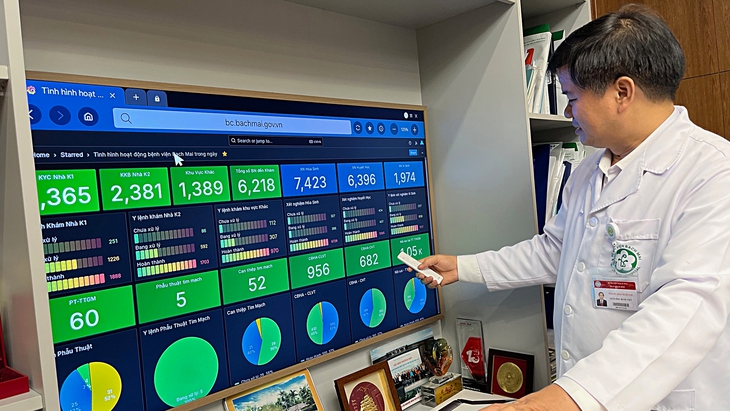
Thanks to information technology, the management board of Bach Mai Hospital now has specific information on how many patients are being examined and treated, what services are being used, and whether the flow is smooth or congested, allowing for timely resolution of issues. - Photo: HONG HA
"Previously, we didn't have regulations on what percentage of total revenue hospitals had to allocate for reinvestment in information technology applications. Introducing regulations on the percentage of revenue hospitals are required to reinvest in information technology would help hospitals accelerate development in this area, without placing an additional burden on the public."
According to the cost norms for information technology application in the circular guiding the criteria for information technology application in medical examination and treatment facilities, the investment cost for information technology application in Grade I hospitals ranges from 10.5 billion VND to nearly 40 billion VND (from level 1 to level 7).
This cost accounts for 0.57% to 2.1% of the total revenue of healthcare facilities. The level of investment depends on the number of patient visits, the size of the hospital, etc.
Source: https://tuoitre.vn/them-phi-cong-nghe-thong-tin-vien-phi-co-tang-20250504224528801.htm

![[Photo] Head of the Central Propaganda and Mass Mobilization Department visits and congratulates the Ministry of Health and the Military Traditional Medicine Institute.](https://vphoto.vietnam.vn/thumb/1200x675/vietnam/resource/IMAGE/2026/02/24/1771938483290_img-2682-3562-jpg.webp)
![[Photo] White pear blossoms bloom across the border of Pho Bang](https://vphoto.vietnam.vn/thumb/1200x675/vietnam/resource/IMAGE/2026/02/24/1771927665653_a8-8280-jpg.webp)


![[Image] A dreamy "livable city" under pink clouds](https://vphoto.vietnam.vn/thumb/1200x675/vietnam/resource/IMAGE/2026/02/24/1771930060937_tp4-jpg.webp)
![[Video] A heart that travels across Vietnam, bringing life to an 11-year-old patient.](https://vphoto.vietnam.vn/thumb/402x226/vietnam/resource/IMAGE/2026/02/24/1771945369923_dung00-25-14-23still008-png.webp)























































































Comment (0)