From bustling fishing ports to distant fishing grounds, these "news reports" are quietly accompanying ships out to sea, contributing to raising awareness of law enforcement, protecting maritime sovereignty and islands, and joining the whole country in efforts to lift the European Commission's (EC) "yellow card".
Those who bring the law down to the fishing harbor.
As dawn broke, the Lach Bang area came alive with the familiar rhythm of a coastal region in the midst of its fishing season. Under the yellow lights reflecting on the water's surface, fishing boats lay side by side, preparing for a voyage that would last for many days.

The crisp sound of engines mingled with the calls of people transferring ice, checking the quality of the goods, and inspecting fishing gear, creating the characteristic sounds of the estuary before departure.
On the fishing vessel QNG-92936-TS anchored at Lach Bang fishing port, Mr. Nguyen Cong Khoi, from Quang Ngai province, arrived very early to prepare with the crew for their new fishing trip.
Having spent over four years working in the Nghi Son sea area and decades making a living at sea, this fisherman understands that each time he sets sail, he not only carries the hope of a bountiful catch but also the responsibility to strictly abide by the law.
While in the past, fishermen were mainly concerned with fishing gear, fuel, or food for long voyages at sea, now, checking vessel tracking devices, fishing licenses, and regulations on combating IUU fishing has become an indispensable task before each trip out to sea.
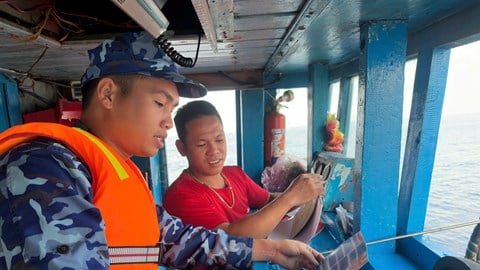
When the task force from the Nghi Son Port Border Guard Station boarded the ship, Mr. Khoẻ paused his work to talk with the border guard officers. The conversation revolved around new regulations in fisheries exploitation, maintaining the connection of vessel tracking devices, recording fishing logs, emergency contact numbers at sea, and penalties for violating foreign waters.
Such brief but practical exchanges have become commonplace at Lach Bang fishing port before each fishing trip. Receiving a leaflet from the border guard officer, Mr. Khoẻ carefully put it in his cabin and shared: "During each port call and before each fishing trip, border guards always come down to the boats to meet, encourage, and educate the fishermen."
The new regulations related to fishing were explained very clearly by the officers. As a result, the fishermen better understood their responsibilities when going out to sea.”
In the Nghi Son coastal area, the sight of border guards present at the fishing docks from early morning has become familiar. Public awareness campaigns are not only conducted in centralized meetings but also through various flexible methods. These campaigns can take place on the decks of ships, at the fishing docks, or even in the homes of fishermen. The most important thing is to help people understand the law, thereby fostering a sense of voluntary compliance.
Lieutenant Colonel Bui Ba Ngoc, Commander of the Nghi Son Port Border Guard Command, said that the unit currently manages over 19.3km of coastline with 893 fishing vessels and more than 2,000 workers engaged in marine activities. This area has two large estuaries, Ha Nam and Lang Bang, resulting in a high volume of vessels entering and exiting, posing many potential risks of violations in fishing operations.
"To ensure people comply with the law, we must first help them understand it. Therefore, we consider public awareness campaigns to be the most important solution," Lieutenant Colonel Ngoc said.
In 2025, the unit distributed 840 portraits of President Ho Chi Minh, 370 national flags, and 550 leaflets on legal education to fishermen; coordinated with localities to organize nine propaganda sessions attracting nearly 1,000 people; and broadcast 92 times for 32 hours on the local public address system.


The unit also coordinated the opening of two training courses for Class III fishing vessel captains for 75 trainees, contributing to improving legal knowledge and fishing skills for fishermen. According to Lieutenant Colonel Bui Ba Ngoc, along with propaganda work, the unit focuses on combating violations of the law at sea, especially those related to illegal fishing.
In 2025 and the first six months of 2026, the unit handled dozens of violations in the fisheries sector, imposing fines totaling hundreds of millions of VND. Simultaneously, the unit coordinated in detecting and apprehending numerous cases related to smuggling, drugs, explosives, and other illegal activities at sea.
"The ultimate goal is to raise awareness among fishermen about complying with the law, ensuring security and order at sea, and contributing to the effective implementation of the nationwide task of combating IUU fishing," Lieutenant Colonel Bui Ba Ngoc emphasized.
Leaving Lach Bang fishing port, we continued to follow the officers of Hoang Truong Border Guard Station to the coastal fishing villages of Hoang Thanh. Despite the intense early summer sun, the village cultural center was still packed with people. On a nautical map hanging in the center of the hall, the border guard officers patiently explained each sea area, each coordinate, and each regulation related to fishing activities.
What impressed us was the open exchange between the fishermen and the authorities. When the awareness session ended, many people lingered to ask more questions about the new regulations. Some inquired about the responsibility of maintaining vessel tracking devices, others wanted to learn about regulations on logging fishing activities, and still others were interested in the penalties for violating foreign waters.
Lieutenant Colonel Mai Chi Thuc, Political Officer of Hoang Truong Border Guard Station, said that the unit is assigned to manage 12.8km of coastline with more than 100 fishing vessels. In addition to centralized meetings, border guard officers regularly go to the fishing docks, board individual ships, or visit fishermen's families to disseminate information.
There are things that need to be repeated many times, and regulations that require explanations with very specific examples. But it is precisely this persistence that has brought about significant changes in people's awareness.
Living landmarks in the middle of the ocean
In the afternoon, at the Hoang Thanh Commune Police Station, local police officers were still intently monitoring fishing vessel data on the electronic system. On the computer screen, green signals continuously moved offshore. Each signal represented a vessel operating at sea. For the officer on duty, this was not just simple electronic data, but also the livelihood of hundreds of fishing families.

In recent years, along with the border guard force, the Hoang Thanh commune police have become one of the core forces in the fight against IUU fishing. From inspecting vessels, updating fishing boat data, disseminating legal information to monitoring vessel tracking devices, all activities have been implemented regularly and synchronously.
Lieutenant Colonel Le Dinh Minh, Head of Hoang Thanh Commune Police, said that combating IUU fishing is not only an immediate requirement to help lift the EC's "yellow card" but also a long-term task to protect aquatic resources and develop sustainable fisheries. Therefore, in addition to inspection and monitoring, the commune police force places special emphasis on raising awareness among the people.
The persistent journey to lift the IUU "yellow card" from fishing vessels at sea.
Thanks to the decisive intervention of the authorities, 100% of ship owners in the area have now signed commitments not to violate foreign waters. All fishing vessels currently in operation are being closely monitored. Cases of lost connection with vessel tracking devices are detected, verified, and handled according to regulations.
Not far from there, in Tien Trang commune, one of the localities with the province's largest fishing fleet with more than 500 fishing vessels, the fight against IUU fishing is also taking place with equal fervor.



Following the local police officers to the fishing docks, we witnessed conversations taking place right next to stacks of nets that had just been pulled up from the boat's hold. Many boat owners are now accustomed to checking their vessel tracking devices before each trip. Many are proactively learning about the new regulations and fully complying with the requirements for updating fishing data and traceability .
These changes are the result of hundreds of awareness campaigns, on-site training sessions for fishermen on using electronic systems, and reminder calls when vessels show signs of losing connectivity. This work, though quiet, is of great significance in the journey towards building a responsible fishing industry.
In the vast ocean, alongside border guards and local police, there are "extended arms" contributing to maintaining peace in fishing grounds. These are the production solidarity groups at sea.
For many fishermen, the solidarity group is not simply a model for supporting production, but also a source of support whenever they face difficulties. At sea, the distance between ships can sometimes be tens of nautical miles. When encountering mechanical problems, fuel shortages, or unpredictable weather changes, support from ships within the solidarity group becomes extremely important.
In the late afternoon, the fiery red sun gradually sank below the horizon. Far out at sea, the ships had become tiny dots amidst the vast expanse of ocean and sky. On each of these ships were fishermen making a living, national flags fluttering in the wind, and news from the mainland accompanying them.
Source: https://baovanhoa.vn/doi-song/theo-nhung-dong-tin-ra-khoi-238878.html