

Based on the stable score distribution from the first round, the second round of the competency assessment exam is seen as an opportunity for candidates to improve their results, while also requiring careful preparation of test-taking strategies and mental readiness before entering the examination room.
During the "Bringing Schools to Candidates" program on the morning of April 18th in Da Nang City, Dr. Nguyen Quoc Chinh, Director of the Center for Testing and Quality Assessment - Vietnam National University Ho Chi Minh City, stated that this year's entrance exam has many innovations, mostly aimed at facilitating the process for candidates.
Understanding the aptitude test correctly
According to the Vietnam National University Ho Chi Minh City, compared to 2025, the score distribution of the 2026 National Competency Assessment Exam has shifted slightly towards higher scores and is more dispersed. This indicates that candidates have adapted better to the new exam structure, while the exam still ensures its ability to differentiate between candidates.
The difficulty and discrimination indicators of the questions are all good, with the majority of questions being of medium difficulty. More than half of the questions achieve a high discrimination level, contributing to the enhanced value of the exam results in university admissions.
Dr. Nguyen Quoc Chinh gives notes on the competency assessment exam and guidance on preparing for the high school graduation exam ( VIDEO : HUE XUAN)
The results of the first exam session showed that both the average and median scores were 682 points; the highest score was 1,098 and the lowest was 27. The score distribution was close to a normal distribution, mainly concentrated in the average to above-average range but still spread across many score levels.
Regarding the use of exam results, Dr. Nguyen Quoc Chinh stated that the admissions process is carried out by the Ministry of Education and Training and universities, using various methods such as high school graduation exam scores, aptitude tests, academic transcripts, or a combination of these. Candidates only need to register for suitable preferences and should not worry too much about the admission method.

Dr. Nguyen Quoc Chinh advises students to choose majors that align with their career aspirations, rather than chasing after "hot" fields. PHOTO: HUE XUAN
Therefore, candidates need to focus on doing well in the exam and choosing a major that suits their abilities, aspirations, family circumstances, and societal needs. The choice of major should be based on career orientation, not on chasing after "hot" majors.
The National Competency Assessment Exam (ĐGNL) has been held since 2018 to better assess students' abilities for university studies. The exam consists of 120 questions, focusing on three groups of competencies: language use, logical thinking, and problem-solving.
The exam doesn't require rote memorization but provides data for candidates to process; therefore, it's necessary to focus on improving reading comprehension and critical thinking skills. Currently, 118 universities and colleges use the results of this exam in their admissions process. Notably, the Vietnam National University Ho Chi Minh City uses this method with a high weighting in some majors. Therefore, the exam results are considered an important indicator, helping to increase competitiveness in desired universities and majors.
How to get a high score
In response to a student's question about how to prepare for the second round of the exam, Dr. Nguyen Quoc Chinh suggested making good use of the 150-minute exam time. Candidates must demonstrate their full capabilities throughout the exam. In the month leading up to the upcoming second round of the National Competency Assessment Exam, students should avoid cramming or memorizing information. Instead, they should systematically review and consolidate their learned material.
In addition, maintaining good health and a stable mental state is crucial. Candidates need to get enough sleep, eat a balanced diet, and supplement their nutrition appropriately to maintain good physical condition. Dr. Nguyen Quoc Chinh also advised candidates not to put too much pressure on themselves but to focus on studying to achieve the best results. Staying calm will help them perform well during the exam.

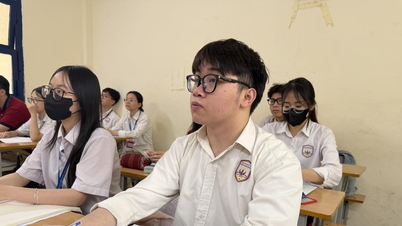
Students should avoid negative thinking and not put too much pressure on themselves. PHOTO: HUE XUAN
From a psychological perspective, Dr. Mai My Hanh, Deputy Head of the Psychology Department at Ho Chi Minh City University of Education, believes that while everyone's starting point isn't drastically different, the results will change significantly after 5-10 years. The difference lies in each individual's choices and level of perseverance; therefore, decisions made in the present will contribute to shaping the future.

Dr. Mai My Hanh believes that anxiety before an exam is a normal reaction, even necessary to increase concentration. PHOTO: HUE XUAN
However, if left unchecked, this state can lead to stress or anxiety disorders. Regarding revision, two common mistakes are cramming or procrastinating, both of which are ineffective. Instead, candidates should create a reasonable plan, break down goals into smaller steps, and maintain a consistent study schedule.
Dr. Mai My Hanh shares ways to help students relieve exam pressure, stabilize their psychology, and avoid stress and anxiety disorders. VIDEO: HUE XUAN
In addition, taking care of physical and mental health is essential. When feeling stressed, students should rest, relax, and share their feelings with family, teachers, or friends to receive timely support.
"Bringing Schools to Students" is a career guidance and admissions counseling program organized by the Nguoi Lao Dong Newspaper for the past 25 years. On the morning of April 18th, more than 1,700 students from four high schools in Da Nang City, including Sao Nam, Nguyen Hien - Duy Xuyen, Ho Nghinh, and Le Hong Phong, participated to alleviate their anxieties about career guidance, choosing majors, and selecting schools during this year's exam season.
The first phase of the 2026 Competency Assessment Exam was conducted safely and in accordance with regulations, with effective coordination between units and localities. The exam results were announced on April 17th via an online system, using electronic certificates. The second phase is scheduled to take place on May 24th in 9 provinces and cities. Registration for the second phase is open from April 18th to April 25th.
Source: https://nld.com.vn/thi-danh-gia-nang-luc-dung-hoc-tu-196260418165352966.htm


![[Photo] “Red Journey” 2026: Vietnamese Youth Continue Building the Bridge of Friendship Between Vietnam and China](https://vphoto.vietnam.vn/thumb/1200x675/vietnam/resource/IMAGE/2026/04/20/1776629730866_4055880775670638308-9618-4200-jpg.webp)








































































































Comment (0)