

 |
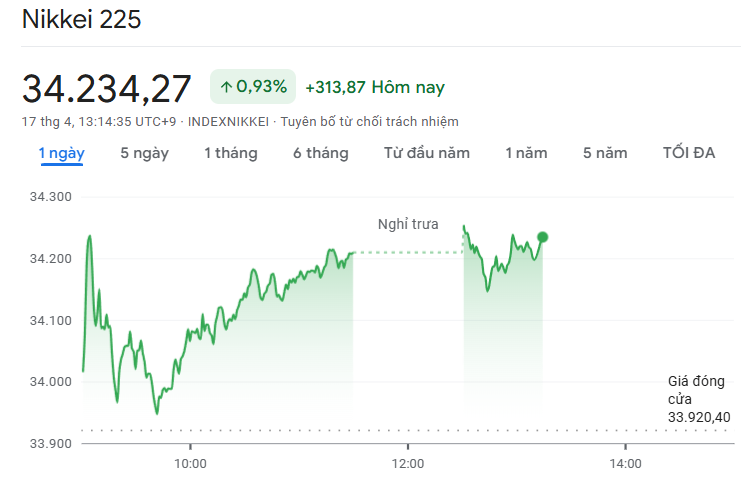
| Nikkei 225 Index Performance |
Speaking at the Chicago Economic Club on Wednesday (April 16), his first statement since President Trump unexpectedly postponed retaliatory tariffs, Federal Reserve Chairman Jerome Powell said the Fed would wait for more data on the direction of the economy before making any changes to interest rates.
Commenting on these statements, Tom Graff, chief investment officer at Facet, said the Fed chairman is in a difficult position. “The Fed cannot act proactively to prevent any potential economic weakness, as tariffs are likely to also cause inflation,” he said, adding: “They simply cannot cut interest rates while inflation is rising. This is doubly true when inflation is already high.”
Meanwhile, the US stock market witnessed a sell-off in technology stocks after Nvidia, a pioneer in AI, announced a quarterly charge of $5.5 billion due to government restrictions on AI chip exports. Dutch chipmaker ASML warned that tariffs are increasing uncertainty surrounding the company's outlook for 2025 and 2026.
As a result, the Nasdaq Composite closed down 3.07%, led by Nvidia's 6.9% drop. The Dow Jones Industrial Average also lost 699.57 points, or 1.73%, closing at 39,669.39; the S&P 500 fell 2.24%, to 5,275.70.
All of that has made investors cautious in Asian trading this morning. As a result, stock markets in the region are moving in opposite directions. South Korea's Kospi index rose 0.4%; while Taiwanese stocks fell 0.5%.
Notably, Japan's Nikkei 225 index rose nearly 1% after US President Donald Trump, who directly participated in negotiations with the Japanese delegation, said that bilateral trade talks had made "great progress".
Chinese stocks fell in early trading amid concerns about escalating US-China trade tensions. The blue-chip index dropped 0.5%, while Hong Kong's Hang Seng index rose 0.6%.
All eyes will now be on the earnings forecast of the world's largest contract chipmaker, Taiwan Semiconductor Manufacturing Co., to assess the health of the chip industry.
“Chip manufacturers are highly cyclical, so if we fall into a recession for any reason, that’s not good for chip manufacturers and we could see demand drop,” said Chris Zaccarelli, chief investment officer at Northlight Asset Management. “But there are also implications that if there are tariff barriers or if there are costs imposed in the short term, that could also lead to lower demand.”Source: https://thoibaonganhang.vn/thi-truong-co-phieu-chau-a-giao-dich-trong-than-trong-162920.html


























































































Comment (0)