|
The Eiffel Tower in Paris was closed on the afternoon of June 23rd due to the intense heat. Photo: Sarah Meyssonnier/Reuters . |
According to Reuters , Western Europe is experiencing an unprecedented heatwave. As of June 24th (local time), the heat has claimed dozens of lives, paralyzed the power grid, and forced numerous schools to close. Meteorological experts warn that these extreme temperatures could last until the end of the week.
The scorching heat has broken numerous records.
The heatwave sweeping across Western Europe has shattered numerous historical records. In southern England, temperatures reached 36.1 degrees Celsius – the highest June temperature ever recorded in the country.
In France , on June 24th, temperatures in the capital Paris reached a record high of 40.9 degrees Celsius. The day before, France had also experienced its hottest day in nearly 80 years, with a peak temperature of 44.3 degrees Celsius in the town of Pissos (southwest).
Meanwhile, the Italian Ministry of Health has declared a red alert – the most severe level – in 16 major cities, including Florence, Milan, Rome, Turin, and Verona, warning that the heatwave will continue to escalate and peak on June 28-29.
This heatwave has left devastating consequences in terms of human lives and property. In France, at least 48 people have died from drowning while trying to cool off in rivers and lakes. Two young children also died from heatstroke in a car.
In Spain, the national weather agency AEMET reported that although temperatures had begun to drop slightly on June 24, at least two elderly people still died from heatstroke.
The agricultural sector suffered significant losses as hundreds of thousands of poultry suffocated to death on farms in Brittany and Pays de la Loire. Notably, nuclear power plants, which supply the majority of France's electricity, were forced to cut capacity by around 7% due to limited cooling water supplies caused by high temperatures.
The Meteo-France meteorological agency believes this heatwave is as severe as the 16-day heatwave tragedy in August 2003, an event that claimed the lives of around 80,000 people across Europe.
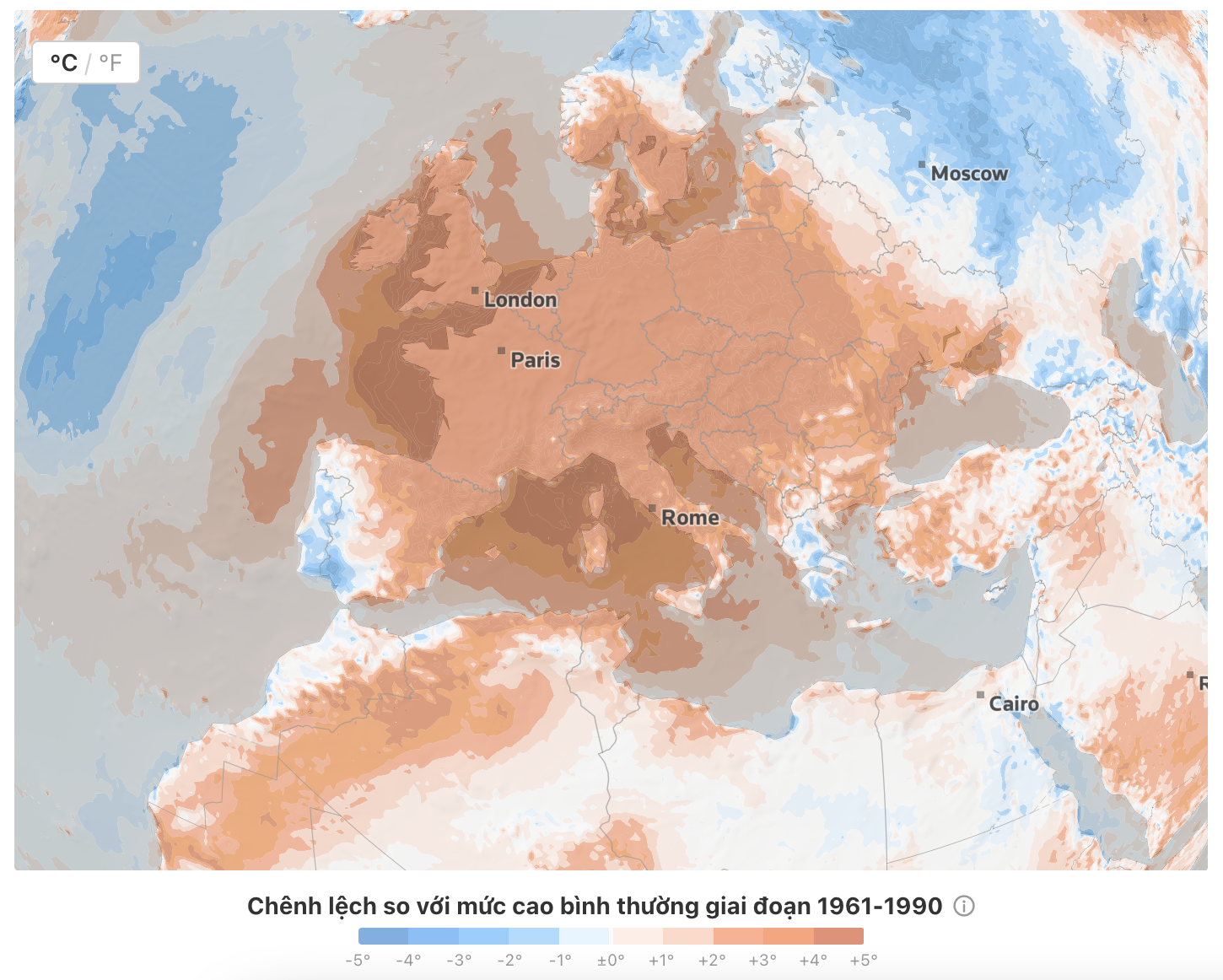 |
A scorching heat blankets Western Europe. Photo: Reuters. You may also like  650 new students enroll at the College of Technology and Engineering.GD&TĐ - On June 27th, the College of Technical and Technological Vocational Training held an enrollment ceremony for 650 new students of the 20th cohort.  Hai Phong announces the entrance exam scores for 10th grade in high schools for the 2026-2027 school year.(CLO) On the evening of June 26th, the Hai Phong Department of Education and Training officially announced the admission cutoff scores for grade 10 in public and specialized high schools for the 2026-2027 academic year.  Minister Hoang Minh Son: STEM human resources are the foundation for high-tech development.Minister of Education and Training Hoang Minh Son affirmed that the fundamental human resources for developing high technologies are those in STEM fields. When there is a sufficient number and quality of STEM human resources, adapting to, mastering, and developing high-tech fields, especially strategic technologies, will happen faster and more effectively. |
Why Western Europe is facing an inescapable heatwave.
According to AMNA, the widespread heatwave in Western Europe is not simply a result of rising temperatures. This prolonged heatwave is due to a persistent weather pattern that has slowed the natural movement of air masses across the continent.
This weather pattern is called the Omega Block because it resembles the letter Ω in the Greek alphabet. Under normal meteorological conditions, countercurrents would circulate weather systems from west to east to prevent a weather pattern from persisting in one area for too long. However, the Omega Block disrupted this cycle.
When a large high-pressure area is trapped between two low-pressure areas, the entire region's weather system comes to a standstill. The high-pressure area in the center acts like a dome, trapping warm air while preventing cooler, moist air masses from entering.
Due to the lack of cloud cover and insufficient rain, the ground continuously accumulates heat day after day. This high-pressure system also suppresses cloud formation, allowing more sunlight to reach the surface, exacerbating the warming trend.
However, the impact of the Omega system was not uniform across the continent. Areas directly under the central high-pressure zone, such as France and Spain, were most severely affected, experiencing clear, dry skies and temperatures exceeding 40 degrees Celsius.
Conversely, areas located near the low-pressure system on either side of the block experienced different weather conditions, with cooler air, rain, or unstable climate.
The United Kingdom is currently situated at the boundary between the warm air mass of continental Europe and the cooler air mass in the northwest. Therefore, southern and eastern England experience very high temperatures, while the north and west have constantly changing weather.
This stark contrast is characteristic of block weather patterns: one area experiences extreme heat while the surrounding region has completely different summer weather.
Consequences of climate change
Scientists have not yet definitively confirmed whether climate change will increase the frequency of Omega-blocking clouds. However, the link between global warming and heatwaves has been clearly established.



Human activities—primarily the burning of coal, oil, and natural gas—have raised the Earth's temperature by approximately 1.3 degrees Celsius compared to pre-industrial levels. Because of this higher base temperature, as the trabecular meshwork develops, the amount of heat accumulating beneath the atmospheric dome will be more intense than in the past.
Studies indicate that heatwaves in Europe are currently experiencing temperatures 2-4 degrees Celsius higher than in scenarios without human-induced climate change. Climate change doesn't directly create specific weather patterns, but it exacerbates the intensity and severity of extreme events when they do occur.
Thus, the Omega mass is the reason for keeping temperatures stable, while climate change is the factor that makes the heat more intense.
Source: https://znews.vn/thu-dang-khoa-chat-tay-au-trong-lo-lua-ky-luc-post1662980.html







































![[Photo] Thousands of people participate in a run to show their support for the campaign "Sharing a common determination to build drug-free communes, wards, and special zones".](https://vphoto.vietnam.vn/thumb/1200x675/vietnam/resource/IMAGE/2026/06/27/1782554475933_0673e2a3df7b5e25076a-8283-jpg.webp)