This vast data source not only preserves humanity's intellectual heritage but also opens up opportunities for groundbreaking discoveries and insights into biodiversity, evolution, and the transformation of the natural world .

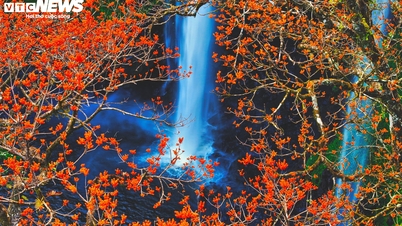
Beautiful nature illustrations
Open for over 20 years, approximately 64 million pages of scientific knowledge have been shared free of charge through the world's largest online Biodiversity Heritage Library. According to The Guardian , more than 680 museums, universities, libraries, and scientific research institutions around the world, from China, Singapore , Australia, and New Zealand to Europe, Africa, Mexico, Canada, and the United States, have contributed millions of documents, historical illustrations, and research papers on both existing and extinct species.
To date, the Biodiversity Heritage Library has attracted millions of visits. These include clicks to read about the type of wood used by Victorian-era (1837-1901) manufacturers to make walking sticks. Many others browse illustrations of the Tasmanian tiger (a carnivorous marsupial resembling a wolf, with stripes on its back). This animal is endemic to Australia and unlike any species existing today. Many visitors admire the field diaries of the first botanist to explore Antarctica.
Recently, a report from the Royal Botanic Gardens Kew (RBG Kew) in the United Kingdom revealed the crucial role of digitalization in “transforming our understanding and response to climate and biodiversity crises.” RBG Kew asserts that its Biodiversity Heritage Library has demonstrated for the first time how to digitize centuries of scientific knowledge.

David Iggulden, head of the BHL executive committee and head of data and digital, library and archives at RBG Kew, described the Biodiversity Heritage Library as an invaluable and “absolutely essential” resource for scientists in this field.
In addition to published documents and journals on biodiversity, there are also letters, illustrations, climate notes, field diaries, ecosystem records, distribution records, and manuscripts containing early accounts of a particular species or detailed descriptions of ancestral expeditions.
Among them, the oldest book, and one of the earliest Western medical manuscripts, known as the medieval pharmacopoeia Circa instans, dates back to around 1190. Considered a fundamental text in the development of modern botany, the book helped standardize plant names and their uses throughout medieval Europe. The book was digitized by the New York Botanical Garden (USA) last year.
This 1892 exhibition catalog, illustrated by Henry Howell & Co., a Victorian-based London company and the world's largest manufacturer of walking sticks, is highly useful for scientists studying economically important tree species, as well as the importance and characteristics of wood and how it has been used throughout history.
Global Alliance for Nature
The Biodiversity Heritage Library was born after librarians around the world came up with a bold idea to improve global research on climate change and biodiversity loss at a transformative time in internet history. It was the dawn of Web 2.0, when the use of the internet for connection and communication began to become widespread. At that time, the idea of international collaboration on a large-scale digitization project was truly "revolutionary."
A famous example is Louis Renard's 18th-century book, *Poissons, Ecrivisses et Crabes*, which includes illustrations of mermaids and other imaginary creatures, interspersed with scientifically accurate images of real fish, lobsters, and crabs. The album is considered the earliest known color publication of fish. This was a truly important part of scientific literature from the Enlightenment (17th and 18th centuries), when people ventured out and explored lands they had never seen before.



During the pandemic, historical logs uploaded to the Biodiversity Heritage Library helped scientists demonstrate that there had been a “major shift” in the distribution and numbers of rare Australian orchid species during the “dark summer” of bushfires, in late 2019 and early 2020.
Therefore, the Biodiversity Heritage Library is the world's most important digital collection of biodiversity literature. The library provides free and open online access to over 250,000 books from the 15th to the 21st centuries on a wide range of biodiversity topics, through its digital library portal: biodiversitylibrary.org.
Source: https://baodanang.vn/thu-vien-so-ve-the-gioi-tu-nhien-3341884.html
































![[Photo] Thousands of people participate in a run to show their support for the campaign "Sharing a common determination to build drug-free communes, wards, and special zones".](https://vphoto.vietnam.vn/thumb/1200x675/vietnam/resource/IMAGE/2026/06/27/1782554475933_0673e2a3df7b5e25076a-8283-jpg.webp)