


When Ms. Nguyen Huong Giang ( Hanoi ) took her child for a check-up at the National Institute of Nutrition, she was shocked when the doctor assessed her child as obese. At only 10 years old, the girl already weighed 60kg.
Another case is that of Nguyen Cam Nhung, a 9th-grade student from Hanoi, who weighs nearly 80kg. “My daughter started gaining weight in 6th grade. By 7th grade, she started eating a lot of fast food. I tried adjusting her diet, but it only worked for a day or two before failing,” the mother sadly explained.
The story of these two mothers is not unique; the rate of overweight and obese students is increasing, especially in large cities.

A recent study conducted by the National Institute of Nutrition in collaboration with the Ministry of Education and Training in numerous preschools revealed an increase in the number of overweight and obese children; in some schools, nearly 30% of children were overweight or obese.
In particular, a survey of 5th-grade students in several districts of Hanoi conducted in 2023 also revealed an alarming situation, with the number of overweight and obese children in many schools in the inner city exceeding 45%. Specifically, this rate was approximately 45.5% at Dich Vong B Primary School; 49.5% at Le Loi Primary School; 55.7% at La Thanh Primary School; 51.4% at Tran Nhat Duat Primary School; and 46.5% at Quynh Loi Primary School… In schools in the suburban areas, this figure was also above 20%.
Associate Professor Bui Thi Nhung, former Head of the Department of School and Occupational Nutrition at the National Institute of Nutrition, stated that the rate of overweight and obese school children is very worrying. Overweight and obesity don't happen suddenly; they are the result of a long-term accumulation of excess energy from diets. Meanwhile, childhood overweight and obesity can lead to many serious consequences. When testing 500 obese children, 35-50% have dyslipidemia (abnormal blood lipid levels). Furthermore, diabetes is no longer just an adult disease but is becoming increasingly prevalent among younger children…
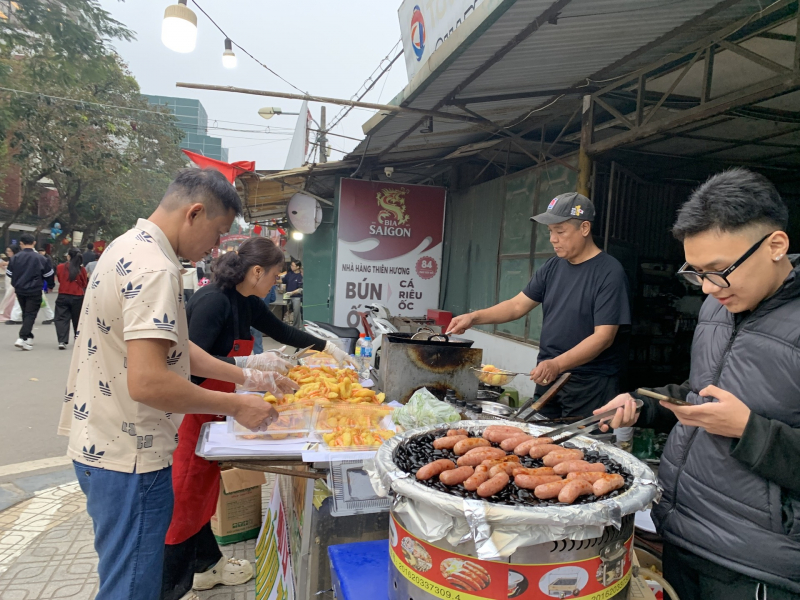
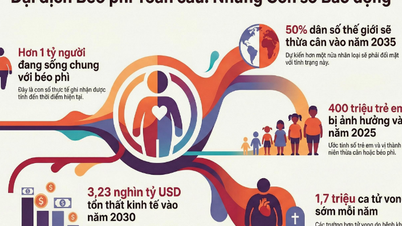
While the obesity rate in Vietnam was only about 2.6% in 2010, it had increased to 3.6% by 2014, a 38% increase in just four years. The obesity rate in urban areas (22.1%) is almost double that of rural areas (11.2%). Even more alarming is the prevalence of overweight and obesity among children aged 5-19. In 2010, only 8.5% of children were overweight, but by 2020, this number had more than doubled to 19%. Of these, children in urban areas accounted for 26.8%, compared to 18.3% in rural areas and 6.9% in mountainous regions.
According to information from the Department of Disease Prevention ( Ministry of Health ), Vietnam currently has 17 million people with hypertension, nearly 4.6 million with diabetes, 2 million with chronic obstructive pulmonary disease (COPD), and over 180,000 new cancer cases each year. Numerous scientific studies confirm that a diet rich in processed foods and high in energy density increases the risk of metabolic and non-communicable diseases such as overweight and obesity, diabetes, cardiovascular disease, and cancer, creating a double burden on both health and the economy.
According to Dr. Le Thi Huong Giang, Head of the Dietetics and Nutrition Department at 19-8 Hospital, ultra-processed foods are those produced industrially through many stages, containing a large number of additives (sweeteners, colorings, synthetic flavorings, emulsifiers, etc.) and virtually no longer retaining their original natural properties.
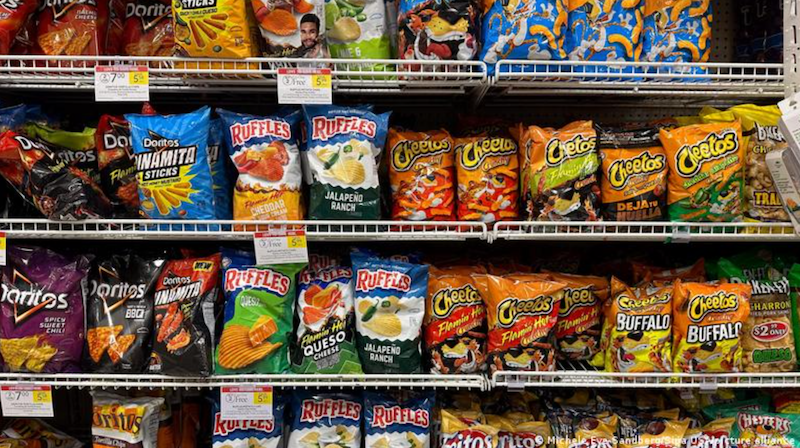
The Head of the Nutrition Department at the 19-8 Hospital stated that there are four reasons why ultra-processed foods are dangerous. These include additives (emulsifiers, thickeners, sweeteners) that disrupt the gut microbiome, potentially altering it, causing chronic inflammation, and increasing the risk of chronic diseases in the long term; sugars and starches are absorbed extremely quickly, easily leading to weight gain, metabolic disorders, and type 2 diabetes. Significantly, many large studies have shown that high consumption of ultra-processed foods is associated with an increased risk of cancer, particularly colorectal cancer.
Currently, ultra-processed foods are widespread in modern life. In Vietnam, the trend of consuming nutritionally unbalanced, pre-packaged processed foods is rapidly increasing and at a high risk level, with consumption increasing more than tenfold between 2000 and 2017.
Therefore, Dr. Giang advises people to have a healthy diet, consume less processed food, and increase their intake of fresh food and vegetables to reduce the burden of disease.
Source: https://cand.com.vn/y-te/thua-can-beo-phi-dang-tang-nhanh-i798375/



![[Photo] General Secretary To Lam presides over a meeting with the Editorial Teams to summarize 100 years of the Party's leadership of the Vietnamese revolution and 40 years of implementing the National Construction Program.](https://vphoto.vietnam.vn/thumb/1200x675/vietnam/resource/IMAGE/2026/03/04/1772601288977_a1-bnd-8134-7576-jpg.webp)















































































Comment (0)