

A committed generation
I remember in the third grade (equivalent to today's 10th grade) of the 1966-1967 school year, we produced a student newspaper with 100 copies. At that time, this was a huge number, and we boldly approached the Governor of Quang Nam Province to... ask for permission to publish the newspaper.
The provincial governor arranged for us to meet his private secretary and provided us with enough paper to mimeograph 100 copies of the newspaper, including the use of a camera; however, we had to source our own croquis paper for the cover. Despite the hardship of figuring things out as we went along, the newspaper was finally completed, and... then the trouble began.
In my so-called editorial titled "The Issue of School Ethics Today," there are two lines that read: "When those above are unjust, those below will be in chaos; how true that is" and "Meanwhile, life teaches us more than books."
Two professors, one teaching English and the other History, analyzed the article and concluded: "It disrupts the school and incites students to join the Viet Cong." The school's disciplinary committee met. Fortunately, thanks to the forgiving nature of Principal Hoang Trung and teachers Thong and Danh, the "pardon" vote received 5 out of 8 votes.
Recalling personal memories serves merely as an illustration of a small aspect within the broader context of school life in many cities of South Vietnam during a particularly significant period in the country's history.
In the 1960s and 70s, it's noteworthy that student newspapers emerged as early as the seventh and sixth grades (equivalent to today's sixth and seventh grades), compiling excellent essays from class, written and presented independently. However, by the time they entered high school, these student newspapers could be considered newspapers, encompassing various genres such as commentary, research, and creative writing. The news section, however, was relatively short, only briefly documenting school activities.
When the protest movements in urban areas intensified in the late 1960s and 1970s, news coverage began to include more reports on school strikes, hunger strikes, and street demonstrations. It can be said that one of the starting points of student newspapers was the emergence of literary groups and writing teams at the high school level in the urban areas of Southern Vietnam. During those years, a whole student journalism movement formed, with hundreds of newspapers such as: The Call of Students, The Country, Thai Hoa, Hoa Hop, New Land, The Call of Students...
This was a phenomenon unprecedented and unlikely to reappear. Numerous studies over the past few decades have concluded that the struggle of various social classes in the urban areas of Southern Vietnam significantly contributed to the overall victory in the national defense effort. Within this powerful movement, the role and impact of youth journalism, particularly among students, was immense.
The voice of patriotism
In Quang Nam and Da Nang alone, many young, self-taught journalists at that time later became professional journalists. Notable examples include: Cung Van, Hoang Thoai Chau, Vu Duc Sao Bien, Tu Huy, Huynh Ba Thanh, Vo Nhu Lanh, Tran Pha Nhac, Tran Ngoc Chau, Huynh Son Phuoc…
This fact is perhaps understandable, when placed within the context of the continuing tradition of patriotism, a tradition particularly evident in this land where "the rain hasn't yet soaked the soil," and one can recall the first prominent figures who followed.
These were Luong Khac Ninh (1862 - 1945), from Dien Ban, editor of the Nong Co Min Dam newspaper (1901 - 1921). There was also Phan Khoi (1887 - 1959), also from Dien Ban, a journalist who advocated for literary reform, founded the Song Huong weekly newspaper (1936 - 1937); the initiator of the New Poetry movement with "Old Love" and a journalist who raised fundamental issues contributing to the transformation of the nation's spiritual life.
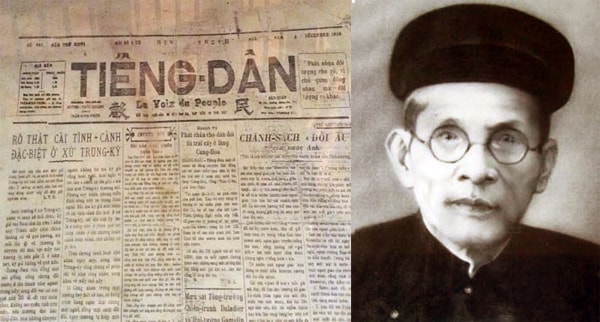
These were Le Dinh Tham (1897 - 1969), the founder of Vien Am (1933), the first newspaper of the Central Annam Buddhist Association. And Huynh Thuc Khang (1876 - 1947), from Tien Phuoc, the founder of Tieng Dan (1927 - 1943), a newspaper that "shouted the voice of the people" amidst the censorship of the French colonialists…
Those who followed in their footsteps include Phan Thanh, Phan Boi, Luu Quy Ky, Phan Thao… and especially the large number of Quang Nam journalists who have grown up from 1975 to the present day…
Recalling my student days as a journalist, and mentioning prominent figures in the journalistic world who hailed from this land—what is the purpose? Simply to say that it was nothing more than patriotism and love for the people, the spirit of struggle for peace and independence, intertwined with pride in the traditions of the land and people of Quang Nam, that created this historical truth and value. And to preserve and pass it on as an essential legacy for future generations.
Source: https://baoquangnam.vn/thuo-lam-bao-ngay-xua-3157002.html

![[Photo] General Secretary and President To Lam presides over a working session with the Central Policy and Strategy Committee on the development of the materials industry.](https://vphoto.vietnam.vn/thumb/1200x675/vietnam/resource/IMAGE/2026/05/21/1779359935432_a3-bnd-3129-1412-jpg.webp)

![[Photo] National Assembly Chairman Tran Thanh Man working with the Standing Committee of the Law and Justice Committee](https://vphoto.vietnam.vn/thumb/1200x675/vietnam/resource/IMAGE/2026/05/21/1779378929214_ndo_br_1-4610-jpg.webp)











































































Comment (0)