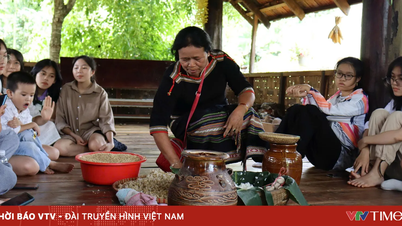
Artisans in Cao Phong commune are passing on the art of Muong gong playing to the younger generation.
During the ceremony, the elders carefully take the gong from its most prominent place in the house, rub white wine on their hands, and then gently rub it evenly over the gong's knob. This is the ritual to awaken the gong, to call its spirit back. The sound of the gong begins softly, like a forest breeze rustling through leaves, then gradually becomes resonant, full, and joyful. Once the gong is "awakened," the elders strike the gong to welcome the new year – a majestic yet warm melody that awakens the entire Muong village in that transitional moment.
That sound not only heralds the arrival of spring, but also hints at the millennia-long journey of a sacred musical instrument – the immortal soul of the Muong community.
I once celebrated the New Year to the sound of Muong gongs in my hometown of Muong Be, Quyet Thang commune; I sat silently amidst the resonant gongs in Muong Coc, Kim Boi commune; and I immersed myself in the reenactment of the New Year's greetings performed by the shamans during the Spring Festival at the Khai Ha and Khai Mua festivals in Muong Bi and Muong Thang... Each time, the sound of the gongs deeply moved the hearts of the Muong people, stirring up love for their homeland, their roots, and the enduring values that have stood the test of time.
Cultural researchers believe that gongs are ancient musical instruments, originating from the Dong Son civilization at least 3,500-4,000 years ago. The image of people playing gongs on the Dong Son bronze drums serves as vivid evidence of the musical and religious life of the ancient Vietnamese people. For the Muong people, gongs were created and passed down from the time before the separation of the Vietnamese and Muong ethnic groups. From the 11th century onwards, gong culture continuously developed, taking deep root in community life.
Muong gongs are crafted from copper using two main techniques: casting and hand-forging. Each gong is not only a finely crafted product but also the culmination of folk knowledge, skillful hands, and the soul of the artisan. The decorative patterns on the surface of these ancient copper gongs, simple yet rich in symbolism, tell stories about humanity, nature, and the universe in the beliefs of the Muong people.
Introducing the space where the precious antique gongs are hung in his family's stilt house, People's Artisan Bui Van Minh shared: "For the Muong people, gongs are sacred objects, precious possessions in every family. The sound of the gongs carries the spirit of the mountains and forests, a link connecting people with the supernatural world . Gongs are present in life cycle rituals, in folk festivals, in religious activities, and even in everyday moments."



Beyond its spiritual significance, the Muong gong also plays a vital role in conveying information and signaling within the community. During festivals, gongs accompany shamans bringing good fortune to every household at the beginning of the year; they bless newlyweds on their wedding day; they respectfully bid farewell to the deceased; they urge people to join in the festivities and head to the fields; and they call families together to celebrate the new harvest. The sound of the gongs has been a rhythm and breath of life in the Muong villages for generations.
For the Muong people, gongs are not simply traditional musical instruments, but the most sacred sound in their cultural life. When not in use, gongs are hung in the most prominent position in the house. The Muong believe that gongs also have a "mouth," so when placing gongs, they are always placed face up, with the knob facing down; they are rarely placed face down, because that would be "covering the mouth of the gong," making the gong silent.
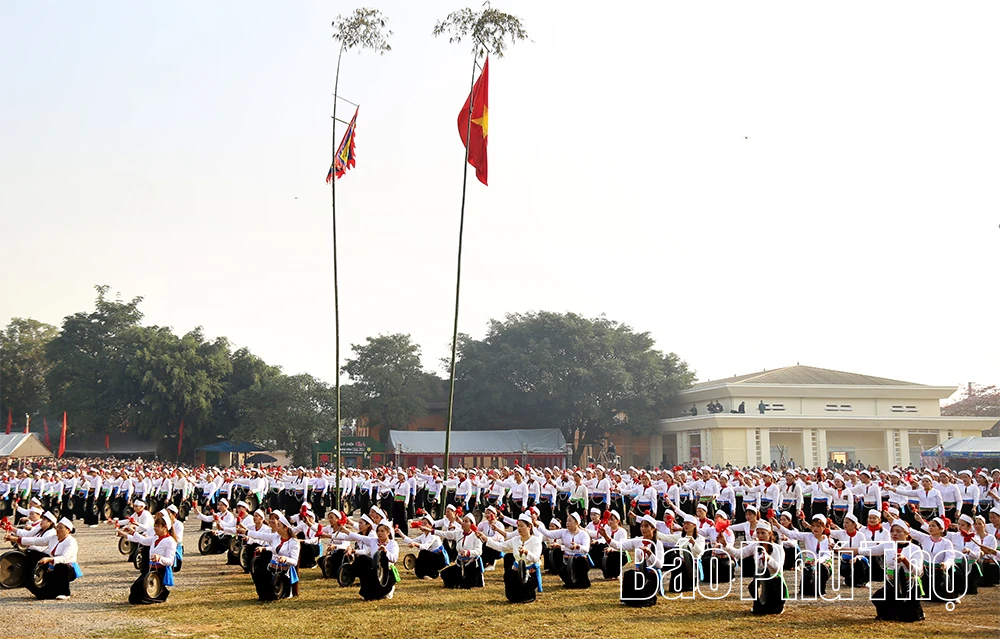
Muong ethnic group's gong musicians perform at the 2025 Muong ethnic group's opening ceremony.
According to animistic beliefs, gongs possess souls and spirits. If a gong is left unplayed for a long time or improperly preserved, its sound will lose its clarity and warmth, and its spirit will "fall asleep," causing the sound to no longer resonate with people or reach heaven, earth, and the gods. Therefore, before each performance, the musicians perform a ritual to "awaken the gong," calling its spirit back. When playing the gong, they don't use their hands to strike or tap it, but instead use mallets made from guava or rosewood, wrapped in buffalo or deer hide, to create full, resonant, and deeply moving sounds.
The Muong gong ensemble has a tight structure and high pitch accuracy. The Chot gong, with its high, bright sound, is used for embellishment and as a supporting part. The Bong gong, of medium size and full sound, serves as the main part and is the backbone of the gong piece. The Kham gong, large in size and with a warm, deep sound, maintains the rhythm and provides impetus for the development of the melody. The harmonious blend of these gongs creates melodies that rise and fall, sometimes leisurely and profound, other times heroic and stirring.
Through the ups and downs of history, the sound of gongs has steadfastly accompanied the Muong community in the major Muong regions of Hoa Binh province in the past, and in Thanh Son, Tan Son, and Thu Cuc communes (Phu Tho province)... Particularly since the 2000s, Muong gongs have been strongly promoted through festivals and socio-political events. The performance space has expanded, and the methods of expression have become more flexible, developing from small gong ensembles to large ones, combined with many other art forms, creating a contemporary look for gong culture.
In 2011 and 2016, the former Hoa Binh province twice set Guinness World Records for the largest gong performance in the country, with 1,200 and 1,600 gongs respectively. At the end of 2016, the "Muong Gong Art" was recognized as a national intangible cultural heritage. According to 2024 statistics, the Hoa Binh region still preserves nearly 15,000 gongs, with over 10,000 people who know how to play them, 224 Muong gong clubs, and more than 30 ancient gong melodies collected and preserved. Many dedicated artisans such as Meritorious Artisans Nguyen Thi Hinh, Bui Van Lung, Bui Thanh Binh, Bui Tien Xo, Dinh Thi Kieu Dung, etc., have been diligently teaching Muong gong music to the younger generation.



On a spring day, amidst the mountain and forest landscape, listening to the resonant sound of the Muong gongs, one can fully appreciate the essence and profoundness of this folk sound. It is the sound of the harmony between heaven and earth, of the past echoing into the present, of tradition continuing into the future.
Hong Duyen
Source: https://baophutho.vn/tieng-chieng-muong-goi-xuan-ve-248025.htm



















































































![[INFOGRAPHICS] Can Tho implements the Strategy for Ethnic Affairs until 2030, with a vision to 2045](https://vphoto.vietnam.vn/thumb/402x226/vietnam/resource/IMAGE/2026/06/28/1782658308447_1782658217.webp)