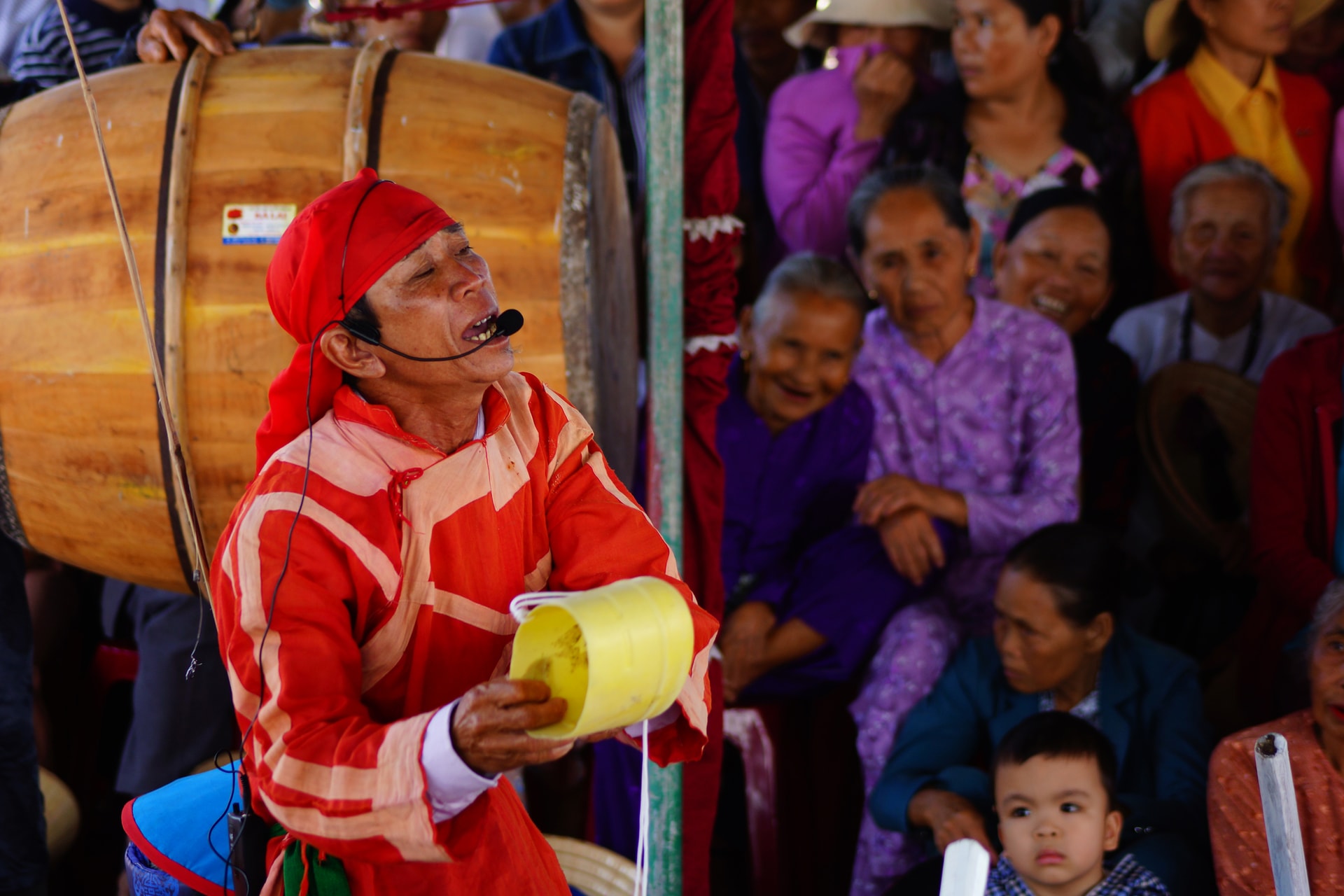
The cymbal struck a short, firm beat. The voice of the village chief, piercing the wind, called the rowers into line. Many onlookers on the Quang Nam coast didn't fully understand the layers of Sino-Vietnamese words, nor grasp the verses that were both sacred and lamenting. But almost everyone felt the pull from the rhythmic strokes of the oars, their bodies bobbing, and the shouts bursting out like a survival command.
Throughout the coastal fishing villages of Quang Nam province, this heritage is a theatrical performance encompassing ritual, music , and labor. It's not merely an accompanying act, but the central expression of the region's maritime culture. Today, the "ba trao" folk singing tradition is in a state of both survival and decline. Some places still have festivals and rowing troupes, but in others, only a few artisans remember the lyrics, facing the risk of extinction.
Three layers of language, one dialect of the coastal village.
To understand the music of the "ba trao" folk theater, one must look at the ensemble. The sound here is organized through labor relations, not theatrical relations.
The chief of the boat stands at the front, holding a large cymbal, singing and giving orders. The chief of the hold stands in the middle, singing in call-and-response and performing water-scooping actions. The chief of the helm controls the rear axle. Many boats also have a chief of the rear, who creates comedic moments and incorporates everyday life elements into the rituals. On either side are the rowers, singing in response to the rhythmic paddling of the oars.
This is an accurate depiction of a voyage at sea. And the music at each position perfectly captures the essence of that role: the bowman shouts loudly and decisively; the helmsman works harder and heavier; the oarsmen move rhythmically and steadily, like the synchronized rowing of oars.
The Bả Trạo is not a single melody. In a performance, the singer goes through at least three layers of music, and the sound of the cymbal of the Chief is the thread connecting them all: each time the cymbal is struck, it is the command to coordinate the breath and body of the entire group.
The rowing and anchor-pulling chants originate from seafaring labor: rowing chants require long, lingering breaths, while anchor-pulling chants use short, firm breaths in rhythm with the pulling. The Southern, lyrical, and verse singing styles have roots in traditional Vietnamese theater and Buddhist music, with slow rhythms and a strong ceremonial tone; singers draw their voices along with the verses, releasing long breaths and building up into high notes. The call-and-response style of the village's folk songs uses colloquialisms from the fishing village, with humorous riddles about fish.
The three layers shift continuously, captivating the listener with their nuanced transitions between powerful, melancholic, urgent, and gentle tones.


The lyrics of the "bả trạo" folk songs are layered texts: formal Sino-Vietnamese sentences, Nôm verses, classical theatrical styles, and simple Quảng Nam dialect colloquialisms like "bên tê," "tề," "chừ," and "răng rứa." Researchers translating these ancient scripts must grapple with numerous Nôm characters transcribed according to dialects, and maritime terms not found in dictionaries.
This blend creates a strange effect: outsiders can't hear everything, yet they still shiver. They hear simultaneously the sounds of rituals, labor, and the voices of the people of the coastal region for hundreds of years. The "difficulty in understanding" isn't a barrier; it's the imprint of the community's hand on the lyrics.
When the lead singer sings, "In the quiet night, alone, before and after / I must stay awake to tend to the water," the lyrics and body movements perfectly match. Moving on to the chanting section, the entire group chants "Namo Amitabha Buddha," the rhythm of the chanting blending with the rhythm of the rowing. In the Long Than Ba Trao Ca, the chanting is "Ho Hau Ong," while in the Am Linh Ba Trao Ca, it changes to "Ho Hau Linh." Using the same call-and-response mechanism, each ritual scene has its own unique character.
In the boat dance, the shouts of the members are always at the same pitch, demonstrating their unity and cooperation in crossing the sea. No one sings higher, no one sings lower. There is one boat, and everyone holds on together. Music becomes a symbol of solidarity.
The ritualistic chanting is not merely flamboyant. The spiritual aspect, dedicated to the souls of those who died at sea, has a slow pace and a high degree of reflection. This mixed emotion of courage and sorrow truly reflects the life of a community constantly facing storms and loss.
Will the fishing village become a town, and the traditional boat dance fade into oblivion?
The decision to include Ba Trao singing in the National List of Intangible Cultural Heritage in 2013 cannot reverse the reality that this art form in the coastal corridor of Quang Nam province is being pushed into fragmented "memories" due to urbanization narrowing the cultural space of the coastal area.
The biggest challenge today is the situation where some people remember the lyrics but there is a shortage of performers. Even in Nai Hien Dong, although the club was established in 2023, Meritorious Artist Nguyen Thuc still warns that the "ba trao" folk singing style is fading faster than "bai choi" folk singing. The disruption in the transmission of the craft is evident when the number of elderly artisans is dwindling, causing the fishing festival in Son Tra to sometimes be without "ba trao" performances, or requiring the addition of performers from other fishing villages.
The risk of extinction lies not in the costumes or the lacquered oars, but in the disappearance of the acoustic essence of the heritage, including breathing techniques, the art of emphasizing words, and the distinctive rhythm of each community. With each passing artist, an original version risks being erased. When the chanting is muddled by forgetfulness, the salty essence of the sea will diminish, putting national heritage under immense pressure regarding its continuity.
Over the years, researchers' efforts to preserve the Ba Trao folk singing tradition have shaped important documentary foundations. Musician Xa Van Hung completed the musical notation of 14 basic melodies, translated 67 pages of documents, and packaged them into a DVD reconstructing the ancient script. Musician Van Thu Bich published the work "Folk Music of the Da Nang Coastal Region" with a detailed lyrical appendix, while the Hoi An Cultural Heritage Conservation Center continues to preserve a system of records on rituals and Cheo folk songs for the funeral of the Whale God.



However, a truly comprehensive audio data bank has yet to be established due to limited preservation thinking. The Bả Trạo folk songs are highly variable, from the lyrics to the way roles are named in each fishing village, making it impossible for compiled performance videos to preserve the heritage. Standard documentation requires the multi-channel separation of the main voice of the bow, the responses of the main crew, and the choral singing of the rowers; the accompanying text must accurately transcribe the Quảng dialect, and assign specific codes to each chant, verse, or rowing song.
This model should be a vibrant, shared data network with local artisans and the management board of the Ông Temple. The community must hold co-ownership rights, rejecting one-sided exploitation of the data. The open data system will serve museums, schools, and return the data to fishing villages that are experiencing a shortage of people familiar with the local dialect.
From Son Tra to Cu Lao Cham, the chants on the waves still maintain their rhythm. But each year, an artist passes away, and the fishing community forever loses a unique way of breathing, a distinctive frequency of vocalization that no book can recreate. Preserving the "ba trao" folk song is not about freezing an ancient melody, but about preserving the survival voice of a community that once knew how to lean on each other, using a shared pitch to overcome the uncertainties of the open sea.
Source: https://baodanang.vn/tieng-ho-tren-song-3339597.html

![[Photo] Opening Ceremony of the 13th National Congress of the Ho Chi Minh Communist Youth Union](https://vphoto.vietnam.vn/thumb/1200x675/vietnam/resource/IMAGE/2026/06/24/1782286753905_ndo_br_1-8510-jpg.webp)
![[Photo] General Secretary and President To Lam attends the Central Public Security Party Committee Conference](https://vphoto.vietnam.vn/thumb/1200x675/vietnam/resource/IMAGE/2026/06/24/1782302063612_a1-bnd-9302-9166-jpg.webp)
![[Photo] The 13th National Congress of the Youth Union conducts personnel work.](https://vphoto.vietnam.vn/thumb/1200x675/vietnam/resource/IMAGE/2026/06/24/1782299943080_ndo_br_1-6868-jpg.webp)