In that remote, windswept place, the sound of the conch shell is not simply an echo from the sea. It is the memory of the coastal community. It is a signal, a ritual. It is a trace of the brave troops of the Hoang Sa Islands who once braved the vast ocean to assert sovereignty over the islands.
Amidst the hustle and bustle of modern life, where telephones, walkie-talkies, and technology have replaced all traditional means of communication, the sound of conch shells remains present in Ly Son as an indispensable part of the island's soul.

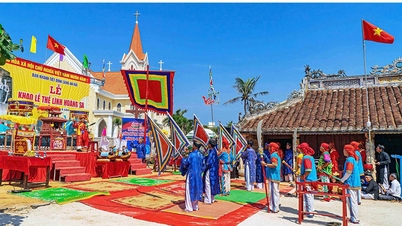
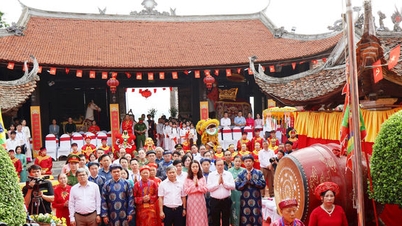
The ceremony honoring the soldiers who died in the Hoang Sa Islands was held in the Ly Son Special Zone, Quang Ngai province.
PHOTO: NGUYEN HUU THU
When the whistle blows, it's time to march out.
Sitting by the village communal house, Mr. Tran Cuong, 61 years old, Head of the An Vinh Village Communal House's Celebration Committee, slowly recounted the sound that has accompanied the island's history. "The Hoang Sa (Paracel Islands) troops of the past used conch shells as signals. When blown, it meant the troops and ships were ready to set sail to protect the sovereignty of the islands," Mr. Cuong said.
Nowhere is the sound of conch shells more distinctly heard than during the Hoang Sa Soldiers' Commemoration Ceremony – a special ritual preserved by the people of Ly Son for generations. In the past, whenever the imperial court dispatched the Hoang Sa troops to the Hoang Sa and Truong Sa archipelagos to carry out tasks such as marking sovereignty, surveying waterways, exploiting marine resources, and protecting territorial waters, the islanders would hold a ceremony to offer sacrifices to the living. The soldiers set out carrying national orders, but also the uncertainty of "those who go may not return."

Mr. Tran Van Ngu (right) and Mr. Tran Cuong sit by the village communal house, talking about the conch shell.
PHOTO: HAI PHONG
After the solemn ceremonies, the sound of conch shells echoed. Not the rapid beat of war drums, nor the boisterous clang of festival gongs, but a prolonged, subdued sound that spread far across the sea. It was a signal, a farewell. Five boats immediately left the dock. One main boat led the way, followed by four boats carrying soldiers...
According to folklore in Ly Son, the sound of conch shells also carries a spiritual element. Islanders say that if a child or someone gets lost and is "hidden by ghosts," the sound of the conch shells will help them find their way home. This sound has long transcended its ordinary function as a signal to become an integral part of the spiritual life of the coastal inhabitants.
According to Mr. Tran Cuong, conch shells live in the deep sea around the Hoang Sa and Truong Sa areas. This species of shell is not rare, but choosing a shell that can produce a resonant sound is not easy. Depending on the structure of each shell, some may look beautiful but do not produce a resonant sound when blown.

Mr. Tran Van Ngu blows up conch shells near the beach of Ly Son Special Economic Zone.
PHOTO: HAI PHONG



After being caught, the conch shells must be kept alive and hung to dry naturally. Then, the meat is removed, washed thoroughly with seawater, and then soaked and scrubbed repeatedly until shiny. When the shell reaches its dryest and hardest state, a small hole is carved in the tail end to create an air passage. This seemingly simple step almost entirely determines the sound quality. Creating a complete conch shell can sometimes take months, even years.
Signals in the middle of the ocean
In Dong An Vinh village, Mr. Tran Van Ngu (73 years old) is one of the few people who still preserve the proper technique of blowing the conch shell flute. For more than half a century, he has been closely associated with that unique sound.
Previously, Mr. Ngu learned how to blow the conch shell from the elders in the village. Later, when he was on duty patrolling the crops on the island, the sound of the conch shell continued to be a valuable tool. "Back then, the island didn't have telephones like it does now. If we saw thieves or something unusual, we just had to stand on the mountain and blow the conch shell for a while, and the villagers would know something was wrong," Mr. Ngu recounted.

Mr. Tran Van Ngu blows up conch shells near the beach of Ly Son Special Economic Zone.
PHOTO: HAI PHONG
Not only used on land, but also at sea, the sound of conch shells once served as a "communication system" for fishermen. Each conch shell beat carried a specific meaning. From the main ship, if the other ships responded with three beats, it meant everything was normal. Six beats signaled a meeting of the captains. Nine beats indicated enemy presence or an emergency situation. "In the old days, if soldiers unfortunately died at sea, they would wrap the body in a mat along with a name tag and release it into the sea. The conch shell would then sound three times as a farewell," Mr. Ngu said, then silently gazed out at the distant sea. "Going to sea also involved the sound of conch shells. Dying at sea also involved the sound of conch shells as a farewell," his voice softened.
The people of Ly Son Island recount that before the advent of modern means of communication, conch shells played a particularly important role. Using only the natural structure of their shells and a technique of inhaling air, the sounds they produced could travel hundreds of meters, even kilometers. In the vast ocean, where waves and wind could drown out any other calls, the sound of the conch shells still pierced through the air.
Seafarers not only listen, they also perceive distance, distinguish the direction of the sound, and recognize the person blowing it. Each person has their own unique breath rhythm and technique. A unique "acoustic fingerprint." When gathering is needed, the sound of the conch shell rings out. When danger arises, the sound urges them on. When calling for help, the sound is rapid and prolonged. No words, no signals needed, just sound...
Preserve the sounds, preserve the soul of the island.
What worries Mr. Ngu the most is not preserving the conch shell, but preserving the people who know how to play it. "Many people can play the conch shell. But playing it correctly, with the right melody, rhythm, intensity, and resonance, is something only a few people on the island can do now," he said.

The conch shell is used by the people of Ly Son Island for blowing.
PHOTO: HAI PHONG
Every year on the 16th day of the third lunar month, the people of Dong An Vinh village hold the Hoang Sa Soldiers' Feast. It is the occasion when the conch shell music is played with the utmost solemnity. However, creating a truly ceremonial performance of this ritual is no easy feat.



Having dedicated over 50 years to playing the conch shell flute, Mr. Ngu now worries about the lack of successors: "When I'm gone, I don't know who will play it for the traditional feast," he sighed. The number of people who still possess the skill to play the conch shell flute correctly can be counted on the fingers of one hand.
Mr. Tran Cuong believes that the sound of conch shells is not only an aid in rituals, but has become an integral part of the island's cultural depth. "Each conch shell sound is a connection between the present and the past. Between the living and the deceased," Mr. Cuong said.

Reenacting the heroic Hoang Sa troops of the past at the Hoang Sa Soldiers' Commemoration Ceremony.
PHOTO: NGUYEN HUU THU
Today, some experiential activities have begun to introduce the sound of conch shells to tourists. Artisans are also trying to teach the younger generation. But preserving a living heritage has never been easy. Because the important thing is not just to preserve the artifacts, but to maintain the environment so that the value can continue to exist.
As evening falls, on the beach of Dong An Vinh village, Mr. Ngu slowly brings a seashell to his lips. The sound "u…u…u…" lingers. It's not a warning signal at sea, but the sound of the shell is powerful enough to touch the depths of memory. It's the sound of sovereignty. It's a symbol of the island's inhabitants. It's a part of Ly Son's soul.
Source: https://thanhnien.vn/tieng-oc-u-tien-hung-binh-hoang-sa-185260616175456512.htm