

The interconnection helps reduce waiting times and healthcare costs for patients; combats waste and saves costs for the health insurance fund, which can then be used for health insurance-covered medical services. This is also an important step towards synchronizing and interconnecting patient records and data across healthcare facilities nationwide and enhancing the responsibility of healthcare facilities in complying with regulations on hospital quality management.
Consensus
During the ongoing National Assembly session, while discussing the draft law amending and supplementing several articles of the Health Insurance Law, National Assembly representative Nguyen Thi Viet Nga (from Hai Duong province) proposed considering the regulation on the interlinking of clinical examination results between healthcare facilities. This reflects the aspirations and wishes of voters and the people. Agreeing with this viewpoint, National Assembly representative Tran Thi Hoa Ry (from Bac Lieu province) further pointed out that if the health sector could implement the interlinking of test results, it would save thousands of billions of dong for the health insurance fund. More importantly, it would reduce the burden of paying for medical services for the entire society, including millions of poor and near-poor patients and ethnic minorities in difficult circumstances.
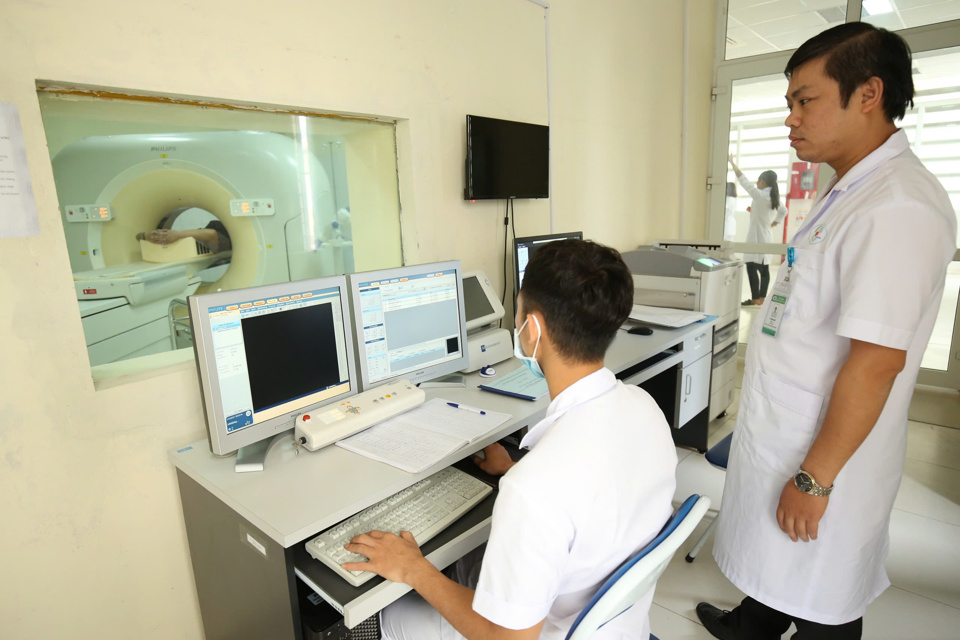
However, many opinions suggest that, for effective implementation, clear regulations on quality standards and evaluation systems, as well as coordination processes between medical facilities and health insurance fund management agencies, need to be established. National Assembly Deputy Nguyen Ngoc Son (from Hai Duong province) argued that when the interlinking of results is legalized in the Health Insurance Law, medical facilities must improve the quality of testing and standardize procedures to meet accreditation requirements from other facilities, promoting consistency and ensuring quality within the healthcare system. This contributes to encouraging data sharing within the healthcare system. When the interlinking of clinical laboratory results becomes a mandatory requirement, medical facilities may have to implement synchronized data management systems, contributing to enhanced digital transformation and improving the accessibility and management of information for citizens and healthcare professionals .
Regarding this issue, National Assembly Deputy Nguyen Hoang Uyen (Long An Province Delegation) suggested that, to limit the practice of not allowing patients to be discharged on Saturdays and Sundays, the drafting committee should research and regulate solutions to avoid waste and protect the rights of people participating in health insurance. This would also contribute to increasing the efficiency and quality of medical examination and treatment, and managing people's health at the primary level. “In the past, the list of drugs covered by health insurance issued by the Ministry of Health has not been suitable for practical application. To ensure fairness between those receiving private medical services and those covered by health insurance, the Ministry of Health should review and evaluate the current regulations on the list of drugs covered by health insurance. If there are any problems, they should be resolved to meet the rights of those with health insurance,” National Assembly Deputy Nguyen Hoang Uyen proposed. Related to this, in 2017, the Ministry of Health issued Decision No. 3148/QD-BYT promulgating the “List of tests applicable for interoperability and recognition of test results”. This can be considered a crucial decision, allowing laboratories to share and recognize each other's results within a specific catalog.
We need the hand of a "conductor".
It is evident that the sharing of clinical examination results between healthcare facilities is a long-standing concern and a goal of the healthcare sector to improve the quality of medical care. Associate Professor Dr. Dao Xuan Co, Director of Bach Mai Hospital, stated that on average, the hospital receives 7,000-10,000 outpatients and approximately 4,000 inpatients daily. The sharing of laboratory test results at Bach Mai Hospital has contributed to minimizing unnecessary repeat tests and shortening patient waiting times from an average of 3 hours to 1 hour. Some tests even yield results within just 15 minutes. Furthermore, for some clinical tests and imaging, patients can simply scan a QR code to view their results.
Preliminary statistics from 21 hospitals currently implementing the storage and transmission of images from diagnostic imaging services without printing films show savings exceeding 267 billion VND. If implemented nationwide in 1,000 hospitals and 22,000 clinics, the savings would amount to trillions of VND.
National Assembly Deputy Tran Thi Hoa Ry (Bac Lieu Province Delegation)
At Bach Mai Hospital, the hematology, biochemistry, and microbiology laboratories have all achieved ISO 15189 certification – a high international standard – and their test results are accepted abroad. Currently, the Biochemistry Department – a reference laboratory within the nationwide network of laboratories – is performing over 30 test procedures with nearly 10,000 tests per day, and plans to add 38 new test categories in the near future.
Dr. Nguyen Van Thuong, Director of Duc Giang General Hospital, also believes that if the sharing of clinical laboratory results is implemented, patients will save on one test, reduce costs, simplify the sample collection process, minimize health risks, and reduce waiting time. In reality, the idea of sharing laboratory and diagnostic imaging results has been proposed by the health sector for a long time; however, many difficulties and obstacles remain unresolved. There is still much to discuss before implementing this.
Specifically, currently, there are no specific regulations or criteria for hospitals to verify, recognize, and use each other's test results. No one can guarantee the same test quality, because test quality is related to four factors: equipment, testing methods, personnel, and operational procedures. Therefore, regarding test quality criteria, there must be an independent verification and recognition agency, and transparency is needed to clearly identify which hospitals are allowed to share data. Furthermore, to achieve data sharing, there must be an information technology system to transfer diagnostic images between hospitals, ensuring transparency and stability.
Therefore, according to Dr. Nguyen Van Thuong, for the effective implementation of the interlinking of clinical laboratory results, a "conductor's" hand is needed, namely the decisive involvement of the Ministry of Health; in particular, an independent accreditation council must be established. This means that all medical facilities nationwide must undergo accreditation; regulations should stipulate a re-accreditation every few years to ensure the quality of testing. In addition, the health sector needs to develop a software system that can share data with each other.
“According to the set objectives, by 2025, the test results of medical examination and treatment facilities nationwide will be interconnected. However, to achieve this interconnection, good standardization and quality management are essential,” stated Associate Professor Dr. Ngo Quoc Dat, Rector of the University of Medicine and Pharmacy, Ho Chi Minh City. Minister of Health Dao Hong Lan also affirmed that to ensure the implementation of this goal, many solutions are needed to create a synchronized infrastructure to meet the requirements.
Currently, the demand for healthcare is increasing rapidly. The challenge is how to ensure affordable costs and standardized diagnostic and treatment processes. Laboratory tests account for 70% of the diagnostic and treatment outcomes for patients. Therefore, improving the quality of laboratory testing and establishing interoperability are essential to achieve the best possible quality and most affordable costs for patients.
Assoc. Prof. Dr. Ngo Quoc Dat , Rector of the University of Medicine and Pharmacy, Ho Chi Minh City
Source: https://kinhtedothi.vn/lien-thong-ket-qua-can-lam-sang-tiet-kiem-thoi-gian-chi-phi.html





























![[Photo] Bustling Election Day in Naval Region 5](https://vphoto.vietnam.vn/thumb/1200x675/vietnam/resource/IMAGE/2026/03/15/1773560007786_1jjo5osf2-4dtcnb-jpg.webp)




































































Comment (0)