Founded in 2014 in Binzhou, Shandong Province, Puhe Reading Space started as a small bookstore relying on book sales. When online competition stifled profits, the bookstore abandoned price wars and shifted to using digital platforms to build a readership community.
“Online channels like our online store and WeChat groups allow us to stay connected with members throughout,” said Wang Hong, founder of Puhe Reading Space. Livestream sessions are organized as an “online living room,” where staff and long-time readers can chat about culture.
According to Xinhua News Agency, a recent nationwide reading survey shows that the percentage of adult readers in China will reach 82.3% by 2025, but nearly 80% of readers are using mobile phones to meet their reading needs. Given this reality, experts suggest that traditional bookstores need to create direct experiences that digital reading cannot replace. “Even in the internet age, people still need to connect with what is present around them,” said Associate Professor Ma Ruijie of Nankai University.
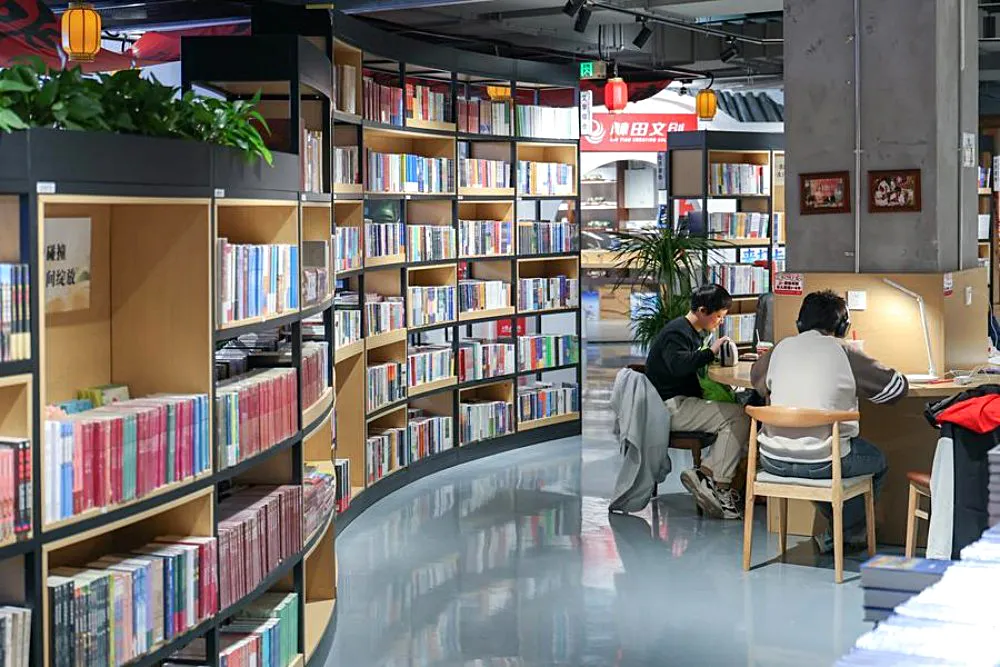
To attract readers back, some bookstores are experimenting with new models. In Zhengzhou, central China, one bookstore launched five small theaters that recreate scenes from classic works in the form of immersive performances.



In Wuhan, Hubei province, a bookstore has developed a circular reading model through an online app, allowing readers to resell books after finishing them and receive book recommendations based on their reading habits. Puhe Reading Space also organizes workshops guiding readers on how to use artificial intelligence (AI) to transform classic passages into visual posters. “AI doesn’t replace reading, but rather becomes a tool to expand the reach of culture,” said Ms. Wang.
Professor Zhao Jianying of the Chinese Academy of Social Sciences emphasized that physical bookstores remain an irreplaceable cultural space where readers seek spiritual empathy and a sense of belonging to a community. He also argued that digital reading and print reading complement each other: "Digital reading solves the accessibility problem, while print books facilitate deeper connection."
This shift is receiving support from the government . A nationwide regulation promoting reading culture, effective from February, encourages traditional bookstores to improve reading conditions and enhance their public service role. A recent government work report also for the first time called for support in developing physical bookstores, while localities are implementing measures to reduce rent and integrate bookstores into public cultural systems.
China currently has around 120,000 traditional bookstores. Against this backdrop, some long-established bookstores are experiencing a revival. In Fuzhou, eastern China, the Xiaofeng Bookstore on Guping Road, which had been closed for eight years, recently reopened. Readers come here not only to read books and enjoy tea, but also to participate in book club and cultural activities.
Zhang Lianwang, who participated in the revival project of Xiaofeng Bookstore, said that while maintaining its own editorial direction, Xiaofeng aims to provide more personalized content and more convenient digital services, opening up greater opportunities for the bookstore.



This return has been welcomed by readers as a long-awaited reunion. Many readers excitedly shared: "There are places that algorithms can never reach."
Source: https://www.sggp.org.vn/tim-lai-ban-doc-nho-cong-cu-so-post850844.html


![[Image] Ho Chi Minh City: Ma Lang area, Chicken-Rice Market about to change its appearance](https://vphoto.vietnam.vn/thumb/1200x675/vietnam/resource/IMAGE/2026/06/25/1782377698627_ndo_br_m1-jpg.webp)





































![[Image] Schools organize meetings and introduce teaching models to students admitted to grade 10.](https://vphoto.vietnam.vn/thumb/1200x675/vietnam/resource/IMAGE/2026/06/25/1782368077271_ndo_br_z7970052192242-1ec8daeb77a6eed1a4e9f58c564ddd3e-jpg.webp)