

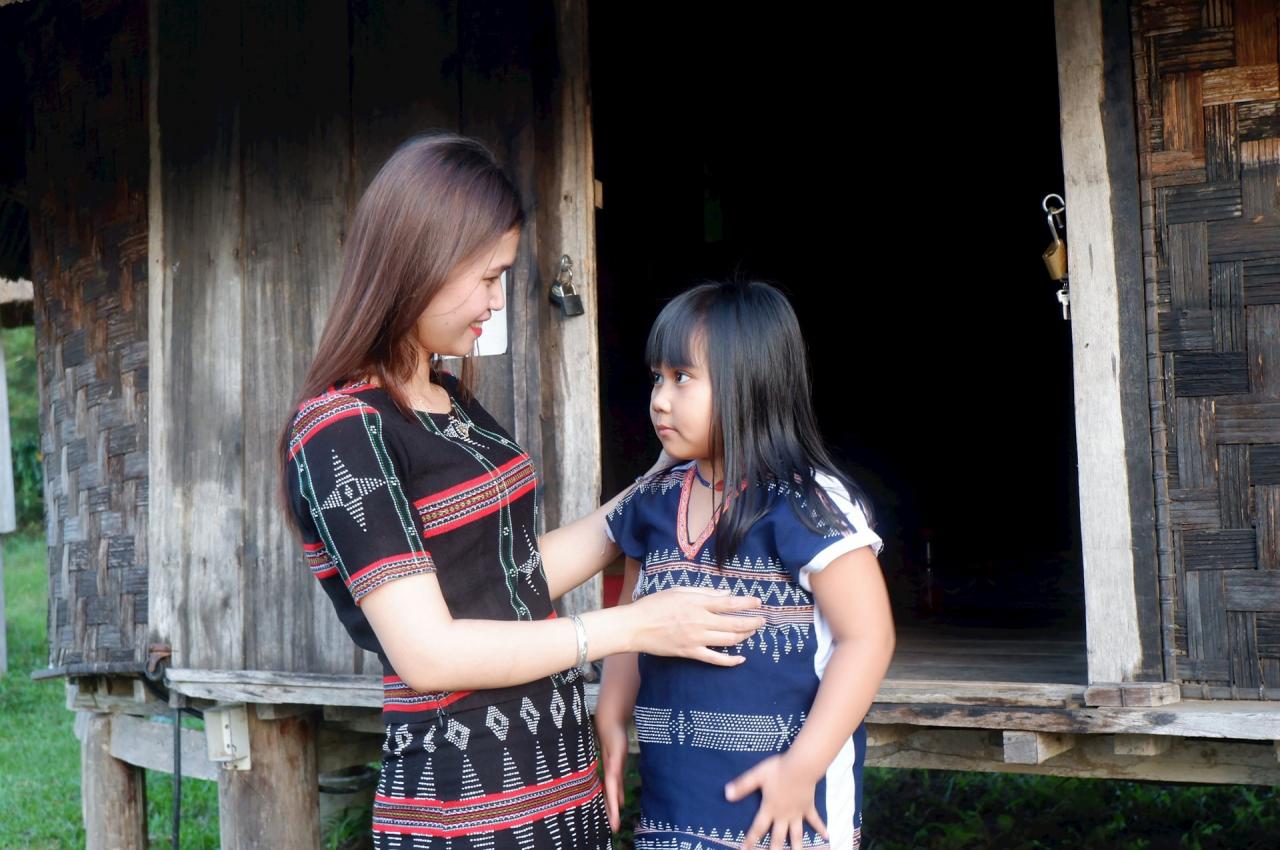
Boundaries of regions
The towering mountain ranges in the vast western borderlands hold rich cultural and folk art values.
The mountainous region of Quang Nam is the origin of the Truong Son and Central Highlands salt route. The harshness and advantages of nature have created a way of survival at the foot of the sacred mountain ranges where they reside, such as A Taouat, Banao, and Anong in Phuoc Son, passing through Nam Giang, or from the mother mountain Ngok Linh – the highest peak of the Truong Son range – which shelters the smaller mountains of Dak Pree, Dak Pring, and Chaval in Nam Giang.
The mountains in Quang Nam are also a place where, since ancient times, ethnic groups speaking the Mon-Khmer language have migrated. They settled in the midland areas of Que Son and Tien Phuoc, and have been present in Phuoc Son and Tra My for a very long time. The mountains also serve as a strategic point of contact, connecting the settlements of ethnic groups in northern Central Highlands with southern Quang Nam, via the large mountain ranges of Sekong, Salavan, and Attapeu.
Ethnic minorities almost completely occupy the northwestern region of Quang Nam and extend as far as southwestern Thua Thien. Although only a relative demarcation, the mountains also serve as a boundary shaping cultural values in a West-East direction.
From the hills and low slopes to the coastal areas, different ethnic groups have formed. The Co Tu people live in three regions: highlands, middlelands, and lowlands. The Co Tu people are separated from other ethnic groups by mountain or waterways, the boundary being the legendary Rang Cua mountain, where they live clustered around Tra Nu, Tra Kot, Tra Giap, and Tra Ka mountains.
In Quang Nam, the long-standing habit of residing in a vast mountainous territory has created a unique blend of indigenous folk art and culture. However, this cannot erase the distinctive features stemming from the relative independence of the residential area and the value of folk culture.
The core essence
In ethnic minority regions, there is always a belief that mountains and rivers represent the union of a married couple, symbolizing yin and yang, fertility, and serving as a model for survival.
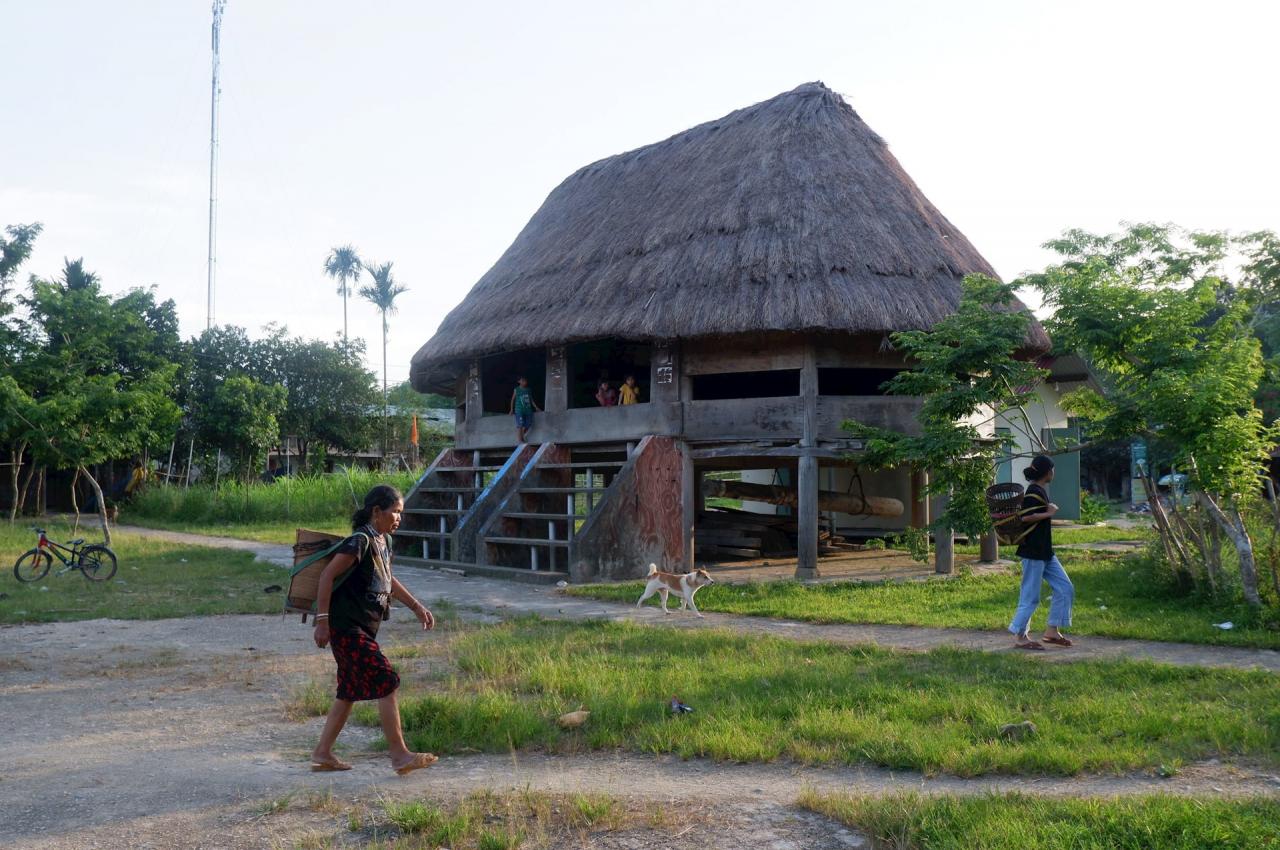
The people name their villages after rivers or the highest mountains in the region, such as A Cu Rang, Zhhung, Ca Di, Axah, Cang Kgir, Cang Aréh, Appê Apang, Apêê, and Aghi. Therefore, the repository of indigenous knowledge and folk art values, expressed in performances, sculptures, and dances, constitutes the core essence of the mountain ethnic groups.
In the folklore and legends of the Co Tu people, and other ethnic groups living nearby, the names of mountains that once sheltered and protected the people from devastating earthquakes and floods are still passed down orally. From this, the people harbor aspirations for expanding their living areas.
The Ca Dong people's mythology in Tra My tells the story: "Once upon a time, there was a great flood that caused landslides, killing all the people except for one woman and one dog who survived by climbing to the top of a high mountain."
The Co people say the mountain peak that isn't flooded is the Sawtooth Range between Tra My and Tra Bong; the Bh'noong people say it's Ngok Rinh Ru mountain, also known as Ngok Linh mountain; and the Ca Dong people say it's Hon Ba mountain in Tra Giap, where they are the "people who live halfway up the mountain".
The mountains and forests of Quang Nam, from the direction of the rising sun near the central plains, on the hills bordering Dai Loc and Hoa Vang districts, also provide a source of bamboo, rattan, and other materials for the local people to make very simple musical instruments, from percussion and wind instruments to plucked instruments.
These are musical instruments that have become part of the country's folk art, such as the Dinh Tut flute of the Ta Rieng people, the Vrook lute of the Ca Dong people, or the Cathu drum of the Co Tu people…
Or, if we speak of the harmony with the natural environment of the mountains and forests, the Coan water drum system of the Xê Đăng people in Trà My, erected in the valleys at the foot of the mountains where streams flow, is the most friendly expression of their connection with nature.
To better understand Quang Nam province, one must visit its high mountain regions. Here, the people, with their innocent, simple, and hospitable hearts, are deeply connected to the vast forests and the Truong Son mountain range since the dawn of time.
*
* *
The folk art of the mountainous inhabitants of Quang Nam always evokes in everyone's mind images of villages nestled in the heart of the valley. In the process of cultural exchange and adaptation, even while absorbing folk art forms from the lowlands, the people of the mountainous regions have still preserved their traditional cultural values.
Because the mountainous landscape and villages have been deeply ingrained in their blood and flesh for generations, reflected in the mountain scenery in folk art such as the Xoang-Cheo dance (Xơ Đăng), the Da dá dance (Cơ Tu), Kađháo (Co)... and especially in the everyday language of the ethnic people: "Tơ moi" means "I live on the other side of the mountain range."
Source: https://baoquangnam.vn/tim-loi-dan-gian-tu-huong-nui-3141945.html


![[Photo] Young people in Da Nang radiate the spirit of spring in traditional ao dai dresses.](/_next/image?url=https%3A%2F%2Fvphoto.vietnam.vn%2Fthumb%2F1200x675%2Fvietnam%2Fresource%2FIMAGE%2F2026%2F02%2F05%2F1770283565383_ndo_br_d7fd33c1bcc2329c6bd3-3439-jpg.webp&w=3840&q=75)



Comment (0)