During his lifetime, faced with the national destiny of reform and modernization to escape poverty and integrate into the global community, the late General Secretary Nguyen Van Linh directed "Things that need to be done immediately." Today, streamlining the administrative apparatus is an urgent matter that cannot be postponed.
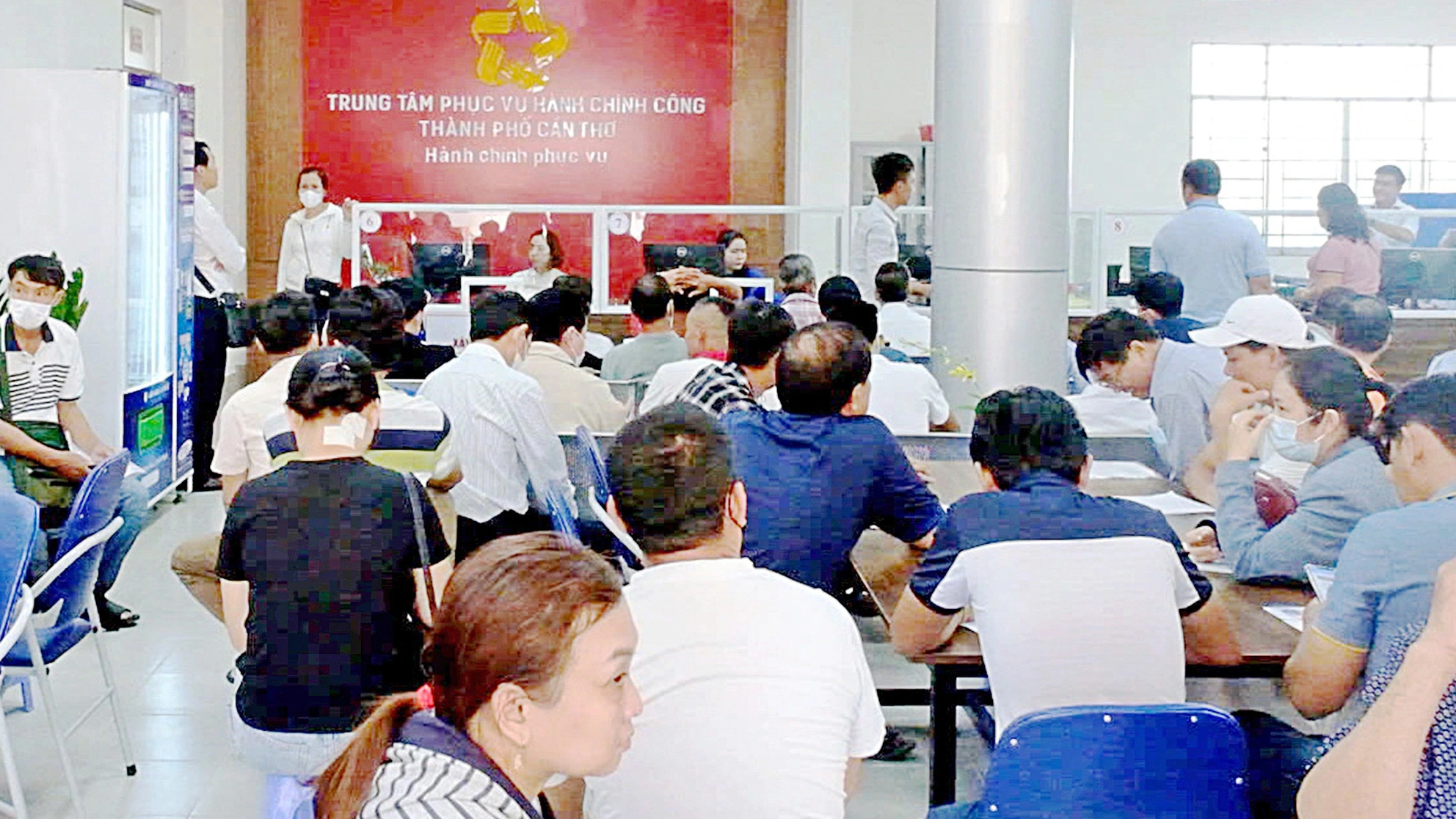
Citizens carrying out administrative procedures at the Can Tho City Public Administrative Service Center - Photo: CHI QUOC
Streamlining the political system in our country is not a new endeavor, but in reality, previous efforts have not met the set objectives. This is partly due to a lack of consistent and thorough implementation, and the absence of truly appropriate methods. After several attempts at streamlining, the leadership and management apparatus has sometimes and in some places expanded again, diminishing the significance and effectiveness of the policy.
This limitation is clearly evident in the system of Party agencies, where Economic and Internal Affairs departments, after being dissolved, are re-established from the central to local levels. Similarly, there is a "merging, splitting," abolishing, and then re-establishing of many departments (at the provincial level).
Despite the significant expenditure by the government to encourage downsizing, the number of civil servants and public employees continues to grow. Many still simply go to work and return home without doing any work. This truly represents a burden on the state budget and the people.


The effectiveness of the policy to streamline the administrative apparatus and civil servant workforce is undeniable. Since the dissolution and merger of the Ministries of Forestry, Irrigation, and Fisheries into the Ministry of Agriculture, these sectors have not only not declined but have also developed strongly, such as: planted forest area, forest cover, production and export value of forestry and aquatic products...
Despite no longer having a national irrigation system, Vietnam has still invested in and built many unprecedented large-scale irrigation projects with effective irrigation and salinity control capabilities in many parts of the country.
The Party Central Committee's decision to thoroughly implement the restructuring, consolidation, and streamlining of the apparatus and civil servant workforce is greatly facilitated by the timing at the beginning of 2025, and especially by the election of new personnel at all levels and sectors. This provides a favorable context and conditions for all levels, sectors, and units to consolidate, consolidate, and reorganize their agency systems, innovate in organization and operation, and elevate the level and quality of Party members and officials.
Besides the aforementioned advantages, the policy of restructuring, consolidating, and streamlining the civil service apparatus and workforce also faces significant difficulties and challenges. One of these difficulties and challenges is the mindset, spirit, attitude, and even inertia of a considerable number of "insiders."
Currently, it is the opportune moment for our country to enter a new era of "Efficiency - Effectiveness - Efficiency," as directed by General Secretary To Lam. Successfully implementing the policy, plan, and objectives of streamlining the leadership and management apparatus at all levels and the civil servant workforce is also a "task that needs to be done immediately."
Reduce the number of deputy positions and strengthen the workforce with highly skilled personnel.



Streamline staffing in associations.
It is necessary to boldly streamline the personnel of associations in accordance with the spirit of the associations. Except for associations such as the Vietnam Farmers' Association, the Vietnam Women's Union, and the Vietnam Veterans' Association, when established, associations must ensure financial autonomy; state budget support is only provided in conjunction with assigned tasks. The current model of associations includes the leadership (president and vice-presidents), specialized committees, and support staff. For example, the Cooperative Union usually sets a staffing target of 10-11 people. Typically, a provincial Cooperative Union has three leadership positions (president and two vice-presidents), two specialists to compile reports, plan, and provide legal support to members. The remaining 5-6 staff members handle support tasks such as human resources, clerical work, accounting, treasury, emulation and reward, and driving. In reality, the workload of associations is not as heavy as that of specialized departments, but they have a complete organizational structure as described above. The department has an accountant, the association has an accountant; the department has a clerical staff, the association also has a clerical staff. So why not merge those associations into one organization? In the newly established organization, besides reducing the number of deputy positions, it would also streamline staff such as clerks, accountants, treasurers, awards and commendations officers, and drivers. Doing so would save the budget by reducing the need to pay salaries for at least 6 or 7 people per association. Such an organization would hopefully be much more streamlined and efficient.Tuoitre.vn
Source: https://tuoitre.vn/tinh-gon-bo-may-viec-can-lam-ngay-20241203222552297.htm




![[Image] Overview of the construction site for the underground station of metro line 5 at the Hanoi Ring Road 1 intersection.](https://vphoto.vietnam.vn/thumb/1200x675/vietnam/resource/IMAGE/2026/07/03/1783065595682_ndo_br_z7974930852369-100ca093c306e72675f1d3700966a86b-jpg.webp)