Children admire and choose from a selection of cute clay figurines. Photo: DANH THÀNH
At the Tao Dan Chieu Anh Cac Festival in Ha Tien ward, the image of a diligent artisan working with colorful dough attracts a large audience. With skillful hands and a few simple tools, lifeless lumps of dough are gradually transformed into fairy tale characters, whimsical animals, or familiar figures from everyday life. Watching intently as the artisans perform their tasks, Nguyen Gia Han, a 4th-grade student from Dong Ho Primary School in Ha Tien ward, couldn't hide her excitement. In her hands was a freshly sculpted rabbit in vibrant colors. “I like clay figurines because they look so beautiful. What surprises me is that you can sculpt so many different shapes from just a lump of dough,” Han said.
Many parents also took the opportunity to bring their children to experience it. They not only wanted their children to have another toy but also hoped that the children would be exposed to the beauty of traditional culture. While watching the children engrossed in the colorful clay figurines, Ms. Le Thi Lan (62 years old) - a tourist from Can Tho City - smiled as childhood memories flooded back. According to Ms. Lan, in the past, clay figurines were a familiar toy at rural markets and fairs. Children at that time eagerly stood around the figurine makers, waiting to receive their favorite chickens, fish, flowers, or characters. Over time, the appearance of technological toys caused clay figurines to gradually disappear. Many people once worried that the craft of making clay figurines would fade away. "Back then, there weren't as many toys as there are now. Every time there was a market day or fair with people selling clay figurines, children were so happy. Just getting a small chicken or bird from their parents was enough to cherish it all day. Clay figurines weren't just toys; they were also memories for many generations," Mrs. Lan recalled.



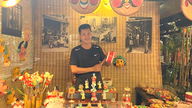
Sitting amidst a circle of children, the tò he (traditional Vietnamese toy) artisan Tiên Triệu hardly has a moment's rest. Through her skillful movements, handfuls of colorful dough quickly transform into vivid shapes. To create the pliable, soft, and sticky dough, the tò he maker must go through many meticulous steps. Glutinous rice is mixed with regular rice in the right proportion, soaked in water, and then ground or pounded into a fine powder. After kneading thoroughly until the dough is pliable and no longer sticky, it is boiled and divided into portions to be colored with different food colorings.
Creating a finished product requires patience, meticulousness, and years of practice. When sculpting tò he (traditional Vietnamese figurines made from rice dough), harmonious color coordination, balanced shaping, and most importantly, infusing each piece with "soul." Some simple tò he designs only take a few minutes to complete, while more elaborate pieces require more time and intense concentration. "Every time the children carefully observe and ask how I can sculpt them like that, I feel very happy. It shows they care about traditional culture. As long as there are people who like it, this craft still has a chance to survive. However, to preserve the craft, I also have to innovate, maintaining traditional techniques but being flexible in shaping," shared tò he artisan Tien Trieu.
Today, tò he (traditional Vietnamese figurines made from rice flour) is not only found in rural markets but also at festivals and tourist areas. This change has given many people, especially children, the opportunity to get closer to a form of folk art that was once thought to be forgotten. According to the head of the Culture and Social Affairs Department of Ha Tien ward, for many years, the locality has consistently invited tò he artisans to participate in festivals and cultural and tourism events. This is one of the activities aimed at enriching the festival space, while also creating opportunities for people, tourists, especially the younger generation, to access and experience this traditional folk art form, contributing to preserving the national cultural identity.
As evening falls over the festival space, the colorful clay figurines still lie neatly arranged on the artisan's tray. Amidst the hustle and bustle of modern life, they are like small fragments of childhood memories, quietly waiting to be cherished in the hands of children. Because there are folk values that, seemingly simple, never grow old with time.

Source: https://baoangiang.com.vn/to-he-van-doi-tre-tho-a489929.html
![[Photo] The 13th National Congress of the Youth Union conducts personnel work.](https://vphoto.vietnam.vn/thumb/1200x675/vietnam/resource/IMAGE/2026/06/24/1782299943080_ndo_br_1-6868-jpg.webp)
![[Photo] Opening Ceremony of the 13th National Congress of the Ho Chi Minh Communist Youth Union](https://vphoto.vietnam.vn/thumb/1200x675/vietnam/resource/IMAGE/2026/06/24/1782286753905_ndo_br_1-8510-jpg.webp)
![[Photo] General Secretary and President To Lam attends the Central Public Security Party Committee Conference](https://vphoto.vietnam.vn/thumb/1200x675/vietnam/resource/IMAGE/2026/06/24/1782302063612_a1-bnd-9302-9166-jpg.webp)