

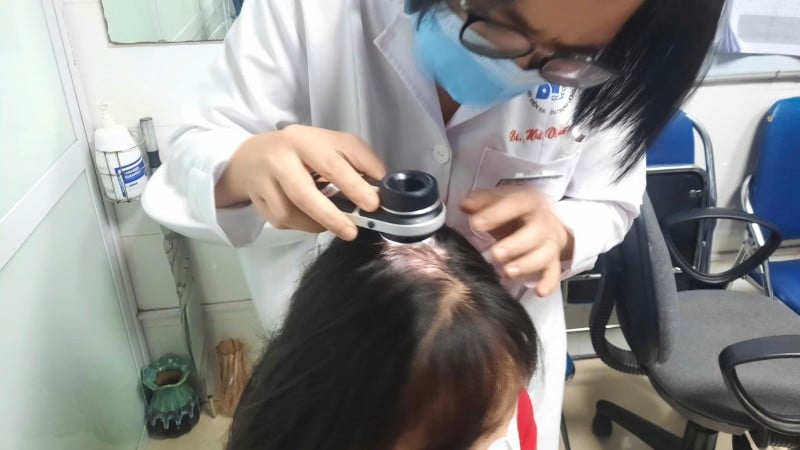
According to Dr. Nguyen Thi Ha Vinh, Deputy Head of the Day Inpatient Treatment Department and Head of the Clinic for Alopecia areata and Hair Pathologies (National Dermatology Hospital), there are currently many studies on gray hair and related factors.
Premature graying of hair is not related to cancer.
Dr. Ha Vinh affirms that gray hair is mainly related to natural aging, meaning that pigment cells weaken with age. Some people have a genetic predisposition to gray hair early; others experience prolonged stress: oxidative stress increases free radicals, causing gray hair. There are also cases of micronutrient deficiencies: lack of vitamin B12, iron, zinc, vitamin D… And some other medical conditions or habits such as thyroid disorders, obesity, alcoholism, smoking…
"All of these factors contribute to the premature aging of hair," said Dr. Ha Vinh.
However, there is insufficient strong scientific evidence to definitively conclude that gray hair is an increased risk factor for cancer. Some studies are still at the hypothetical or prospective research stage, lacking sufficient basis to establish a direct link.
"The association of gray hair or hair loss with cancer largely stems from images of cancer patients experiencing hair loss during chemotherapy, not the other way around," Dr. Vinh said.
However, in reality, changes in hair color in cancer patients are mainly due to the effects of medication or debilitation, which is completely different from the natural graying mechanism of hair.
"Gray hair is not a sign of cancer, nor is it a predictive factor for the disease. If gray hair appears along with unusual symptoms such as weight loss, prolonged fatigue, unusually excessive hair loss, etc., people should see a doctor for a full assessment instead of relying solely on hair color," said Dr. Ha Vinh.
The trend of premature graying of hair is on the rise.
According to Dr. Ha Vinh, gray hair before the age of 25 is considered early in Caucasians; before the age of 30 in Asians; and before the age of 35 in Black people.
For Vietnamese people, gray hair typically begins to appear around the age of 40, which is a normal physiological aging process. Gray hair, like wrinkles on the skin, is a sign of aging.
However, in reality, due to modern lifestyles, stress, and unbalanced diets, the number of people experiencing premature graying of hair is on the rise.
At the Central Dermatology Hospital, many families have also directly examined their children who were worried about gray hair appearing at the age of 6-7. In these cases, doctors will carefully investigate genetic factors; screen for micronutrient deficiencies (zinc, vitamin B12); and rule out underlying medical conditions.
"If all other pathological causes have been ruled out, then it's mostly due to genes, and there is currently no specific treatment," Dr. Vinh shared.
Sharing more about the notion that gray hair is caused by "bad blood," Dr. Vinh said that in Western medicine, the concept of "bad blood" does not exist. Instead, doctors will assess cases of premature graying as a result of micronutrient deficiencies or excesses; oxidative stress; and inflammatory reactions in the body.
From a traditional Chinese medicine perspective, when blood and energy flow are impaired, nutrients and oxygen are not adequately delivered to the scalp, thus affecting the hair. The two medical systems have different approaches, but both aim to explain the decline in nourishment of hair follicles.
Speaking of Polygonum multiflorum, a familiar herb in traditional medicine, it is beneficial for hair if used correctly. However, Dr. Vinh shared that Western medicine does not have a specific treatment for gray hair. Currently, research on safe dosages and long-term effectiveness of Polygonum multiflorum is still limited.
"Buying and using Polygonum multiflorum on your own can be ineffective, or even have adverse effects if it's not suitable for your body type or if it's prepared incorrectly. Therefore, if you want to use it, you should consult a traditional medicine doctor and get a prescription; you shouldn't use it based on word-of-mouth," said Dr. Vinh.
Specifically, doctors advise that while plucking ingrown hairs may provide temporary psychological relief, it does not improve the condition long-term. Frequent and excessive hair pulling can damage hair follicles, causing regrowth to be worse and coarser. Pulling a few individual hairs is not too harmful, but if excessive pulling becomes a compulsive habit (trichotillomania), medical intervention is necessary.
Source: https://nhandan.vn/toc-bac-som-lieu-co-lien-quan-den-ung-thu-post930252.html

































































































Comment (0)