Sing in place of the singer.
During a trip to Truong Sa (May 2019) as part of the press team, I was assigned to the media team of Task Force No. 13, which included Lai Minh, Huong, Son, Trieu, and myself. Every afternoon, after the team returned from the islands, we produced an internal news bulletin, summarizing the day's activities, touching stories, beautiful images, and exemplary officers and soldiers we had just witnessed on the islands. At exactly 9 PM, the internal news bulletin was broadcast to the entire ship, helping officers, soldiers, and members of the team to review the day's work. After the news bulletin, there would be a cultural performance.
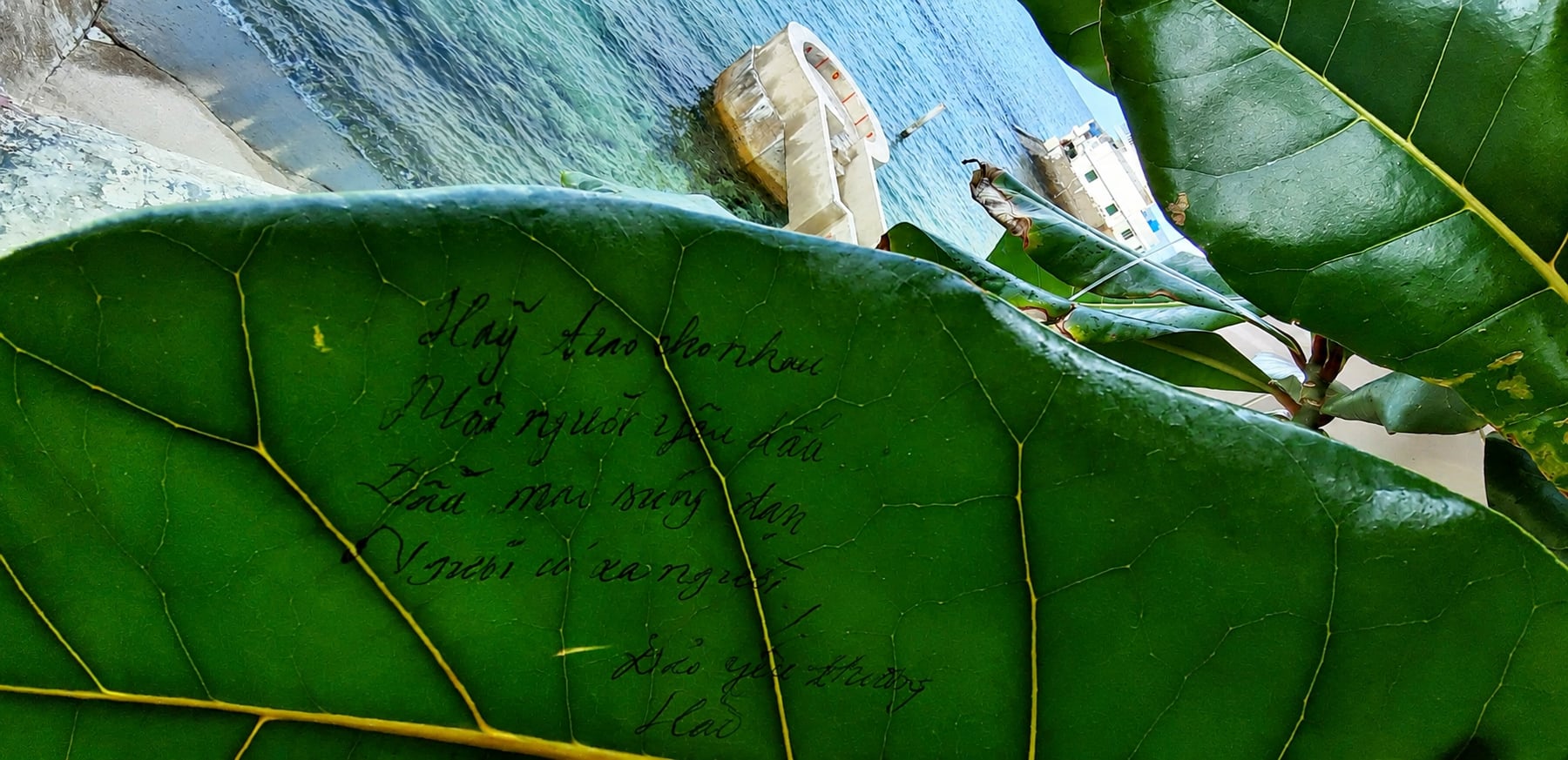
Words of love inscribed on square-leafed Terminalia leaves in Len Dao. Photo: Viet Hai.
It's worth mentioning that accompanying the delegation to Truong Sa always includes a performing arts troupe from military units or local authorities to bring songs and music to entertain the soldiers and people on the islands. On that occasion, the Lao Cai Art Troupe accompanied us, led by Mr. Luong Cong Nghe, the troupe's head.
Returning to the topic of the media team. The first night of broadcasting the news was May 19th – President Ho Chi Minh's birthday. During the day, the ship had just docked at Da Lon A Island. The program design included a segment reflecting the celebrations of President Ho Chi Minh's birthday on the island, handled by reporters and editors, and a cultural segment featuring songs about President Ho Chi Minh performed by singers from the Lao Cai Art Troupe. In the afternoon, before dinner, the head of the Lao Cai Art Troupe, Luong Cong Nghe, sent a female singer to work with us on the ship to produce the news broadcast.
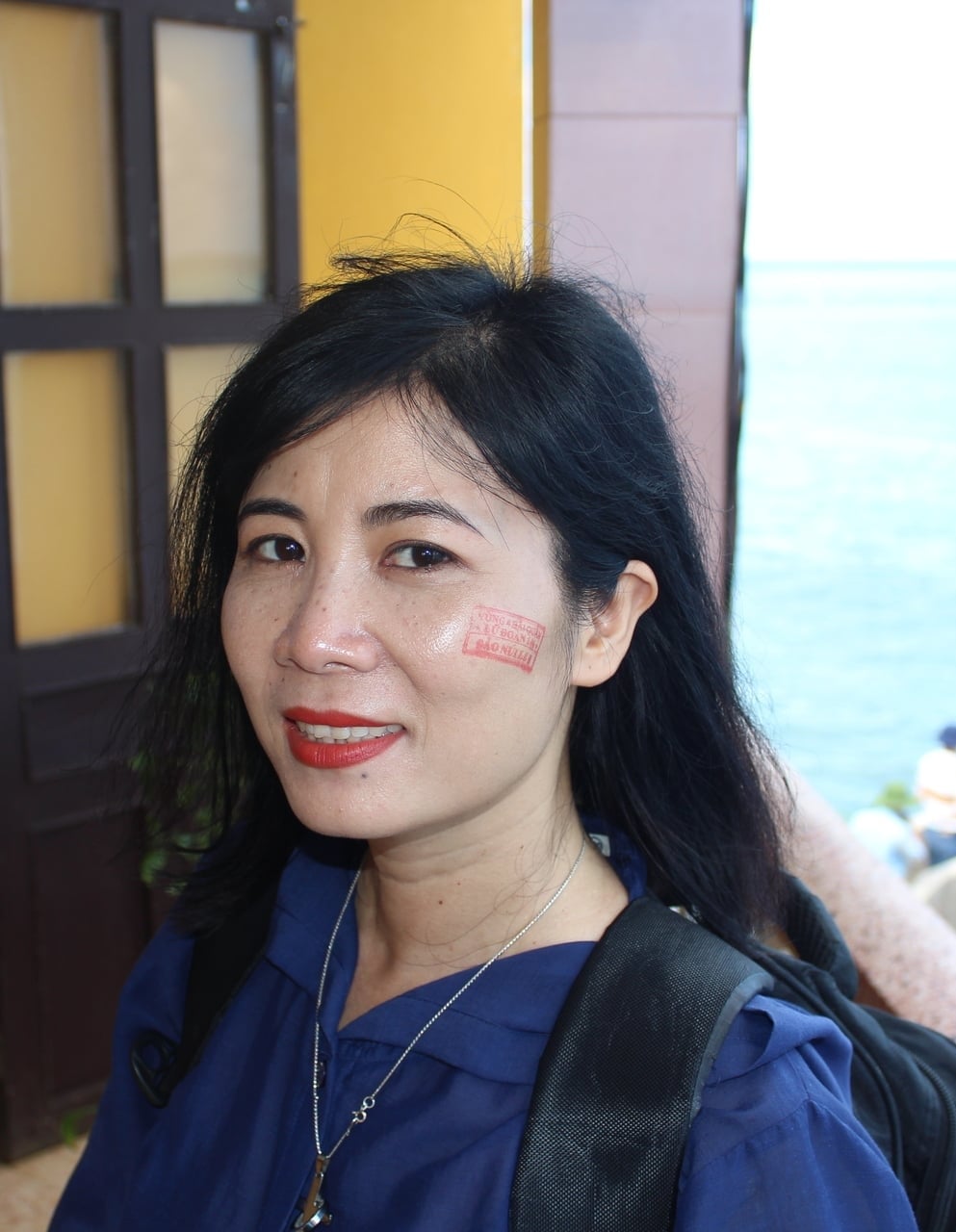
I stamped my name on the Trường Sa (Spratly Islands) map. Photo: Nguyễn Hưởng.
At 9 PM on May 19th, despite my voice still hoarse from seasickness, the news broadcast that Son and I were doing went smoothly. While broadcasting, Triệu ran off to look for the singers, then returned to report: “They’re all seasick, lying there listlessly. I felt so sorry for them that I didn’t dare call them.” This situation was truly unimaginable and incredibly difficult, especially in a military environment. When boarding the ship, each member is a soldier – a Trường Sa (Spratly Islands) soldier – who must complete their mission and report any incidents immediately. However, there was no regular phone signal on the ship, only satellite signals allocated to essential locations. We couldn’t call the team leader, Lương Công Nghệ, and if we ran back to the room to find him, the program would be ruined due to time constraints.
I don't know what gave me the strength and confidence to suggest, "Let me sing." We quickly conferred, tested my singing voice, and then Son introduced: "Next, we invite the delegation to enjoy a musical program. Comrades and friends, today is May 19th, and we are on a mission to Truong Sa, coinciding with President Ho Chi Minh's birthday. The first song we present to you is a composition by musician Thuan Yen titled 'The Moon over Ba Dinh'."
Then I sang.
In front of me was the microphone of a walkie-talkie, firmly attached to the deck to prevent movement, not a handheld performance microphone. In the cockpit, my companions held their breath. Outside, the full moon hung vast and boundless over the sea. It was the tenth night of the lunar month. Each golden ray shimmered on the waves, surging with each rising wave. I placed my hand on my chest, reminiscing about the faithful moon over the sacred Ba Dinh Square, picturing the boat bathed in moonlight on the Day River during the war years, remembering a moonlit night in Ba Dinh Square, where a mother from the South, facing the Mausoleum, sang this song while sobbing. The singing made me forget who I was. A song I sometimes forgot the lyrics to every day, yet that night it flowed on, carried away by emotion. I didn't know if anyone in the other compartments was still awake or if anyone had fallen into a deep sleep after a tiring journey, or if anyone could imagine me, with the cockpit microphone, transforming into a singer. The crew fell silent, as did my friends around me, first out of fear, then swept away by emotion. Sadly, because we were so caught up in the emotions that day, no one thought to take a memorable photo.
At 5 a.m. the next morning, just as the "All-ship wake-up call" sounded, Luong Cong Nghe knocked on my door and asked, "Last night, the members of the Lao Cai Art Troupe were terribly seasick, so who was the singer? I recognized the voice; it wasn't from our troupe. I want to know who sang last night?" Instead of answering his question directly, I said, "Thanks to the seasickness of the Art Troupe's singers, I was given an honorable job, beyond my wildest dreams, but I succeeded – I got to sing about President Ho Chi Minh in Truong Sa."
Green for peace of mind
In the following days, as the seasickness subsided and daily life returned to normal, the women began to venture down to the kitchen to help with the ship's logistics. There, the first thing that caught my eye was the male cooks standing with their legs apart, balancing themselves while… cooking.

He's a cook on board the KN491 ship. Photo: Luong Thao.
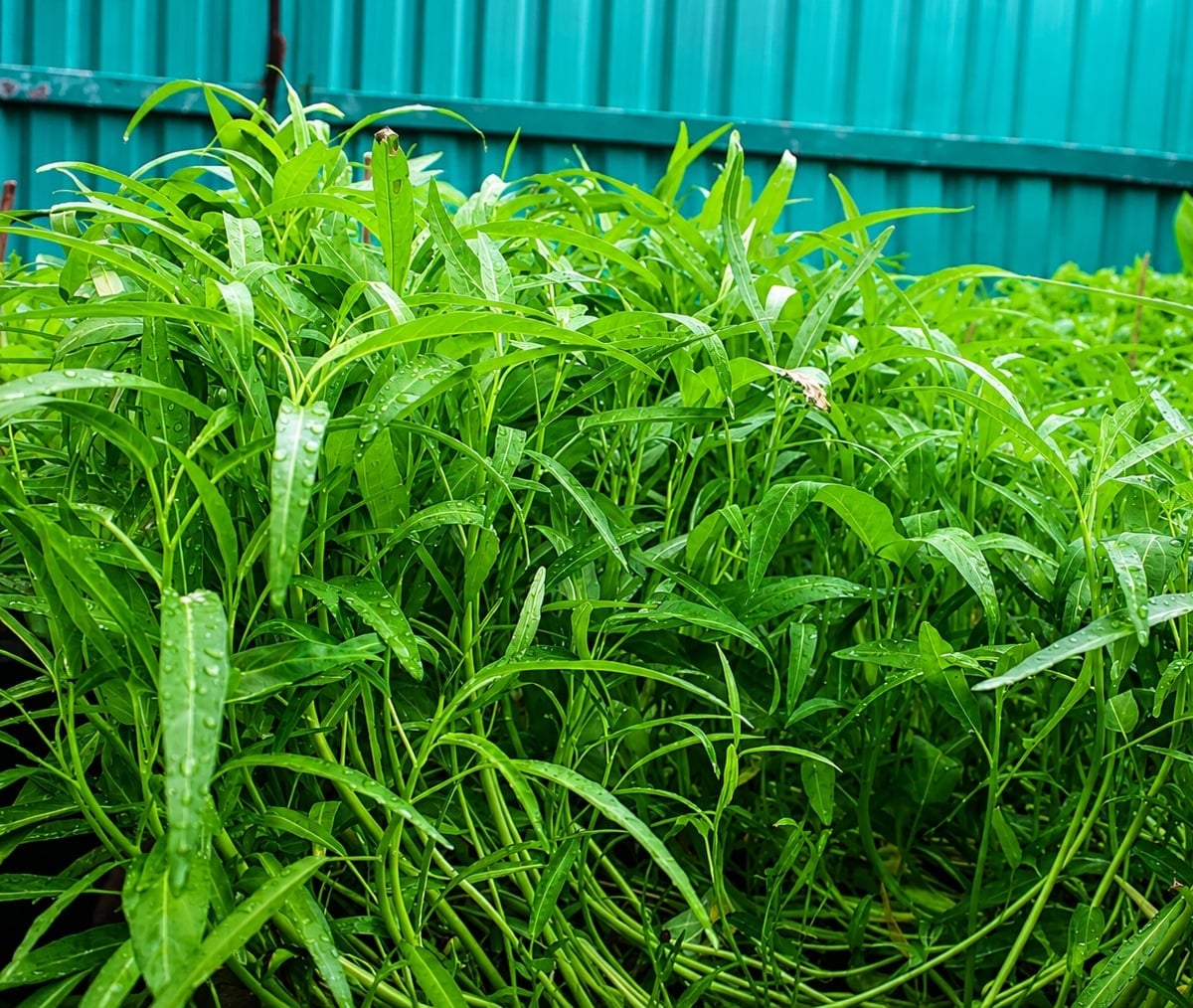
Old vegetable patch in Tien Nu. Photo: Viet Hai.
They wake up at 3 a.m. to prepare breakfast. While we eat breakfast, they prepare lunch. While we eat lunch, they prepare dinner. Then they clean up, prepare porridge or meals for those who get seasick and can't eat regular rice, prepare food supplies for the next morning, and finally lie down at 11 or 12 midnight to start a new cycle the next day.
I went without food for the first day and night (before the ship reached the first island, Da Lon A). The first thing I ate on the ship was a bowl of porridge that the cook brought to my room at 11 pm. He said, "Try to eat, or you won't be able to survive." The bowl of porridge and the way the cooks stood preparing the meal made me question myself, and from then on, whenever I had free time, I would go into the kitchen.
After washing the dishes, I picked the vegetables. That afternoon, when I lingered around asking to pick vegetables, "taught" me how to be an adult. My foster brother opened the refrigerator door and said, "Today we're starting to eat vegetables with firm stems," then placed a basket of vegetables with stems still white but leaves turning yellow in front of me. Lai Minh and I looked at him. He casually said, "They're yellow, but they're not spoiled. The cooling system on this ship is great, that's why they can preserve them for so many days. Next time we'll be eating chayote, carrots, zucchini, and potatoes, okay? There won't be any vegetables to eat, whether they're green or yellow, they're all delicious."
The time we visited the island was the most favorable season of the year. Although sometimes unpredictable, the sea was generally calm, the wind gentle, and storms hadn't yet raged, allowing the vegetable plots on the island to thrive and stay green for longer. At each island location, the group enthusiastically took photos and videos, marveling at the scenery without noticing that some of the vegetable patches were quite old. When I asked, "Is it because you want to preserve as many green vegetable plots as possible for mainland delegations to see and touch, so that people on the mainland can feel reassured?", I only received smiles in response.
Yes, indeed. Why force the soldiers in Truong Sa to talk about hardships, deprivations, and difficulties when they feel it's normal, ready to overcome everything, even danger, for the peace of the homeland and the peace of mind of the mainland? Just recently, Colonel Phan Van Quang showed me how a cargo ship preserves fresh vegetables on its voyage to Truong Sa. Seeing the dried cabbages hanging from the ship's rack, I remembered the basket of yellowed vegetables the cook used, and the image of the old, withered vegetables on the islands and reefs evoked an inexplicable feeling in me, causing tears to stream down my face.
Of course, it wasn't just now, but ever since I left the KN491 ship and returned to the mainland, I've changed my kitchen habits by buying only the right amount of vegetables, avoiding excess. If I don't use it all one day, I can save it for the next. Yellowed vegetables are also edible, unless they're spoiled or mushy.
Now, the sea remains the same, with storms intensifying and becoming unpredictable. Except for ships on long voyages stationed at the islands, the support from the mainland, the creativity and resilience of the officers and soldiers in all circumstances, and their ability to master the sea, islands, and weather conditions have ensured that vegetables are available year-round, even during stormy seasons. That's the reality; there's no need to "beautify" the situation to encourage the mainland as before. There's only one thing that's never enough, something that's never enough: the warmth of the mainland.

Cabbage hanging in the wind during a mission to the Spratly Islands. Photo: Phan Quang.
During the sea season, the Navy and Coast Guard often use large, modern vessels to transport delegations visiting and working in the Spratly Islands, DK1, etc.
The forces on long-term duty at sea are usually on small ships with limited logistical support. To ensure a long supply of fresh vegetables, the soldiers preserve them by building racks for squash, onions, potatoes, etc. (the vegetables that last the longest), and strung cabbage on wire and hanging it on poles in the ship's compartments in a well-ventilated area for later use. By the end of a mission, the cabbage may have dried out like medicine, so they have to stew it until tender to retain its vegetable value.
You may also likeA family's support system in the Spratly Islands.In the vast ocean, Truong Sa is not only a bulwark protecting the sovereignty of the Fatherland, but also a place where families are nurtured. Family bonds become the foundation that helps the soldiers and civilians on these remote islands steadfastly cling to the sea and defend the islands.The lottery winner of 85 billion VND gets lucky for the fourth time.Mr. Bui Van Manh received 96 million VND from 16 lottery tickets that won the consolation prize in the draw on June 30th.Korean heartthrob is happy to be in Vietnam.Ji Chang Wook expressed his happiness at meeting his fans. The actor said that Vietnam always brings him positive energy.



Country dialect
It is because of this "never enough" feeling that, historically, during trips to the islands, working groups have always proactively sought out soldiers, drawn to each other, and listened to one another. In that listening, they sometimes receive familiar signals, find compatriots, or brothers among the crowd. That's how I found Thanh.
Thanh is two years older than me. He went to village school, did his military service, then transferred to a professional career, worked for many years in the 3rd Naval Region, then served on islands, and at the time I went to Truong Sa, he was working on Son Ca Island.
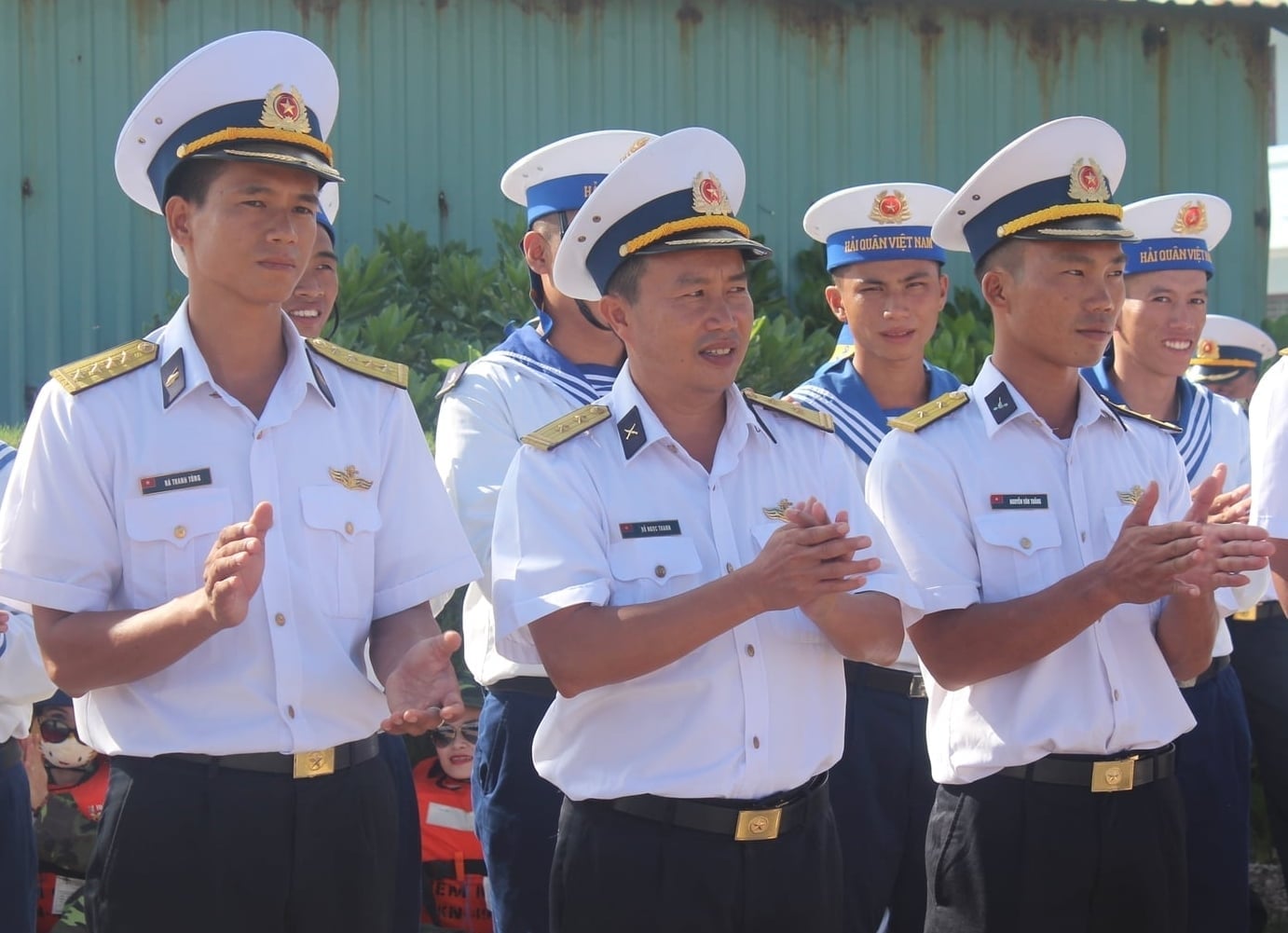
Do Van Thanh (center) - an officer working on Son Ca Island in 2019. Photo: Viet Hai.
My hometown Thanh Hoa accent, miraculously, is unmistakable among the crowd. After a moment of recognition, I rushed to him, and surprisingly, we recognized each other as fellow villagers. Unfortunately, time was limited, and the group's schedule was packed. Thanh was part of the honor guard welcoming the delegation, so we only had time to exchange a few words before everyone went about their business and hastily parted ways. As the ship bid farewell to the island, my hometown boy stood there, staring at his younger brother, forgetting to even shake hands with everyone else.
That evening, back on the ship, I opened my notebook and wrote the poem "The Sound of My Homeland" in one go. I wasn't sure if the poem was good or not, but I knew one thing for sure: it was a poem from the depths of my heart, written in a moment when my heart could no longer contain its emotions, and "The Sound of My Homeland" just burst forth like that.
The poem earned me the title of "Muse" of Task Force No. 13.
Perhaps it's because of "Homeland Voice," because of the song, because of the changes after returning from Truong Sa, that even today, I still feel I owe Truong Sa a debt of maturity. Truong Sa gave me more than I brought with me when I boarded the ship that year. That place at the forefront of the waves gave me the courage to sing in place of a professional singer, to understand that within each person there are abilities that only great circumstances can awaken. It taught me to see the green patches of vegetables growing old and to know that the soldiers were trying to reassure the mainland, helping me recognize the value of every simple thing life offers. And it was also there that inspired me to write poetry. People often think of Truong Sa as the furthest place. But for me, it is the place that brings people closest to the core values of life: gratitude, sharing, love for the homeland, and love for humanity. Whenever I think of the islands, the sovereignty markers, the familiar faces, the stories of life, and even the vegetable patches, the sounds of my homeland, and the moonlight on President Ho Chi Minh's birthday, it stays with me as if I never sleep. As long as those memories remain, I will still be indebted to Truong Sa – a debt of a person who has been made bigger, more mature, and more decent by the sea.

The author bids farewell to the DK1/15 Huyen Tran offshore platform. Photo: Nguyen Huong.
Country dialect
Hesitantly listening in Truong Sa
Let's call each other by a sincere name: "My hometown!"
My eyes met theirs.
The sound of my homeland shattered, scattering a sky full of childhood memories…
"This is my hometown. How long have you been on this island?"
Even wooden boats are becoming scarce.
How do people still recognize their hometown?
Because I still keep my promise."
With a mix of emotions, we held hands.
It seems like tears are already welling up in my eyes.
"Hush now, please be quiet."
The salty sounds of my homeland whisper softly beside me.
This sound is from the rice fields and potato paddies.
Embankment, thatched roof, morning mist, afternoon sun…
Carefully collecting the mud and soil of my poor homeland.
Vietnam encourages US businesses to expand investment in high technology.On the morning of June 26th, at the Government Headquarters, Deputy Prime Minister Ho Quoc Dung received Mr. Jeff Place, Supply Chain Director of Coherent Group (USA). During the meeting, the Deputy Prime Minister affirmed that Vietnam encourages US businesses to expand investment, especially in high-tech, innovation, and semiconductor industries.Encourage U.S. businesses to expand investment in high-tech sectors.Deputy Prime Minister Ho Quoc Dung said that Vietnam welcomes US businesses to continue expanding their operations in Vietnam, especially in high-tech industries and sectors with high added value.Vietnam and the United States strengthen cooperation in addressing the consequences of war.VTV.vn - On June 22, General Secretary and President To Lam received Acting Secretary of the US Navy Hung Cao.Parents make a kite of dreams.
Then they went far from the harbor and shore.
The vast ocean is ablaze with the sacred red flag.
Storms and rough seas can break rocks.
The gunman is surely defending sovereignty over the high seas.
This is my mother's voice!
Even if we travel to the ends of the earth, our love will never fade!
The fishing ball flashed across the sky.
The ship sails, cutting through the waves, bidding farewell to those parting ways.
My hometown on the island is home.
The vast ocean is also our homeland.
The sound of one's homeland binds one across long distances.
The resilient defensive wall of the distant island is being built./.



Source: https://nongnghiepmoitruong.vn/toi-con-no-voi-truong-sa-d816258.html


![[Photo] Strengthening character and expertise: Intense training for artillery soldiers.](https://vphoto.vietnam.vn/thumb/1200x675/vietnam/resource/IMAGE/2026/06/30/1782815602541_lu-368-1875-4571-jpg.webp)