|
Children with severe hand, foot, and mouth disease receive intensive treatment in Ho Chi Minh City. (Illustrative photo: Hoai Bao) |
According to information from the City Children's Hospital, patient LTK (10 years old, residing in Tan My ward, Ho Chi Minh City) was transferred to the hospital in a critical condition with stage 3 complications.
According to the medical history, the child had been ill for 5 days. On the first day, the child had only a mild fever (2-3 episodes) accompanied by a rash on the hands and feet. A private doctor diagnosed the child with hand, foot, and mouth disease (stage 1). On the second day, the child's fever rose to 40°C, and the rash became more pronounced on the palms, soles, knees, and elbows. By the fifth day, despite antibiotic and fever-reducing treatment at the local hospital, the child's condition did not improve and dangerous neurological symptoms began to appear: leg fatigue, unsteady gait, excessive sleepiness, frequent startling during sleep accompanied by jerking of the hands and feet, and unusual movements.
Upon emergency transfer to the City Children's Hospital, baby K. was lethargic, drowsy, had trembling hands, a high fever of 39°C, and a rapid pulse of 138 beats/minute, immediately diagnosed as stage 3. Tests showed slightly elevated liver enzymes, metabolic acidosis, and elevated blood lactate. Doctors immediately administered oxygen, gave the sedative Phenobarbital, used the immunomodulator Gammaglobulin (IVIG), and actively worked to reduce fever and correct electrolyte imbalances.


The child's condition was extremely complex, with persistently high fevers of 39-40°C that wouldn't subside, delirium, and a rapid pulse of 150 beats per minute. An MRI scan of the brain revealed severe damage in the brainstem. Thanks to timely consultation, the child received a second dose of IVIG, continued seizure control, and blood glucose and acid-base balance were maintained.
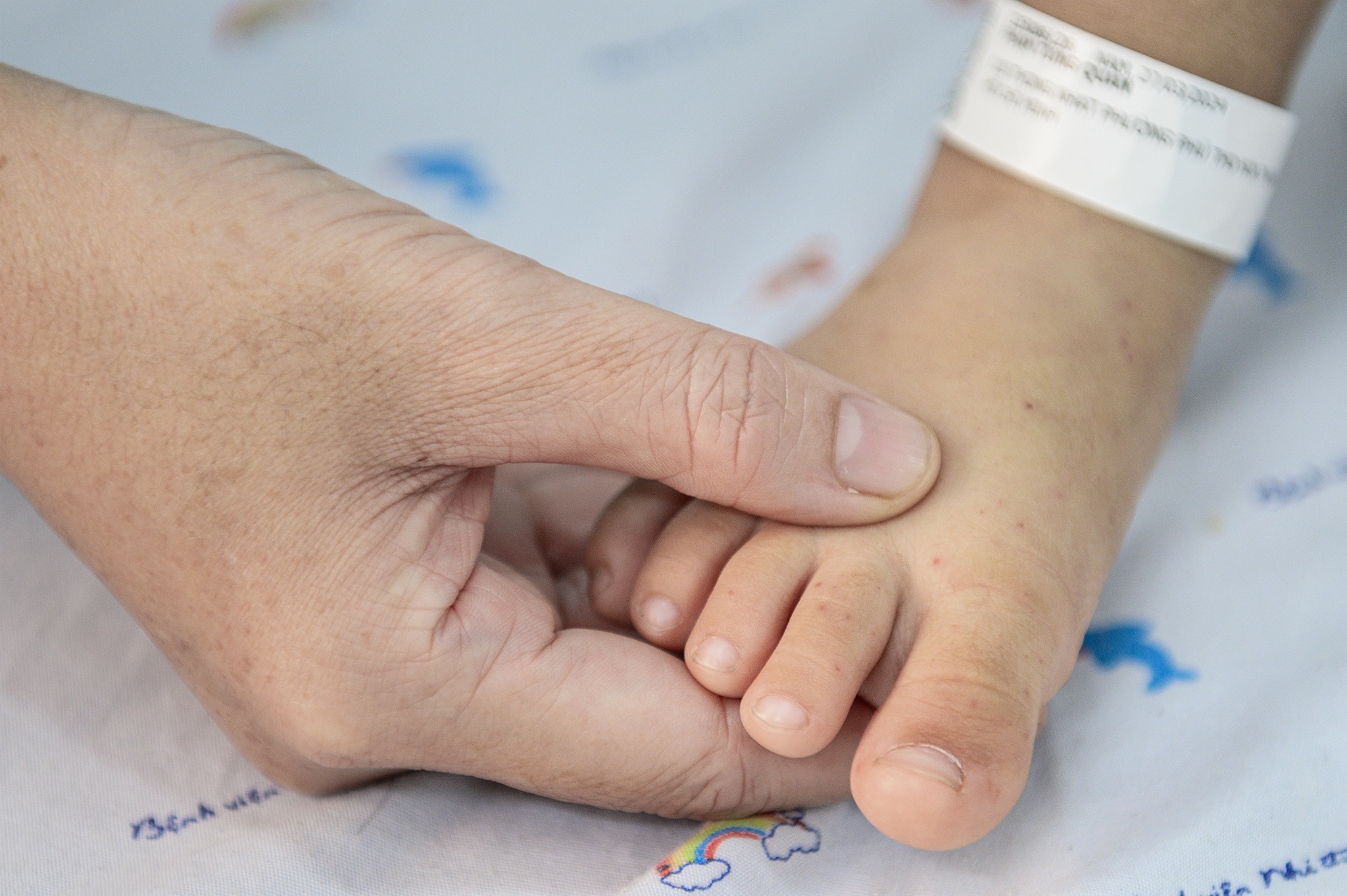 |
Children with hand, foot, and mouth disease typically exhibit characteristic symptoms including fever, mouth ulcers, sore throat, and excessive drooling... Photo: Hoai Bao. |
After a week of fighting for survival, the child's fever subsided, the tremors stopped, the child became alert, responsive, and able to walk independently. Subsequent PCR rectal swab tests confirmed the child was positive for Enterovirus.
Through this case, Dr. Nguyen Minh Tien, Deputy Director of the City Children's Hospital, particularly cautioned parents against neglecting disease prevention in older children. If a child shows signs of fever, red rash with blisters on the hands, feet, buttocks, knees, mouth ulcers, etc., along with any of the following symptoms, they should be taken to the hospital immediately: startled reactions, frequent vomiting, high fever that is difficult to bring down, abnormal breathing, trembling hands and feet, unsteady gait, inability to sit steadily, difficulty swallowing, mottled skin (purple streaks), paleness, lethargy, or seizures...



To proactively prevent hand, foot, and mouth disease, experts emphasize the "3 clean" principles:
- Eat clean, live clean, play clean, and have clean hands. Instruct children to wash their hands with soap under running water before and after meals, after playing with toys, after using the toilet, or whenever their hands are dirty.
- Caregivers should wash their hands thoroughly with soap after changing children's clothes and diapers; after contact with feces, urine, saliva, and before and after preparing food, especially before and after caring for different children. Toys, utensils, floors, railings, doorknobs, etc., should be regularly cleaned and disinfected with disinfectant solution.
- In the event that a child becomes ill, it is necessary to proactively isolate the child for 7-10 days, keep them home from school, and avoid breaking the blisters to minimize the risk of spreading the disease.
Source: https://znews.vn/tphcm-tre-ton-thuong-nao-vi-mac-benh-tay-chan-mieng-post1662357.html



![[Photo] Strengthening character and expertise: Intense training for artillery soldiers.](https://vphoto.vietnam.vn/thumb/1200x675/vietnam/resource/IMAGE/2026/06/30/1782815602541_lu-368-1875-4571-jpg.webp)