

The People's Committee of Ho Chi Minh City has just issued a plan to implement the project on arranging, assigning, and implementing regimes and policies for officials, civil servants, public employees, non-specialized workers, and workers (collectively referred to as officials and civil servants) after the restructuring of the administrative apparatus.
Besides reducing the number of people receiving salaries from the state budget by 20% within 5 years (4% per year), Ho Chi Minh City has also proposed many solutions for managing surplus staff, such as prioritizing recruitment, internal restructuring, expansion, and strengthening at the grassroots level.
Regarding recruitment, heads of agencies, organizations, and units (hereinafter referred to as agencies) shall review their personnel recruitment needs, prioritizing the placement and arrangement of the maximum number of surplus personnel within the city's political system.
Agencies that need to recruit civil servants, public employees, or workers must proactively work, coordinate, and exchange information with agencies that have surplus personnel to agree on procedures for recruitment and immediate placement in suitable positions.
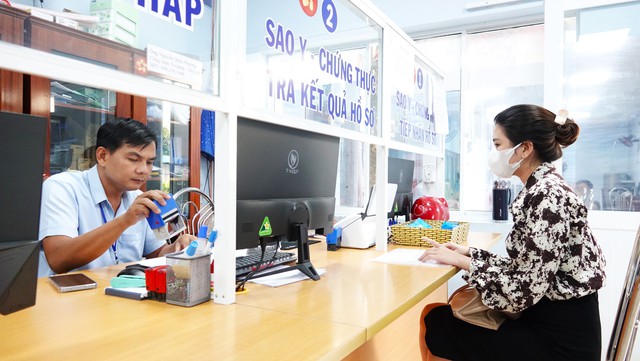
Civil servants at Vo Thi Sau ward (District 3, Ho Chi Minh City) process photocopies of documents for residents.
PHOTO: SY DONG
Regarding internal restructuring solutions, the plan clearly states that, based on the evaluation and classification of officials and civil servants, the head of the agency will proactively coordinate with relevant internal organizations and units to rearrange and reassign the staff to suit the requirements, conditions, and standards of the assigned positions.

Each agency develops a job position plan as a basis for determining the structure and number of civil servants, public employees, and workers to be allocated to agencies and units after restructuring, ensuring suitability with functions and tasks and guaranteeing the implementation of state management and service to citizens and businesses.
In this process, the internal restructuring and arrangement of the agency must ensure a sufficient number of civil servants and public employees for all positions that are needed (including positions that are expected to be filled but have not yet been filled, and positions for newly established agencies and units) in order to minimize the number of redundant personnel.
For cases where new positions cannot yet be assigned, the agencies compile a list and send it to the Department of Internal Affairs for recommendation and transfer to city departments, boards, and agencies, as well as the City Party Committee's Organization Department, to fill vacant positions within the allocated staffing quota.
Transferring civil servants between government agencies.
Regarding the restructuring and expansion plan, Ho Chi Minh City will redeploy officials and civil servants between agencies and units within the state sector, and transfer them from the administrative sector to the public service sector.
Accordingly, surplus officials, civil servants, and public employees will be transferred to other agencies, units, and localities that have available positions and recruitment needs. Priority will be given to those who meet the required standards and conditions regarding qualifications, experience, and work achievements, are young, and have a desire to continue contributing to the public sector in the long term.
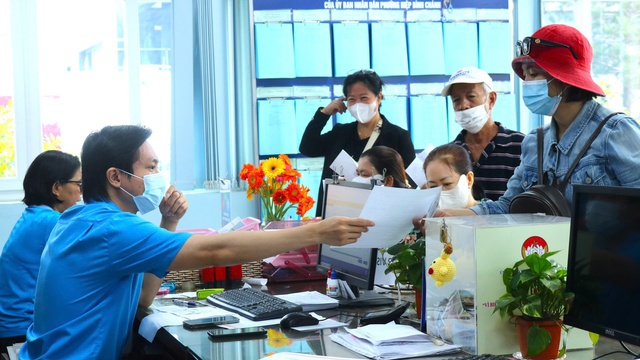
Civil servant working at the People's Committee of Hiep Binh Chanh Ward, Thu Duc City, Ho Chi Minh City.
PHOTO: MY DIEP

Simultaneously, Ho Chi Minh City is researching, transferring, and assigning surplus civil servants from state agencies to public service units in positions that match their qualifications, experience, and skills; especially leadership and management positions, common professional positions, and support and service positions.
After completing the organizational restructuring, the Department of Internal Affairs advised the Ho Chi Minh City People's Committee to develop a plan to send officials, civil servants, and public employees under its management to work at the grassroots level.
At the same time, organize training and professional development courses for cadres, civil servants, and public employees who are transferred to new positions or assigned additional functions and responsibilities, in order to improve their knowledge and skills in public service.
Source: https://thanhnien.vn/tphcm-dieu-dong-can-bo-cong-chuc-doi-du-nhu-the-nao-185250521215323284.htm



















































![[Video] Sunset at Lap An Lagoon – Where the sun sets over the fishing nets](https://vphoto.vietnam.vn/thumb/1200x675/vietnam/resource/IMAGE/2026/05/31/1780192137701_beach-landscape-sea-water-nature-grass-745871-pxhere-com.jpeg)







































Comment (0)