


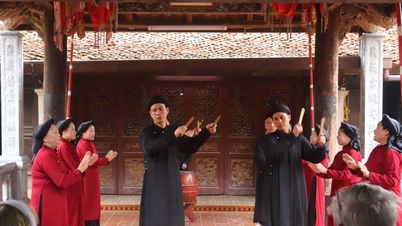
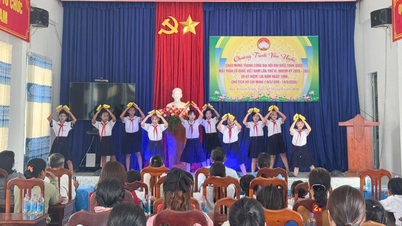
The folk art performance "Lantern dance forming letters and traditional Chèo singing" in Thieu Quang commune.
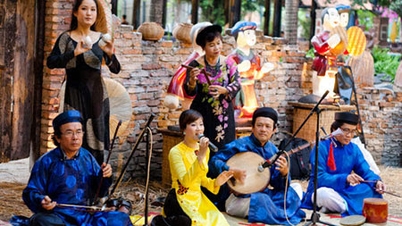
From a form of folk performance that was fading away and facing the risk of extinction, the folk songs and dances of Dong Anh (also known as the five traditional performances of Vien Khe) in Dong Son ward have now become a source of pride not only for the people of Vien Khe residential area in particular but also for Thanh Hoa province in general, after being recognized as a national intangible cultural heritage by the Ministry of Culture, Sports and Tourism.
To learn more about the folk songs and dances of Dong Anh, we visited the home of the distinguished artisan Le Ba Tuat in Vien Khe residential area. In conversation, Mr. Tuat explained: Dong Anh folk songs and dances are a form of folk performance that authentically reflects the working life, daily activities, and spiritual and emotional life of the agricultural inhabitants of the Ma River delta. Previously, Dong Anh folk songs and dances were performed regularly and were closely associated with the Nghe Sam Festival. However, due to the passage of time and the vicissitudes of history, Nghe Sam no longer exists, and therefore, Dong Anh folk songs and dances are no longer performed at the festival as before. Consequently, Dong Anh folk songs and dances have gradually faded away. To preserve the memory of Dong Anh folk songs and dances, some people knowledgeable about this heritage have had to record and describe them in plays to prevent them from being forgotten.
Around the year 2000, with the assistance of the Vietnam National Institute of Music, the People's Committee of the former Dong Son district implemented a project to collect, research, and restore the folk songs and dances of Dong Anh. Fortunately, at that time, some knowledgeable individuals who still remembered the performances, such as Mr. and Mrs. Nguyen Sy Lich and Le Thi Nghi; Mrs. Nguyen Thi Coc... actively cooperated with units and localities to collect, research, and restore the system of performances.
The recognition of Dong Anh folk songs and dances as a national intangible cultural heritage not only awakens pride in the local community but also gives cultural heritage a better chance of being cared for and protected, and raises awareness among all levels of society about protecting and promoting cultural heritage.
Therefore, according to Mr. Tuat, in order for Dong Anh folk songs and dances to spread further in the community, we, the artisans, are constantly striving to preserve, practice, teach, and promote this heritage in daily life. For many years, Dong Anh folk songs and dances have been performed at many major events both within and outside the province. The artisans also cooperate with schools in the area to teach knowledge and practical skills in some folk performances within the Dong Anh folk song and dance system to teachers and students. Periodically, one to two competitions of short theatrical performances for children, based on folk stories, are organized annually.
According to Hoang Thi Huyen, Head of the Culture and Social Affairs Department of Dong Son Ward: "After being recognized as a National Intangible Cultural Heritage, Dong Anh folk songs and dances have affirmed their value in daily life and contributed to the formation of cultural and tourism products from the heritage, promoting local economic development. Therefore, we have implemented many measures to promote the value of the heritage, such as nurturing artisans and training successor generations, creating conditions for artisans to teach and spread the heritage in the community, and actively restoring cultural spaces for practicing the heritage. In addition, in the process of promoting the value of cultural heritage, some performances that were previously only performed in rituals have been staged as acts in competitions, festivals, and performances, contributing to the vitality of folk songs and meeting the needs of contemporary audiences."
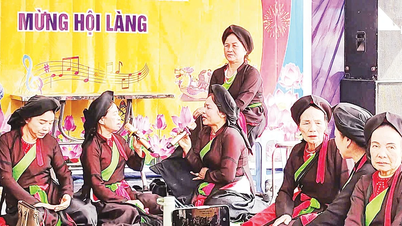
After being recognized as a National Intangible Cultural Heritage in 2023, the folk performing art of "Lantern Dance with Letter Forming and Traditional Cheo Singing" in Nhan Cao village, Thieu Quang commune, has increasingly spread and promoted its value in daily life. Artisan Nguyen Thi Thuy, who is closely associated with "Lantern Dance with Letter Forming and Traditional Cheo Singing," shared: "This is a rather unique art form and is performed in the Ngu Vong ward festival. It includes 3 performances of traditional Cheo singing and dancing, and 5 performances of lantern dance with letter formation. This folk art form is deeply rooted in the riverine beliefs of the Nhan Cao village community, offered to the deities and patron saints of the craft."
According to Ms. Thuy, after the heritage was recognized, the artisans and people of Nhan Cao village have always preserved, protected, and promoted the value of the heritage with dedication, affection, responsibility, and all their pride. At the same time, they continuously strive to promote and introduce the heritage to a wider audience throughout the country by participating in competitions and performances. Furthermore, the teaching of this heritage to the younger generation is also given priority.
To date, not only the folk songs and dances of Dong Anh or the folk performing arts of "Lantern Dance and Cheo Chai Co" (traditional Vietnamese opera), but also many other heritage sites in the province have been honored as National Intangible Cultural Heritage, such as the Xuan Pha folk performance, the Tro Chieng festival, the Kin Chieng Booc May festival, the Cau Ngu festival, the Doc Cuoc temple festival, etc. It must be affirmed that, in recent years, all levels, sectors, and localities in the province have continuously strived to implement many comprehensive solutions to promote the value of heritage after it has been recognized, such as actively protecting, teaching, promoting, and developing cultural tourism. Emphasis has been placed on investing in heritage spaces, integrating heritage into daily life, and connecting heritage and tourism. Policies have been implemented to reward and honor folk culture artisans – those who "keep the flame" and "pass on the flame," determining the survival of cultural heritage in daily life. However, the reality shows that the conservation and promotion of national intangible cultural heritage still face many limitations and challenges, especially in the context of rapid technological development. Therefore, it requires even greater cooperation from the community, government, and relevant organizations to preserve and promote these heritages, so that they can shine even brighter in the community.
Text and photos: Nguyen Dat
Source: https://baothanhhoa.vn/trach-nhiem-sau-vinh-danh-257715.htm







































































Comment (0)