

A century of preservation
In the 18th century (1732), Lord Nguyen established the Phan Tran Citadel, a new administrative unit called Long Ho Citadel (present-day Vinh Long province), and chose An Binh Dong village (now Cai Be commune, Dong Thap province) as the administrative center of Long Ho Citadel. It existed for 25 years (until 1757), after which the administrative center in An Binh Dong village was moved to Tam Bao, located in Long Ho village, Vinh Long province.
During the period when Long Ho Palace was established, the Dong Hoa Hiep area attracted many officials and landowners to live there. Many houses, built of wood with tiled roofs, tall, spacious, and three-bay, in a blend of Eastern and Western architectural styles, were built one after another. These old houses were not built close together but interspersed with lush orchards, creating a rustic and poetic beauty.
To this day, some old houses in Dong Hoa Hiep still exist and retain their old features, such as: the house of Mr. Tran Van Lau, built in the 19th century (he was one of the wealthy landowners), now inherited by Mr. Tran Tuan Kiet; the house of Mr. Phan Van Duc; the house of Mr. Le Van Xoat; the house of Mr. Vo Van Vo; and several other old houses located in Dong Hoa Hiep Ancient Village.

Mrs. Le Thi Chin, wife of Mr. Tran Tuan Kiet (the 4th generation of the Tran family, the ancestral home of Mr. Tran Van Lau), said: “The ancient houses in Dong Hoa Hiep are built according to the traditional Southern Vietnamese house structure with 5 bays and 3 wings in the shape of the letter 'Dinh'. Inside these ancient houses, the rafters, beams, and door frames are carved and decorated with very exquisite patterns. The most unique are the ornate wooden panels carved with stylized pine, chrysanthemum, bamboo, and plum blossom trees in harmonious proportions.”
The horizontal and vertical couplets in Mr. Kiet's old house are elaborately carved and inlaid with mother-of-pearl, featuring soft and graceful motifs that demonstrate the high level of artistic skill of the people of the past.
In addition, wooden, ceramic, and bronze items such as altars, tables, chairs, vases, plates, cups, incense burners, and statues, which are aesthetically pleasing and of rare value, have also been preserved to this day. The outdoor space is a spacious courtyard, decorated with antique ornamental plants; in front, there is a sturdy and elegant fence and gate, creating a space that is both solemn and beautiful. It reflects the luxury, grandeur, majesty, and imposing presence of the wealthy people of this period.”

Meanwhile, Mr. Ba Duc's old house is located next to the Cai Be canal. Built in 1870, the house faces the river and follows traditional architecture. However, after a major renovation in 1938, the interior columns were raised and the facade was redesigned in a French architectural style.
Inside the house, there are also many elaborately carved and mother-of-pearl inlaid decorative panels, horizontal plaques, and couplets. In addition, wooden, ceramic, and bronze items such as altars, tables and chairs, vases, plates, cups, incense burners, and statues, which are of great aesthetic value and rarity, are still preserved.
Leading us on a tour around his house, Mr. Phan Van Duc, owner of the Ba Duc ancient house in Cai Be commune, Dong Thap province, said: “This year, at the Dong Hoa Hiep Ancient Village Culture and Tourism Festival, my family's ancient house has been chosen to host the competition for arranging the five-fruit offering tray and the seminar on developing tourism products in Dong Hoa Hiep ancient village: Connecting heritage - creativity - sustainability. To organize these activities, the ancient house has focused on renovation, trimming trees…; arranging and organizing the dining area and seminar space appropriately. At this point, the ancient house is ready for the festival activities.”

Preserving architecture for the future.
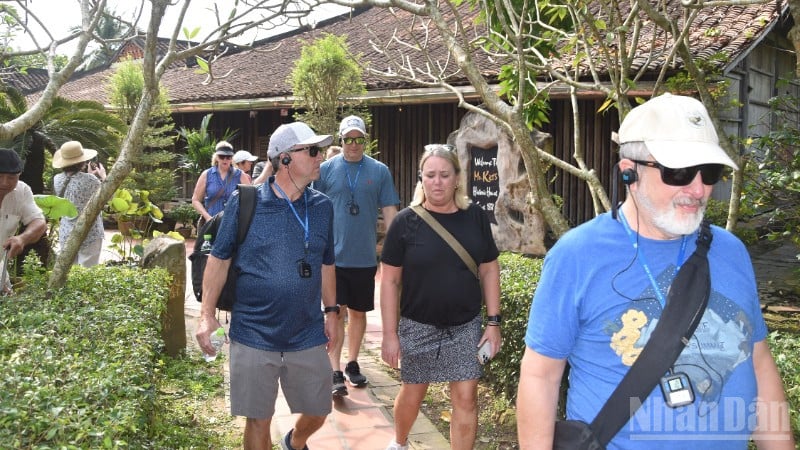
Cai Be commune has the Dong Hoa Hiep Ancient Village, an architectural and artistic heritage site managed by organizations, individuals, and the community. It comprises over 14 ancient houses dating back more than 100 years, including 5 houses currently used for tourism: Mr. Kiet's ancient house, Mr. Ba Duc's ancient house, Mr. Vo's ancient house, Mr. Muoi's ancient house, and Mr. Xoat's ancient house.
Among them, Mr. Kiet's ancient house was restored and repaired by the JICA organization of the Japanese government , while some other ancient houses were repaired and restored by the homeowners themselves for tourism business, such as the Ba Duc ancient house, Mr. Vo's ancient house, Mr. Muoi's ancient house, etc. These ancient houses have successfully exploited their advantages to serve tourists visiting and relaxing, especially during holidays, Tet (Lunar New Year), and the Dong Hoa Hiep Ancient Village Cultural Festival.
However, some old houses are currently in a state of serious disrepair, such as the houses of Mr. Xoat and Mr. Hong... The repair costs are high, and the families of these old houses cannot afford them, so they have not been able to restore them or organize community tourism activities like other old houses.

In 2020, Cai Be commune also sent a letter to Professor Tomada, Director of the Institute for International Cultural Studies at SAHOWA University (Japan), requesting continued support for the restoration of the dilapidated ancient houses. However, since Dong Hoa Hiep ancient village was classified as a national historical site in 2017, the Japanese side did not provide restoration support... Due to the large-scale restoration and repair costs, Cai Be commune is also proposing to seek approval from the province.
To preserve and promote the value of Dong Hoa Hiep Ancient Village, Vo Pham Tan, Deputy Director of the Department of Culture, Sports and Tourism of Dong Thap province, said: "We will continue to raise awareness of heritage protection among people living in the area, focusing on environmental sanitation. At the same time, we will promote the socialization of conservation and promotion of the value of the ancient village and encourage and create conditions for individuals and organizations both domestically and internationally to participate in the conservation, restoration, and enhancement of the heritage."
From December 3rd to 7th, the People's Committee of Dong Thap province will organize the 6th Dong Hoa Hiep Ancient Village Culture and Tourism Festival in 2025. As part of this series of activities, many events will take place, such as: Memories of the Ancient Village, Heritage Journey, Tourism Product Development, Digital Journey to the Ancient Village, etc.
Dong Hoa Hiep Ancient Village is one of three ancient villages (along with Duong Lam Ancient Village in Hanoi and Phuoc Tich Ancient Village in Hue) in Vietnam selected by the Vietnam National Administration of Tourism (now the Vietnam National Tourism Administration) and the Japan International Cooperation Agency (JICA) for investment in developing a rural tourism model. The architectural and artistic heritage of Dong Hoa Hiep Ancient Village has been classified as a National Monument by the Ministry of Culture, Sports and Tourism in Decision No. 2080/QD-BVHTTDL of 2017.
Source: https://nhandan.vn/tram-nam-lang-co-dong-hoa-hiep-post927596.html
![[Photo] “Red Journey” 2026: Vietnamese Youth Continue Building the Bridge of Friendship Between Vietnam and China](https://vphoto.vietnam.vn/thumb/1200x675/vietnam/resource/IMAGE/2026/04/20/1776629730866_4055880775670638308-9618-4200-jpg.webp)







































































Comment (0)