

Not only are some integrated farms in Dong Cuong ward ( Thanh Hoa City) developing highly efficient production, but they also operate in a circular economy, eliminating waste. This is a production approach that minimizes environmental impact and is being implemented in many places both domestically and internationally.
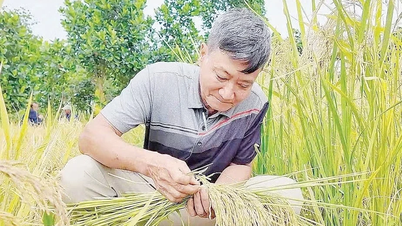
 Nguyen Huu Hong's farm in Dong Cuong ward (Thanh Hoa city), which specializes in flower cultivation, fruit tree farming, and livestock raising, generates virtually no waste.
For over 10 years since starting his business in the Hang Ca rice paddy area, Mr. Nguyen Huu Hong, residing in Street 1, Dong Cuong Ward, has developed a prosperous integrated farm. This is the result of implementing the Party Committee's thematic resolution on converting inefficient rice land to high -yield crops and livestock. At that time, his family independently accumulated land and bid for it according to the general policy to acquire a production area of over 9,800 square meters. Compared to many other farms, this area of less than 1 hectare is quite modest, but the owner quickly selected suitable crops and livestock to maximize income.
“For many years, I have dedicated 6 acres to growing flowers. With intensively cultivated flower beds, we rotate up to 3 crops per year, mainly chrysanthemums, to supply the market. My family also has to hire 5 skilled laborers to take care of the flowers year-round,” Mr. Hong shared.
On the farm, he also dug a 5,000 m2 pond for fish farming. Along the farm's perimeter, including the pathways and remaining areas, he cleverly planted fruit trees such as jackfruit, custard apple, lemon, pomelo, and coconut to green the entire production area and optimize land use. Rows of papaya trees and small vegetable beds were interspersed to meet the family's local needs. Livestock farming was also carried out simultaneously with flocks of chickens, goats, and some pigs for meat.
By-products from farming are used for livestock. Grass around the farm is regularly cut by workers for the fish. Livestock waste is collected and processed, becoming organic fertilizer for crops. Even leftover flower stems and stalks after each harvest are collected by the owner to compost into humus, providing nutrients for plants. Overall, the efficient utilization of by-products means the farm produces virtually no waste. Environmental issues here are well-managed, making it a model for many farm owners in the region to visit and learn from.
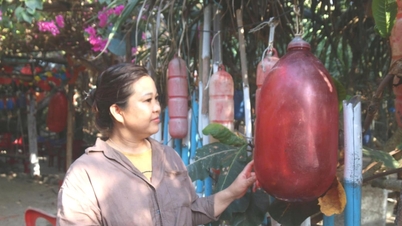
In the Dong Ngat area, also in Dong Cuong ward, there is another farm that is truly pristine and green, resembling a small ecological zone. With less than 0.7 hectares, the farm owner, Mr. Le Thanh Binh from neighborhood 7, has found his own path: raising snails and growing fruit trees. Since 1999, after being discharged from the army and returning to his hometown, he bid for 3,500 square meters following a local call. Continuing to consolidate and expand the area in subsequent years, he now has a production area of 6,900 square meters. Originally a low-lying, flood-prone rice paddy area, he dug snail ponds running parallel to the production area, totaling over 2,500 square meters. Above the ponds are trellises of gourds, pumpkins, loofahs, and chayote, providing year-round greenery. Between the ponds, he planted dragon fruit and guava trees. Much of the remaining area is used for rows of vegetables, cultivated in staggered cycles.
Because the snails have an abundant food source – leftover vegetables and unsold fruits are all utilized. Even with tens of tons of guava each year, he doesn't feel pressured by sales, as any unsold produce is simply put back into use. Similarly, gourds, loofahs, chayote, and other vegetables are all fully utilized.
Observing the ponds, the water is clear and blue because the snails don't excrete many pollutants and also function as water filters. A system of mature fruit trees provides shade and a green canopy around the production area. According to Mr. Binh: "All production processes here are carried out entirely organically. The snails' food consists entirely of natural ingredients. In fact, apple snails are very sensitive; if pesticides are sprayed on nearby vegetable plots, the snails will die, so we must strictly adhere to safe production procedures."
To supplement their income, the family built a 40m² pig pen to maintain a herd of about 15 pigs. Livestock waste is composted and used as fertilizer for crops, so they hardly need to use chemical fertilizers like in many other places. Overall, all production stages are interconnected in a closed-loop system, generating virtually no waste that needs to be disposed of. Despite adhering to clean, organic production practices and minimizing waste, the farm still generates revenue of 1 to 1.3 billion VND per year, with an average profit of around 500 million VND.
According to information from the Dong Cuong Ward Gardening and Farming Association, many farm and household production models in the ward currently adhere to organic production methods and minimize waste. Examples include the production models of Mr. Nguyen Huu Thuan in Street 1; Mr. Le Van Quang, Mr. Le Hong Huong, and Mr. Dam Van Que in Street 2; Mr. Le Tien Loi in Street 3, etc. This is a responsible production approach that benefits the community, producing clean products while protecting the ecological environment. Dong Cuong is a suburban ward, making these production models even more important for sustainable development.
Text and photos: Linh Truong
Source


![[Image] National Assembly discusses the implementation of the socio-economic development plan.](https://vphoto.vietnam.vn/thumb/1200x675/vietnam/resource/IMAGE/2026/04/20/1776696707422_ndo_br_img-20260420-185419-jpg.webp)
![[Photo] General Secretary and President To Lam meets with National Assembly delegates from ethnic minorities.](https://vphoto.vietnam.vn/thumb/1200x675/vietnam/resource/IMAGE/2026/04/20/1776696701056_a1-bnd-8331-3342-jpg.webp)








![[Infographics] Hai Tien Beach Tourism Festival 2026 and celebratory activities](https://vphoto.vietnam.vn/thumb/402x226/vietnam/resource/IMAGE/2026/04/20/1776687221715_infographics-le-w1200t0-di2616d199d1165828t11358l1-2026-029.webp)

















































Comment (0)