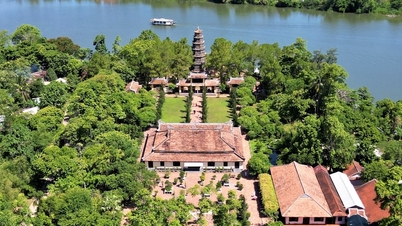
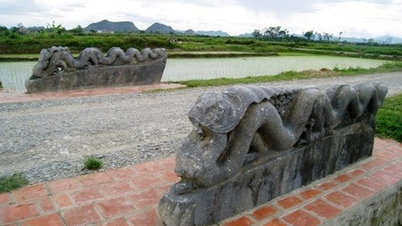
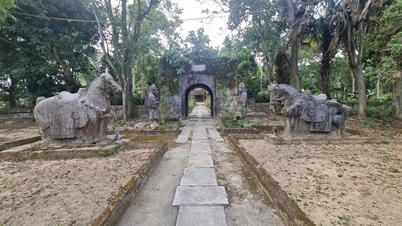
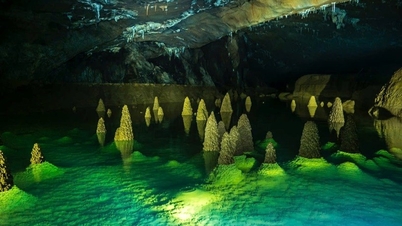
Among the famous ancient villages of Thanh Hoa province, the former La Da hamlet, now Ban Thach village, Xuan Sinh commune (Tho Xuan district), is a land of spiritual significance and outstanding people. With over a thousand years of history, Ban Thach today still preserves a rich and unique collection of tangible and intangible cultural heritage.
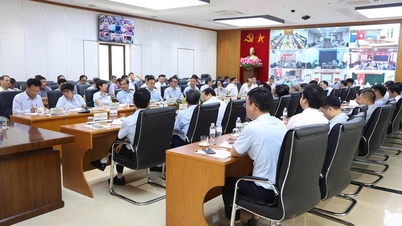
 The Cao Son Temple Festival in 2024 took place on April 23rd (the 15th day of the 3rd lunar month). Photo: KIEU HUYEN
According to the village's history: From the time when Mr. Ham Hue Trung served as an official in the late Le Dynasty and early Ly Dynasty, he recognized this sacred land and decided to settle there, cultivate the land, and establish a solid foundation for generations to come. He named this sacred land La Da village, meaning as solid as a stone slab.
The Cao Son sacred shrine was recorded in 1572 by the Grand Scholar Nguyen Binh (during the reign of King Le Anh Tong) and in the book "Kham Dinh Viet Su Thong Giam Cuong Muc" (Imperial Compilation of Vietnamese History): During the reign of King Le Thai To of the Later Le Dynasty, when he launched the Lam Son Uprising, as he passed the Cao Son shrine in La Da village, his troops suddenly stopped and could not proceed further. The king, surprised, summoned the villagers to inquire about the reason. The people explained everything, and the very next day they prepared offerings before the shrine. From then on, the king swiftly launched his army and marched straight to the Champa army's headquarters for a great battle... Upon returning to La Da village and arriving at the shrine, the king offered thanks, bestowed the title "Upper-class Blessed Deity," granted the villagers 100 quan (Vietnamese currency), and exempted them from military supplies... Le Thai To said: "La Da means 'Stone Table'. The name Ban Thach village originated from that."
Leading us on a tour around the village, Mr. Le Van Truong, head of Village 3, Xuan Sinh Commune, introduced: According to legends passed down by the elders, the ancient Ban Thach village was guarded by four deities in four directions, creating a stable land, a harmonious balance of yin and yang, favorable weather, peaceful settlements, and thriving descendants. Initially, the Le Trong, Le Cong, Le Quoc, Le Doan, and Do families came to establish the village; later, a total of 19 families came to settle and live together, united and living side by side.
As a native of Ban Thach, Colonel Le Quoc Am dedicated his heart and effort to collecting and compiling the book: "Cultural Geography of Ban Thach, Xuan Quang Commune" (now Xuan Sinh Commune, Tho Xuan District), Thanh Hoa Publishing House, 2019. Speaking about sacred land and a land of vitality, he affirmed: Ban Thach has the geographical features of a flying dragon spitting pearls. On the dragon's back are 21 land formations shaped like bats, with a main dragon vein originating from Long Ho and connected to the Luong Giang River (Chu River), so the land never ceases to produce talented people.
In his survey, he confirmed that Ban Thach village has land formations shaped like pens, inkstones, and books, indicating that many descendants have a natural talent for literature and art. There are also land formations resembling horse necks, drumsticks, and swords, promising success in military careers. Furthermore, there are land formations shaped like turtles, with cranes on their backs, suggesting the emergence of many talented fortune tellers and shamans; and land formations shaped like snakes and lizards, promising success in teaching. Particularly, according to oral tradition, the ancient village of Ban Thach has 21 land formations shaped like bats. When added to the four mythical creatures "dragon, lion, turtle, and phoenix," the bat becomes the "five blessings." Therefore, this land was chosen as the burial place for three kings of the Le Trung Hung era: Le Du Tong, Le Hien Tong, and Le Man De.
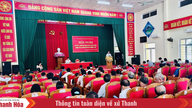
Based on the merger of Xuan Quang and Xuan Son communes, Xuan Sinh commune today has the third largest area and the largest population in Tho Xuan district, with great potential for development, especially in spiritual tourism . Both historical sites – the temple dedicated to the kings of the Le Trung Hung era and the Cao Son temple, dedicated to a revered figure favored by King Ly and honored by the people of Ban Thach village as the village's tutelary deity – have been restored and renovated by the villagers. Every year, the former Ban Thach village, now comprising five hamlets (hamlets 1, 2, 3, 4, and 5), hosts two festivals that attract villagers, people from the surrounding areas, and tourists from all over. These are the festival at the temple dedicated to the kings of the Le Trung Hung era on the 20th day of the first lunar month and the festival at the Cao Son temple on the 15th day of the third lunar month.
Mr. Le Van Truong, the village head, still feeling elated by the atmosphere of the Cao Son temple festival that just took place, said: "Village 3 currently has 1,200 inhabitants in 220 households. Before the festival, the villagers had been preparing to carry the royal decree. We mobilized 30 men to participate in the procession of the palanquin, carrying drums, umbrellas, swords, etc. In addition, we also practiced tug-of-war to compete with 12 other villages in the commune. It was hard work, but it was fun, and everyone enthusiastically participated."
Compared to many other historical sites in the district and commune, Cao Son Temple still preserves quite a lot of valuable documents. These include the genealogy of Lord Cao Son; the genealogy of Princess Ngoc Nuong from the Tran Dynasty; and 15 royal decrees from various kings of Vietnam bestowing titles upon the deity.
Mr. Truong also said that the villagers in Hamlet 3, Xuan Sinh Commune, still recount the old story: fearing thieves might steal or destroy the stele, the elders of Ban Thach village and the clans at that time had to take turns guarding it at night. They discussed hiding the stele in Long Ho (the present-day Ban Thach Lake). In the early 1960s, people in the village and commune often encountered it while shrimping, but now the stone stele is covered in silt, and the village has organized many searches without success. More recently, three rare fans, fan frames made of ivory, and two small bells at the Cao Son temple were also stolen. These artifacts are extremely valuable. Once lost, it is difficult to recover them.
Because of their understanding of traditional cultural and historical values, when building a new rural area, Xuan Sinh commune in general, and the people of Ban Thach village in particular, always strive to preserve and promote heritage values. Vice Chairman of the Xuan Sinh Commune People's Committee, Le Van Tuan, affirmed: Socio-economic development is necessary. But in a village rich in cultural traditions and with many historical relics like Xuan Sinh, the most important thing is to promote the values of these relics. To effectively exploit existing potential and advantages, Xuan Sinh commune is stepping up promotion and attracting investment, while connecting with tourist areas and destinations in the district and province to develop tourism into a key economic sector of the locality, creating more jobs and income for the people, and serving as a driving force for the commune to achieve the model new rural area status in 2024.

KIEU HUYEN
This article uses material from the book "Cultural Geography of Ban Thach Village, Xuan Quang Commune, Tho Xuan District" by Le Quoc Am (Thanh Hoa Publishing House, 2019) and other sources.
Source