We were young soldiers during the years of marching and fighting in the Truong Son Mountains. The years we spent carrying weapons were incredibly rich. Besides backpacks and ammunition, there were countless songs, vigorous and full of affection, as if they were made especially for us soldiers. Those songs were truly exhilarating and full of spirit. One of those songs, which seemed to be sung by every soldier in every unit before meetings, activities, or marches... was "Through the Northwest Region."
It's strange that despite singing, few people know the author. Singing fills the heart with excitement, makes the fight more fervent, and that's enough. The song, written about the days of fighting the French, about the remote Northwest, yet sung in the Truong Son Mountains during the war against the Americans, feels close and familiar, just like the towering mountains stretching endlessly into the distance, the hardships overcome – it is this Truong Son, these very days. Even the sincere, simple expression of our soldiers obeying the orders of the Fatherland is received with genuine emotion and feeling.

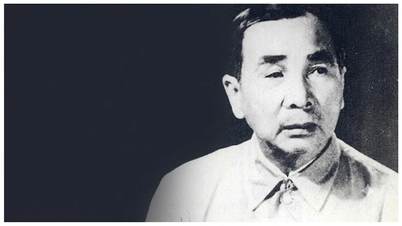
Musician Nguyen Thanh - Photo: NNT
I have a particular interest: seeking out the authors of songs that are rich in fighting spirit and have a powerful impact on the lives of soldiers. And so, one afternoon, I met Nguyen Thanh - the author of the song "Through the Northwest Region"...
Composer Nguyen Thanh recounted: "I wrote the song 'Through the Northwest Region' in about an hour, on top of Khau Vac Pass, during a night march..."
An hour, but his song has and will have a life far greater than that time. To have that hour, he must have marched twice to fight the enemy in the Northwest, and spent his life in the National Guard from before he was fifteen years old. That was in 1945, when the August Revolution broke out, Nguyen Thanh was a schoolboy in Hanoi . One day, the red flag with a yellow star and the song "Marching Song" captivated him, drawing him along with the marching demonstrations, starting from the Grand Theater and sweeping through the Northern Government Palace to seize power.
Nguyen Thanh's life as a soldier began that day, and soon after, he became the deputy platoon leader of a cadet platoon, wearing a beret with a gold-rimmed star, green shorts and socks, and a yellow shirt. The echoes of this soldier's life were the rhythmic tapping of his yellow boots on the road and the clicking of the breech-loading rifle at his waist...
The resistance war broke out. That young cadet joined the westward advance army and went to the front lines. He participated in battles against the army commanded by Curiang, whose legendary figure was made up of him: that his troops were impervious to gunfire...
Crossing the river, traversing the mountain slopes, and reaching the clouds.
The westward marching army pressed forward.
At least once on the first battlefield, Nguyen Thanh, with his rudimentary musical knowledge from his school days, wrote that song about the Northwest. That was in 1946, when he had just arrived in the Northwest. The melody of the song was as romantic as his own romantic soul.
Then the years of fighting passed. He went to many campaigns, to many different lands. In 1949, he became an officer of the shock troop cultural performance of the Vanguard Army Division, that is, the 308th Division. In the autumn and winter of 1952, he and his cultural performance troupe returned to the Northwest to participate in the campaign. The night before the liberation of Nghia Lo, the shock troupe of thirteen people stopped halfway up Khau Vac Pass. They dug trenches, built a fire, sat and discussed the campaign, then hugged each other and waited for dawn. Nguyen Thanh couldn't sleep. His greatest emotion was: President Ho Chi Minh's order to send troops to liberate the Northwest. In the letter President Ho sent, he spoke extensively about the suffering of the people of the Northwest - the land and people with whom Nguyen Thanh had so many memories...

Soldiers advancing towards Northwest Vietnam - Photo: Thanh Nguyen
The lyrics flowed spontaneously. The mandolin in his hand played along, and Nguyen Thanh sat and sang. The poem "Over the Northwest" appeared in words, on paper that night, by the flickering fire in the hastily dug bunker, amidst the pounding footsteps of soldiers marching into battle, and the long howling wind on the mountain pass... Having finished writing, exhausted, the author fell asleep. The next morning, he found Hoan, Phung De, Vu Huong... his comrades in the team, singing enthusiastically. They had retrieved his manuscript from the campfire! Fortunately, the embers had cooled, so the paper hadn't burned...
That very morning, the song was immediately performed for the soldiers going into battle, with mandolin, guitar, bamboo flute... and the author and his friends stood singing right on top of the mountain pass, entertaining the passing troops. The song was like a flame, igniting itself through each soldier. And that flame gradually spread throughout the troops, from one campaign to the next...
The buffalo herders, seeing the soldiers singing, were captivated and joined in, singing along to the sound of the buffalo bells echoing across the liberated fields of Northwest Vietnam. Even the blind street singers used it to perform in Hanoi, which was then occupied by the enemy. The song was passed down to later generations, including us soldiers of the Truong Son Mountains, who used it as a soldier's anthem during our years of fighting the enemy...
Composer Nguyen Thanh continued:
- In 1954, we served in the Dien Bien Phu campaign. One afternoon, in the headquarters' bunker, General Vo Nguyen Giap asked us to sing two songs, including "Through the Northwest." After listening, the General said: "Whoever composed this song deserves a reward!" Luong Ngoc Trac reported to the General that he was the author of "Through the Northwest." The General shook my hand tightly and asked about my life as a soldier. Shortly afterwards, I was awarded a medal for my military achievements...



The years spent in Northwest Vietnam left a lasting impression on Nguyen Thanh, even though more than thirty years have passed. His face is simple and reserved. The most intense feelings are often kept hidden inside, rarely expressed in words. He speaks of his hardships, but when he does speak, he is honest, often innocently endearing and lovable. His life as a soldier and his artistic life began there. And so does a part of his life. His wife, Ngoc Thao, a dancer, television director, and also a performing artist of the 316th Division, first met because of their shared memories of Northwest Vietnam, a battlefield where they were both deeply connected.
I met Nguyen Thanh again one afternoon in Northwest Vietnam. A new battle was about to begin in the mountains and forests of this region. And Nguyen Thanh was there again. Before the mountains and forests, he returned to the innocence and emotion of a fifteen or sixteen-year-old in the Western Advance Army...
"It's been two wars of resistance, and only now have I returned here," he said, his voice tinged with regret.
I understand the intense emotions you're feeling. After the war, you returned to Hanoi, joining the General Political Department's Song and Dance Troupe. During the resistance against the US, you were in Truong Son, leading a performing arts troupe on that front. When you were assigned to be in charge of the music for the military mobilization programs of the Voice of Vietnam Radio , the Northwest region returned once again with a song you wrote in 1956: "The Hmong Flute's Sound Sent to the Soldier" (Lyrics by Khac Tue).
For military musicians, the hottest and most intense battlefields and regions are the places they go. The Trường Sơn Mountains held the same allure and idealism for Nguyễn Thành as the days of the military band's journey to the Northwest. However, during this period, with his work in a performing arts troupe, Nguyễn Thành had very little time to compose. Although he hadn't yet composed, his musical soul was already intertwined with the Trường Sơn Mountains, and he had silently accumulated a considerable amount of emotion and material.
Until he left and took on a new assignment, the memories and attachments resurfaced powerfully. For many years afterward, despite many other captivating topics, Nguyen Thanh still devoted much of his affection and time to writing about Truong Son: The Lion No. 3 (lyrics by Ta Huu Yen); The Star, the Lamp, the Gaze (lyrics by Luu Quang Ha); I Have a Truong Son (lyrics by Chau La Viet) and even the symphony of Truong Son Memories...
Nguyen Thanh is perhaps the kind of musician who fears superficial, fleeting emotions. He usually only dares to pick up a pen or a guitar when emotions deeply penetrate and settle in his soul. This approach rarely yields him a large number of works, but it eliminates for him compositions that are easy to create and easy to forget. That was also the case with his work "October Emotions" (lyrics by Ta Huu Yen). It wasn't until more than twenty years later that he wrote about his close 308th Division from the days of the war against the French, with the inscription: "Respectfully dedicated to the Vanguard Army Division."
Night, the night he sped past under the bridge
He said he would come back tomorrow.
The waves of the Red River lap against the distant shore, singing their song forever.
The lyrics are beautiful, the melody is beautiful, rich in resonance from the soul. Through "October Emotions," we see the diversity of Nguyen Thanh's work. He writes lyrically and passionately, yet vigorously in a marching rhythm. The alternating 6/8 and 2/4 time signatures help him express those emotions well. After finishing the song, Nguyen Thanh himself played the piano and sang, with tears streaming down his cheeks. The vivid memories of his life in combat, deepened over the years, how could they not move him and evoke such longing! "October Emotions" deserves its award: the love and enduring popularity of its listeners.
*
Memories of his life and years of fighting resurfaced in him as he and I sat together in the Northwest front this afternoon.
Across the Northwest region, mountains stretch endlessly into the distance...
Thirty Years of Marching in Song
This morning I passed through the Northwest region again.
The musician wrote the song about the graying hair of the old man.
Departed in the days of defending the nation with youthful hair.
Marching through countless waterfalls and rapids.
The spirit of thirty years still shines brightly against the Northwest sky.



A young poet who sat with us that afternoon wrote these lines for Nguyen Thanh when he recounted the story. Once again, guns fired on the border, and military musicians marched to battle. Nguyen Thanh arrived very early. He managed to write this poem for the troops going to battle today: "March to Defend the Border of the Fatherland" (Poem by Tran Dang Khoa):
The armies marched on in endless columns.
We are used to long-term hardship.
For thousands of years, they fought wars...
The land of our ancestors is our flesh and blood.
The land of Bach Dang, the land of Dong Da
They opened Bạch Đằng again, then they opened Đống Đa again...
The song, still wet with ink, was immediately relayed through the trenches by the troops. I think the "March to Defend the Border of the Fatherland" is a continuation of "Through the Northwest" and will also be a "soldier's song" of the years of fighting to defend the border. And from "Through the Northwest" to "March to Defend the Border of the Fatherland" today are two milestones, with the life of an artist in between, simple, unpretentious, and profound, like the life of soldier Nguyen Thanh...
Chau La Viet
Source



![[Photo] Strengthening character and expertise: Intense training for artillery soldiers.](https://vphoto.vietnam.vn/thumb/1200x675/vietnam/resource/IMAGE/2026/06/30/1782815602541_lu-368-1875-4571-jpg.webp)