In Kim Dien commune, 20 households have registered to raise civets, with a total herd of over 300 animals. Three of these households raise them on a relatively large scale, with 30-40 animals per household. Many households have gradually mastered the breeding techniques, developed their herds, and created a stable source of income.
Previously, Mr. Dinh Ngoc Chau (born in 1993), residing in Lam Khai village, worked as a long-distance truck driver. However, after a work accident, he was unable to continue in that profession. In 2022, he boldly researched civet farming through books and newspapers, then bought 10 breeding civets to raise. To date, he has expanded his enclosure to 50m², raising over 40 civets, including 18 breeding civets.
Mr. Chau shared: "Initially, raising ferrets was very difficult, especially knowing the right time for breeding or preventing diseases. However, I tried hard, learned a lot, and gradually got used to it."
According to Mr. Chau, civets breed twice a year, with 3-4 offspring per litter. Young civets can be sold after about 3 months. For meat civets, after more than a year of raising, they can reach a weight of 4-5 kg per animal. To ensure a steady food supply, his family has invested in planting bananas, jackfruit, and other fruit trees. In addition, he catches and buys fish to feed the civets, reducing breeding costs and ensuring a natural, nutritious food source for them.
 |
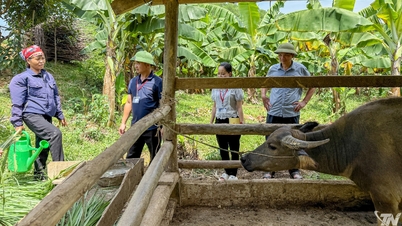
| Forest rangers inspect a civet breeding model in Kim Dien commune - Photo: XV |
Each year, his family sells about 10 pairs of breeding minks, bringing in nearly 100 million VND in revenue. Mr. Chau plans to continue expanding his farm, increasing the number of breeding and commercial minks to further improve his family's income.
Mr. Dinh Thanh Hien, residing in Tan Loi village, currently raises 30 commercial and breeding civets, earning approximately 80 million VND per year.
Mr. Hien said: "Civets are easy to raise, require little space for enclosures, and their main food consists of ripe bananas, fish, vegetables, and readily available local fruits. They eat at night and early in the morning, so breeders can take advantage of their free time to care for them."
According to many breeders in Kim Dien commune, civets originate from the wild, so breeders must arrange their enclosures appropriately. Each civet is kept in a separate cage to prevent fighting and limit the spread of disease. The enclosures are designed to be well-ventilated, dry, and clean; divided into separate areas for breeding civets, young civets, and civet pups.
As the herd size increases, breeders must focus on hygiene in the enclosures, disease prevention, and the development of appropriate feed rations; they also need to monitor the mink's physical condition to adjust the feed ration accordingly, avoiding excessive obesity which will affect reproductive capacity and meat quality.
Currently, 90-day-old breeding minks can be sold for around 10 million VND per pair; pairs ready for breeding can fetch up to 25 million VND per pair. For commercial minks, the selling price ranges from 1.4 to 1.5 million VND per kilogram. The high economic value provides many mink farming households in Kim Dien commune with a decent income and creates jobs for local laborers.
According to Dinh Anh Tuan, Vice Chairman of the Kim Dien Commune People's Committee: "In the coming time, the Commune People's Committee will coordinate with relevant units to organize training on scientific and technical knowledge for mink breeders; take advantage of programs and projects to support capital, breeding stock, building cages and linking product consumption, helping people develop their mink herds in a sustainable direction."
According to Dinh Phu Binh, head of the Hoa Son Forest Ranger Station (located in Kim Dien commune): “The unit always pays attention to and creates favorable conditions for local people to develop civet farming. The station also regularly inspects and monitors the civet farming activities of households; tracks legal documents, the total number of civets, and the time of sale of civets in accordance with regulations.”



Raising civets is becoming a suitable economic development direction for Kim Dien commune, contributing to increasing people's income. This model opens up a new direction in the development of household economies; thereby helping people in border areas stabilize their lives and gradually rise to legitimate wealth in their homeland.
XV
Source: https://baoquangtri.vn/kinh-te/202606/trien-vong-tu-mo-hinh-phat-trien-kinh-te-0cc0bd7/