


Utilizing talented individuals is a crucial factor in promoting national development.
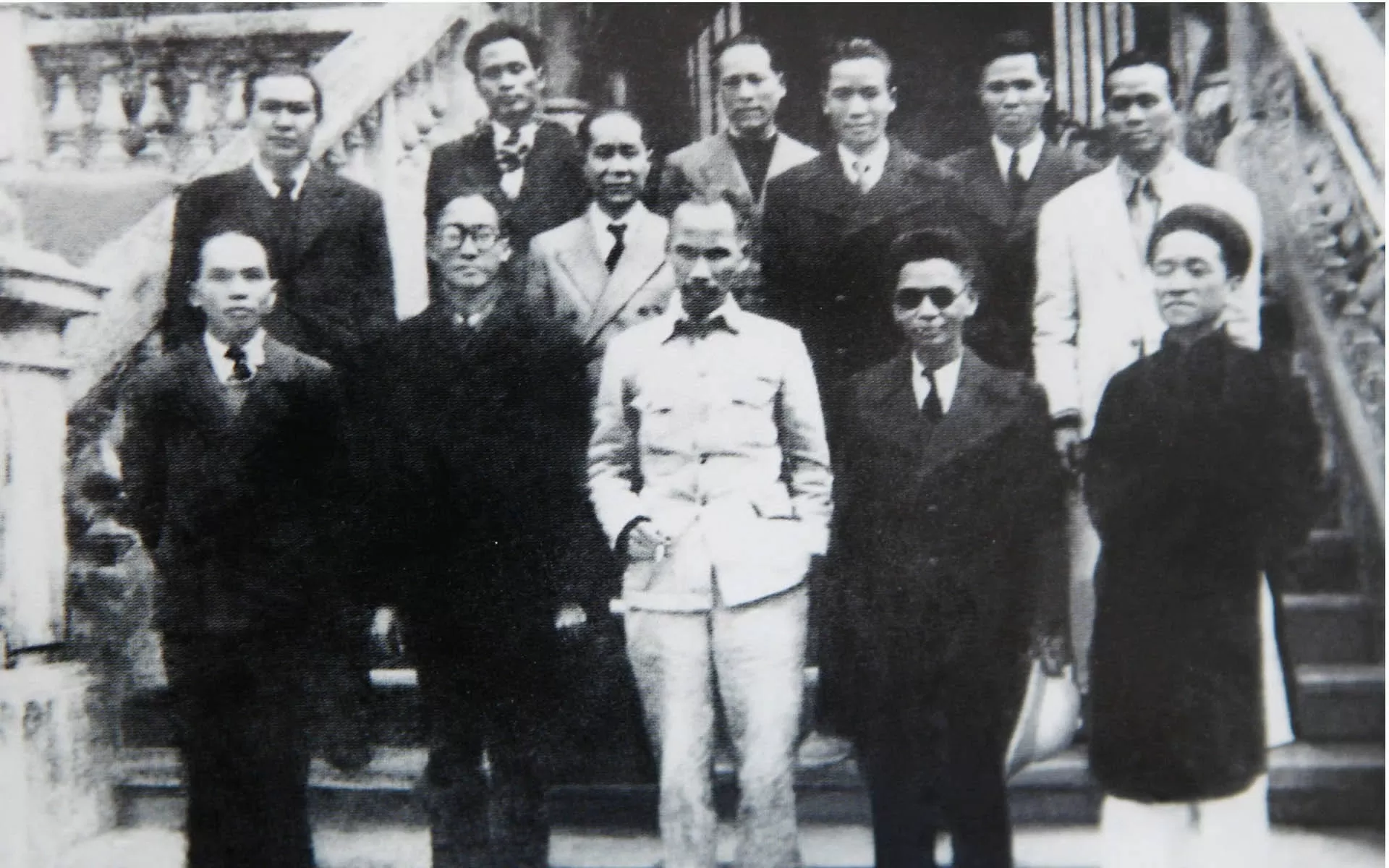 |
| President Ho Chi Minh and some members of the Provisional Government, September 1945. (Archival photo) |
From a historical perspective, President Ho Chi Minh inherited the experience of his forefathers, gathering and harnessing the strength of intellectuals for the resistance war and national construction. Today, when knowledge and science and technology directly become productive forces, the role of those who possess knowledge—the intellectual class—becomes even more crucial. Valuing and utilizing talented individuals is a vital factor in promoting national development.
A touching story
On September 18, 1946, the warship Duymont D'Urville departed from Toulon naval port, bringing President Ho Chi Minh back to Vietnam after nearly four months in France on a special diplomatic mission. On board were engineer Pham Quang Le, along with doctor Tran Huu Tuoc, engineer Vo Dinh Quynh, and engineer Vo Quy Huan. President Ho Chi Minh had granted the wish of these four talented young intellectuals to return home with him to participate in the impending resistance war.
Previously, Pham Quang Le was the chief engineer at a famous French aircraft manufacturing plant, earning a salary many people envied. However, the wealth he accumulated in France that he brought back to Vietnam consisted of nearly a ton of books and scientific and technical documents.
The sea voyage from Toulon to Hai Phong was also the time when four renowned French intellectuals attended a special "political training course" directly taught by President Ho Chi Minh himself, focusing on the revolutionary situation and tasks in their homeland. Seven days after returning to Vietnam, on October 27, 1946, President Ho Chi Minh personally assigned engineer Pham Quang Le the task of researching and manufacturing weapons for the army. Engineer Pham Quang Le became the first Director of the Ordnance Department of the Vietnam People's Army. He became famous under the name Tran Dai Nghia, chosen by President Ho Chi Minh himself.
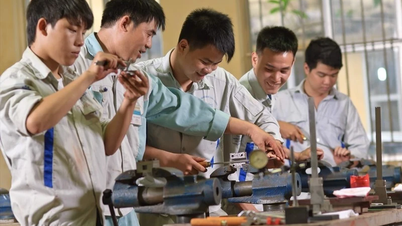
While conducting scientific research and leading the nascent national defense industry during the arduous years of the resistance war against the French, engineer Tran Dai Nghia was also a dedicated teacher, training a workforce of military ordnance workers and technical officers. Many generations of his students continued his work, contributing to victories against invaders and the firm protection of the Fatherland.
 |
| Professor Tran Dai Nghia. |
From the depth of history
During the feudal era, the examination system was responsible for selecting talented individuals. Many doctoral graduates became famous politicians, diplomats, educators, and cultural figures, making significant contributions. Not a few talented people were given important positions regardless of their age, background, or social status.
In the modern era, Vietnamese intellectuals, with their patriotic tradition and deeply ingrained national spirit, played a crucial role in the dramatic economic, social, and cultural transformations in Vietnam during the first half of the 20th century. Many intellectuals used the knowledge they acquired from France as a weapon in the national struggle.
Notable patriotic intellectuals include Phan Van Truong, Nguyen An Ninh, Dao Duy Anh, Pham Ngoc Thach, and Nguyen Huu Tho, who enjoyed immense admiration from the public. They set aside comfortable material lives, promised privileges and glory, and disregarded threats of punishment from the colonial government to spearhead numerous struggles to protect the rights and interests of the people and the nation.
In the early days of building the people's government, President Ho Chi Minh emphasized: "Resistance must go hand in hand with national construction. Only with victory in resistance can national construction succeed. Only with a sure success in national construction can resistance be quickly victorious. Construction requires talented people. Although our country does not yet have many talented people, if we are skillful in selecting, distributing, and utilizing them, then talented people will develop and multiply day by day."
In the same spirit as Than Nhan Trung wrote on the first stone stele in Thang Long Temple of Literature more than five hundred years ago (1484), "Talented people are the lifeblood of the nation. When the lifeblood is strong, the nation will be strong and progress," during the difficult and challenging early years of the new Vietnam, President Ho Chi Minh cherished the contributions of talented people.
Intellectuals and scholars responded to President Ho Chi Minh's respectful invitation to talented individuals. Many were appointed to the Standing Committee of the National Assembly and the Government by the first National Assembly. The renowned scholar Nguyen Van To was elected by the National Assembly to serve as the head of the Standing Committee, along with other members who were prominent intellectuals of the time: Bui Bang Doan, Hoang Van Duc, Nguyen Tan Gi Trong, Hoang Minh Giam, Duong Duc Hien, etc.
The coalition government of resistance included many intellectuals as ministers: Huynh Thuc Khang, Phan Anh, Vu Dinh Hoe, Tran Dang Khoa… The University Affairs Office was headed by Dr. Nguyen Van Huyen… Vietnamese intellectuals and talents were valued and utilized by the Government, led by President Ho Chi Minh, on the fronts of resistance and nation-building in the early years of the young republic and throughout the subsequent stages of protecting independence and building the country.
Utilizing talent in the new context
The process of accelerating industrialization and modernization of the country is creating new demands for high-quality human resources. Developing and improving the quality of human resources, especially high-quality human resources, plays a strategic breakthrough role in meeting development requirements in the context of the ongoing Fourth Industrial Revolution and deep international integration in a globalized world.
General Secretary To Lam emphasized the awareness of the nation's new era: Cadres and cadre work are "extremely crucial" issues, "deciding everything," "cadres are the root of all work," and the decisive factor in the success or failure of the revolution. Building a team of capable cadres to lead the country into a new era, the era of national progress, is an urgent necessity.
Exceptional individual talent often contains an element of innate ability. However, these qualities must be nurtured through a long and arduous process of training. For individual talent to manifest and be utilized, developed, and beneficial to society, it requires the appreciation of leaders and the encouragement of society as a whole, along with a broad network of connections and interactions.
Cultivating and nurturing talent embodies a philosophy of life among people. Valuing talent demonstrates the superiority of the social system. These are the cultural aspects that constitute the "soft power" of the nation that we strive to build.
For each individual, the requirement for professional expertise is placed alongside the requirements for moral character and integrity. Besides innate qualities, the process of rigorous training to perfect both ability and character is essential to becoming an outstanding individual, a talented person with profound cultural and humanistic values.
At the macro level, there is the "National Strategy on Attracting and Utilizing Talents to 2030, with a Vision to 2050," issued by the Government on July 31, 2023. This strategy encourages the search for talent, identifying individuals with exemplary moral character and lifestyles; those with a desire to contribute and serve the nation and its people; while also emphasizing the responsibility of those who recommend and nominate talent; and ensuring openness, transparency, and democracy in the process of recommending, nominating, and recognizing talent.
We have been implementing these policies, applying mechanisms and screening criteria to ensure that truly virtuous and talented individuals are not overlooked, while also preventing those lacking the necessary qualities from being overlooked, so that more talented people will emerge and be given the recognition they deserve.
Source
![[Photo] White pear blossoms bloom across the border of Pho Bang](https://vphoto.vietnam.vn/thumb/1200x675/vietnam/resource/IMAGE/2026/02/24/1771927665653_a8-8280-jpg.webp)
![[Image] A dreamy "livable city" under pink clouds](https://vphoto.vietnam.vn/thumb/1200x675/vietnam/resource/IMAGE/2026/02/24/1771930060937_tp4-jpg.webp)
![[Photo] Head of the Central Propaganda and Mass Mobilization Department visits and congratulates the Ministry of Health and the Military Traditional Medicine Institute.](https://vphoto.vietnam.vn/thumb/1200x675/vietnam/resource/IMAGE/2026/02/24/1771938483290_img-2682-3562-jpg.webp)














































Comment (0)