

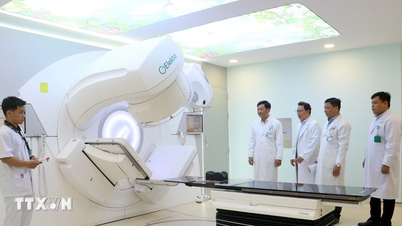
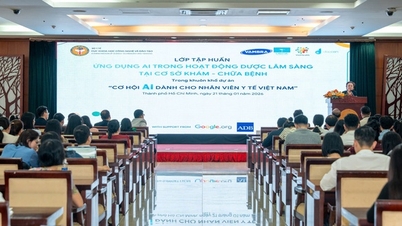
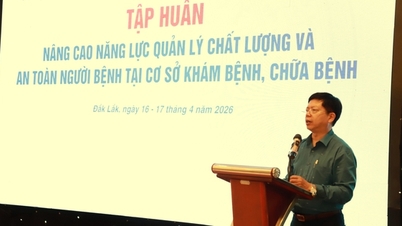
Artificial intelligence (AI) technology is creating tremendous breakthroughs in many fields, especially healthcare . Not only does AI assist doctors in medical examinations, but it also helps improve the quality of healthcare for patients.
Artificial intelligence (AI) technology is creating tremendous breakthroughs in many fields, especially healthcare. Not only does AI assist doctors in medical examinations, but it also helps improve the quality of healthcare for patients.
Early detection of difficult cases
According to Professor Pham Minh Thong, President of the Vietnam Society of Radiology and Nuclear Medicine, diagnostic imaging is one of the leading applications of AI in healthcare. AI can help detect diseases quickly and accurately, saving doctors time and detecting small lesions that are difficult to see with the naked eye.
Associate Professor Dr. Dao Viet Hang, from the Endoscopy Center ( Hanoi Medical University Hospital), shared that in addition to X-ray imaging, many hospitals have applied software integrating AI algorithms to detect liver cancer via CT scans or MRI, and to diagnose the stage of colorectal cancer. In the fields of endoscopy and pathology, AI has helped minimize errors and improve diagnostic accuracy.
Another example is smartphone applications for patients with diabetes, high blood pressure, and hepatitis B. AI reminds patients to take their medication on time, provides questionnaires to help stratify disease risk, detects early warning signs of potential complications, helps patients connect with healthcare facilities early, minimizes emergencies, and improves treatment effectiveness.
AI plays a crucial role in the early detection of cancer. Many major hospitals have applied AI to analyze patients' imaging and genetic data, providing accurate predictions of cancer risk.
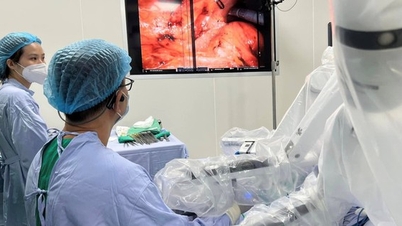
According to Dr. Chu Tan Sy, Head of the Neurosurgery Department (Neurology Center, Tam Anh General Hospital, Ho Chi Minh City), in the past, classic brain surgery methods such as navigation and microsurgical microscopes could not visualize nerve fiber bundles in relation to tumors or hematomas during surgery, leading to the risk of cutting nerve fiber bundles and causing severe sequelae for patients. With the development of technology, the new generation Modus V Synaptive brain surgery robot, which applies AI at a sophisticated level, has overcome these limitations. The robot helps doctors clearly observe the tumor, nerve fiber bundles, and healthy brain tissue on a single 3D image, both before, during, and after surgery.
Robots allow surgeons to simulate surgery in a 3D environment before the actual operation, helping them proactively choose a safe approach to the tumor and avoid damaging vital nerves. The robot continuously monitors the surgery, alerting the surgeon with light signals to ensure that the manipulation follows the established surgical path during the simulation, thus enhancing safety. This results in superior treatment effectiveness, allowing surgeons to remove the maximum amount of tumor while preserving brain function for the patient.
The solution to the healthcare shortage problem.
According to the World Health Organization (WHO), by 2030, there will be a shortage of approximately 18 million healthcare workers globally, posing a major challenge to the healthcare sector. A potential solution is the application of AI in medical examination and treatment, helping to support doctors in diagnosis and treatment, reducing the workload for healthcare staff, and improving patient care efficiency.
As infectious diseases threaten global health, AI plays a crucial role in detecting infectious diseases, especially tuberculosis. In areas lacking specialist doctors, AI-integrated X-ray machines can detect tuberculous lesions quickly and accurately.
In Vietnam, the application of AI in tuberculosis detection has achieved significant results. Associate Professor Dr. Dinh Van Luong, Director of the National Lung Hospital, said that AI integrated into X-ray machines helps detect tuberculosis early, doubling the effectiveness of detection. This is particularly useful in district-level medical facilities and remote areas where there is a shortage of tuberculosis specialists.
In the field of musculoskeletal disorders, according to Associate Professor Dr. Le Manh Cuong, Director of Tue Tinh Hospital (Vietnam Academy of Traditional Medicine), the hospital is also updating AI and robots in the treatment of musculoskeletal diseases and rehabilitation, in combination with traditional medicine solutions.
At Hanoi Medical University Hospital, doctors are using AI to analyze ultrasound, computed tomography (CT), and magnetic resonance imaging (MRI) images for early detection of breast cancer. AI helps detect small tumors that would otherwise be undetectable by traditional methods, enabling doctors to make timely diagnoses and apply appropriate treatments. As a result, patients receive early treatment, have higher survival rates, and experience reduced unnecessary risks.
At Hung Vuong Hospital, AI is used to monitor the health of diabetic patients. This system can analyze physiological indicators such as blood glucose levels, heart rate, and blood pressure, alerting doctors to abnormal changes and helping them intervene promptly to prevent dangerous complications.
Source: https://baodautu.vn/ai---tro-ly-dac-luc-cua-cac-blouse-trang-d249219.html




![[Photo] General Secretary and President visit the China-ASEAN AI Application Cooperation Center](https://vphoto.vietnam.vn/thumb/1200x675/vietnam/resource/IMAGE/2026/04/17/1776404277677_vna-potal-tong-bi-thu-chu-tich-nuoc-tham-trung-tam-hop-tac-ung-dung-ai-trung-quoc-asean-8706616-2286-jpg.webp)























![[Photo] National Assembly Chairman Tran Thanh Man attends the policy seminar to promote Vietnam-Türkiye cooperation.](https://vphoto.vietnam.vn/thumb/1200x675/vietnam/resource/IMAGE/2026/04/16/1776351415367_vna-potal-chu-tich-quoc-hoi-tran-thanh-man-du-toa-dam-chinh-sach-thuc-day-hop-tac-viet-nam-tho-nhi-ky-8705791-jpg.webp)



































































Comment (0)