

Every year, from September to November in the lunar calendar, after harvesting the last tea crops of the year, some households in the villages of Sung Phai commune ( Lai Chau city) harvest the mature tea fruits to plant in order to expand their area and increase their income.
This year, due to busy work schedules and the need to exchange labor with other households, the family of Ms. Sung Thi Cua in Trung Chai village harvested tea leaves later than in previous years.
Ms. Cua shared: "For about 7 years now, my family has been harvesting tea berries to plant every year. We mainly get the berries from the old tea plantations of our neighbors. This area is far from our village, so I have to bring lunch and work through lunchtime to save time going home. In seasons with many laborers, we can get 5 bags of tea berries. We plant a little more each year, and now my family has two tea plantations planted from seeds, yielding 1.5 - 2 tons of tea per harvest. Thanks to this, our family's income has increased significantly."
Ms. Phê Thị Xá's family in Hồi Lùng village has been growing tea from seeds for many years. She doesn't know the exact area of her family's tea plantation, only that they currently have three tea fields that yield a steady harvest. Recognizing the potential of tea cultivation, last year she and her husband converted their less productive land to tea cultivation. Their tea plantation expanded to four fields, three of which are planted with tea from seeds. Ms. Xá shared: "About a week after harvesting the tea berries, I sow the seeds directly into the production field. If left for too long, they spoil easily, so my family plants the tea quickly, completing the plan by the beginning of December in the lunar calendar at the latest."
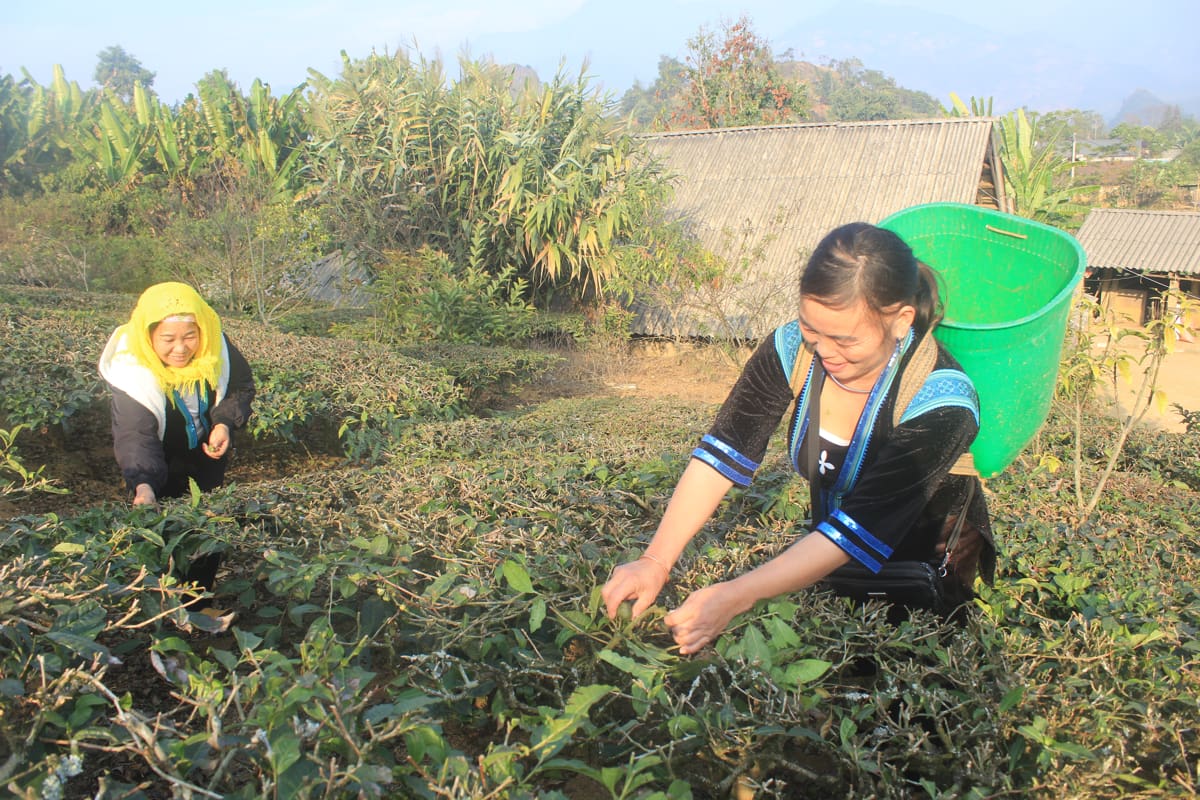
People in Sung Phai commune harvest tea leaves to plant.
The reason some families continue to grow tea from seeds is because the seeds are sourced from old, local Shan tea plantations, 40-50 years old, with strong vitality, requiring little care and no investment in contour lines. Furthermore, Shan tea adapts well to the local climate. Moreover, the planting technique is easy to do, suitable for the traditional farming methods of the local people, with a high survival rate, especially with minimal impact from hot weather. Farmers can obtain seeds for planting without spending money on seedlings. In addition, it allows for proactive production planning. To achieve a high germination rate, farmers usually choose mature tea berries for planting, avoiding unripe or fallen berries. Compared to growing tea from seeds, tea grown from seeds is harvested later, after 3 years, but the yield is comparable while the harvesting period is longer.
Mr. Tan A Pao, Vice Chairman of the People's Committee of Sung Phai commune, said: Currently, the commune has about 425.8 hectares of tea, most of which is tea grown from seeds, concentrated in the villages of Trung Chai, Ta Chai, Cu Nha La, Hoi Lung, and Suoi Thau. Following the city's policy of developing commercial tea products, from 2015 to the present, the commune has repeatedly provided Kim Tuyen tea seedlings, and last year provided Shan tea seedlings to the people in the commune. Households registered to plant according to their available land. However, due to the demand from households wanting to plant local Shan tea, at the end of each tea season, people often harvest the fruit and plant it. From years of production experience, planting tea from seeds has proven effective. Therefore, along with promoting and encouraging people to plant tea from seedlings, the commune encourages families to plant tea from seeds to increase the economic value of their land. Planting tea from seedlings requires significant investment costs. Meanwhile, there are still many struggling families with low incomes.
Currently, Sung Phai commune is focusing on managing, protecting, and caring for existing tea plantations and planting new ones effectively. They are strengthening the management of fertilizer and pesticide use towards safe production, ensuring consumer health, and striving to achieve a fresh tea leaf yield of 3585.4 tons, thereby improving the quality of life for the people.
Source: https://baolaichau.vn/kinh-t%E1%BA%BF/tr%E1%BB%93ng-ch%C3%A8-b%E1%BA%B1ng-h%E1%BA%A1t

![[Image] 20 islands in the Spratly Islands special administrative region hold early elections.](https://vphoto.vietnam.vn/thumb/1200x675/vietnam/resource/IMAGE/2026/03/08/1772949669607_img-20260308-112026-90-jpg.webp)
![[Image] Vietnam's diverse colors on its journey of innovation](https://vphoto.vietnam.vn/thumb/1200x675/vietnam/resource/IMAGE/2026/03/09/1773041390813_anh-man-hinh-2026-03-09-luc-14-28-17.png)

![[Photo] Diary of the photojournalism contest “Vietnam on the journey of innovation”](https://vphoto.vietnam.vn/thumb/1200x675/vietnam/resource/IMAGE/2026/03/09/1773041117692_anh-man-hinh-2026-03-09-luc-14-24-45.png)





















































![[Photo] Diary of the photojournalism contest “Vietnam on the journey of innovation”](https://vphoto.vietnam.vn/thumb/402x226/vietnam/resource/IMAGE/2026/03/09/1773041117692_anh-man-hinh-2026-03-09-luc-14-24-45.png)

























Comment (0)