Current farming practices are putting farmers under immense pressure regarding input costs. According to an analysis by Deputy Director of the Department of Agriculture and Environment, Tran Thanh Hiep, farmers are creating difficulties for themselves by overusing agricultural supplies. Specifically, using 70-80 kg of fertilizer per hectare costs approximately 1.5 million VND. Adding pesticides, the total cost can reach 2.6 million VND per hectare. In the context of fluctuating rice prices, this cost becomes a direct barrier, narrowing profits, and in some cases, only covering labor costs. This necessitates a drastic change in farming practices to "save" farmers' income, shifting from quantity to quality and sustainable efficiency.
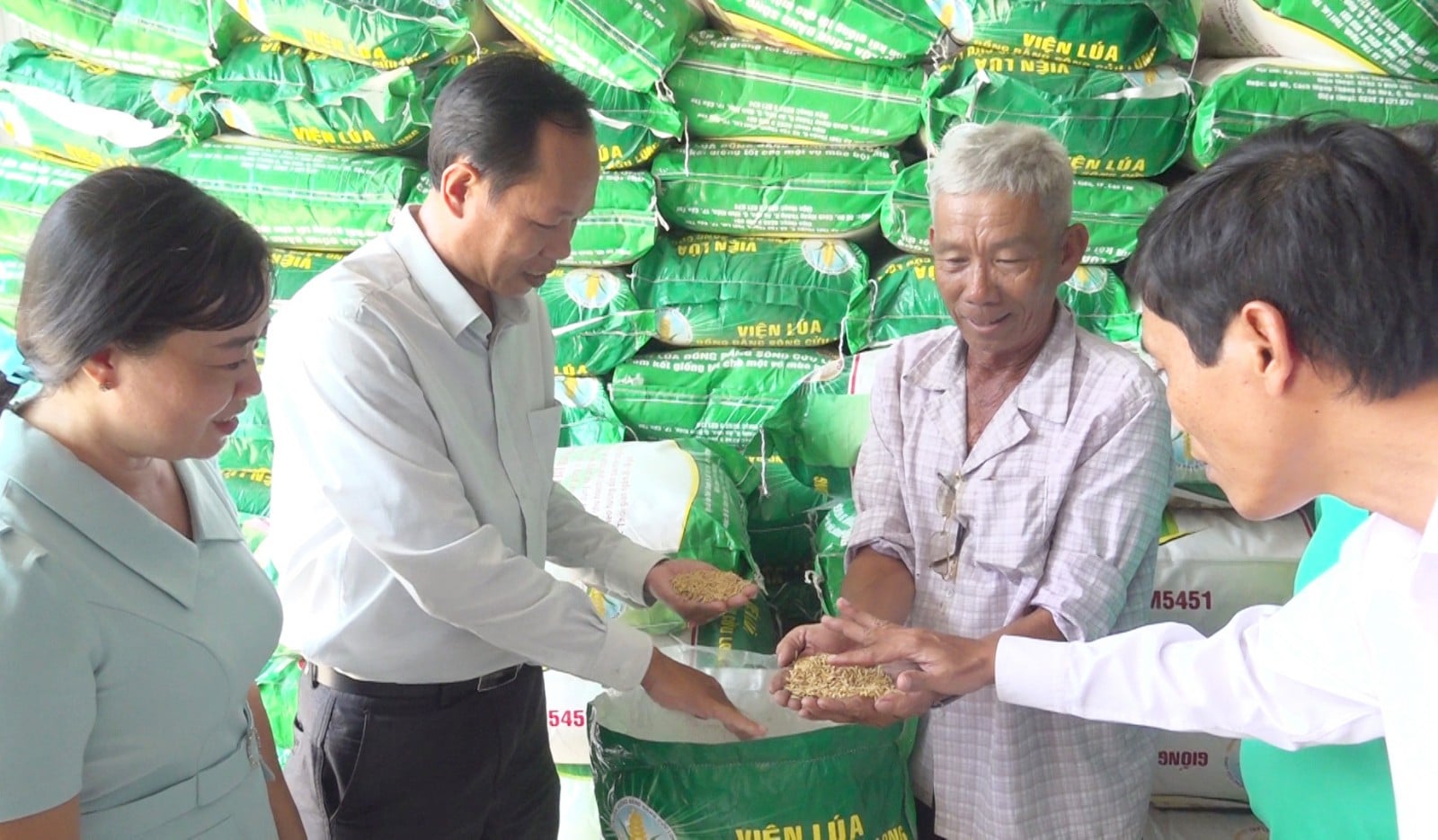
Farmers in Tay Binh hamlet, Thoai Son commune, receive support in the form of high-quality rice seeds. Photo: Phuong Lan
Amidst this whirlwind of pressure, the Hiep Loi Agricultural Cooperative in My Thuan commune has strived for self-improvement. Established in late 2018 with 35 initial members, the cooperative now attracts 72 members, raising its total charter capital to over 284 million VND and managing an area of 135 hectares. By 2025, the Hiep Loi Agricultural Cooperative boldly applied modern technologies such as using drones for spraying pesticides, investing in harvesting machines and transportation services, bringing in nearly 200 million VND in revenue and over 70 million VND in after-tax profit. More importantly, the cooperative plays a key role in linking with large enterprises such as SunRice Company and Tan Long Group to guarantee the purchase of products from farmers.

However, the path to innovation remains fraught with challenges. Despite linking up to sell approximately 1,400 hectares of crops during the 2025 winter-spring season, price fluctuations have resulted in only about 500 hectares having their prices fixed under contract. Limitations in financial capacity, infrastructure such as warehouses and pumping stations, and the lack of a stable office remain significant obstacles that need to be overcome for the cooperative to achieve breakthroughs.
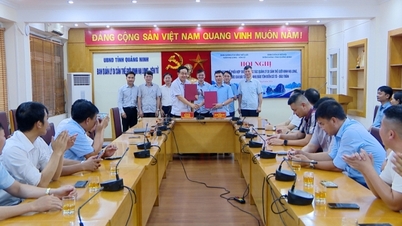
During a site inspection at Hiep Loi Agricultural Cooperative, Vice Chairman of the Provincial People's Committee Ngo Cong Thuc requested that relevant departments review the legality of linkage contracts, ensuring transparency and accountability between businesses, cooperatives, and farmers. This is key to maintaining a stable supply chain and preventing contract breaches when market prices fluctuate. Cooperatives should not only focus on traditional services but also improve their capacity, manage according to the agricultural enterprise model, and apply technology to replace outdated practices. To protect farmers' rights, the Department of Industry and Trade and other relevant agencies need to strengthen inspections of fertilizer and pesticide prices and quality. "We must support farmers, preventing them from buying counterfeit or substandard products that hinder rice growth and incur additional costs," Mr. Ngo Cong Thuc directed.
In terms of technical solutions, the province's agricultural sector is accelerating the cost reduction roadmap through the Project on 1 million hectares of high-quality, low-emission rice cultivation. Mr. Tran Thanh Hiep recommended that farmers quickly shift their mindset from using diesel pumps to electric pumps and apply alternating wet and dry irrigation techniques. This technique not only helps reduce water consumption by 3-4 times but also makes rice plants healthier and reduces pests and diseases. The core goal of applying new technologies and processes is to reduce input costs and ensure farmers' profits. To support this goal, according to Mr. Hiep, the Provincial People's Committee has directed a review of the dike system and electric pumping stations and created maximum conditions for cooperatives to access preferential credit sources.
Alongside this, high-quality rice production models are being strongly implemented in localities. In the 2026 summer-autumn crop season, Thoai Son commune continued to implement a high-quality, low-emission rice production model linked to green growth in the Mekong Delta on a 50-hectare scale in Tay Binh hamlet, attracting 11 participating farmers. A highlight of this model is the practical support from the State, including: 50% of seed costs, 50% of fertilizer costs, and 30% of pesticide costs. Farmers have access to the high-yield OM5451 rice variety and apply an advanced sowing process using only about 65 kg/ha. Compared to the previous practice of dense sowing, reducing the amount of seed combined with transplanting and row planting methods significantly saves costs and limits pests and diseases from the beginning of the season.
The implementation of this model helps farmers access modern farming practices, aiming for sustainable production and reduced greenhouse gas emissions. This is a crucial component of the 1 million hectare high-quality rice monoculture project that An Giang province is determined to implement. As bottlenecks in capital, infrastructure, and legal frameworks are gradually resolved, An Giang rice will not only achieve food security but also affirm its position as a green, clean, and sustainable brand in the market.


PHUONG LAN
Source: https://baoangiang.com.vn/trong-lua-khong-doi-cach-kho-co-loi-a484581.html

![[Photo] General Secretary and President To Lam attends the Central Public Security Party Committee Conference](https://vphoto.vietnam.vn/thumb/1200x675/vietnam/resource/IMAGE/2026/06/24/1782302063612_a1-bnd-9302-9166-jpg.webp)
![[Photo] Opening Ceremony of the 13th National Congress of the Ho Chi Minh Communist Youth Union](https://vphoto.vietnam.vn/thumb/1200x675/vietnam/resource/IMAGE/2026/06/24/1782286753905_ndo_br_1-8510-jpg.webp)
![[Photo] The 13th National Congress of the Youth Union conducts personnel work.](https://vphoto.vietnam.vn/thumb/1200x675/vietnam/resource/IMAGE/2026/06/24/1782299943080_ndo_br_1-6868-jpg.webp)