


 |
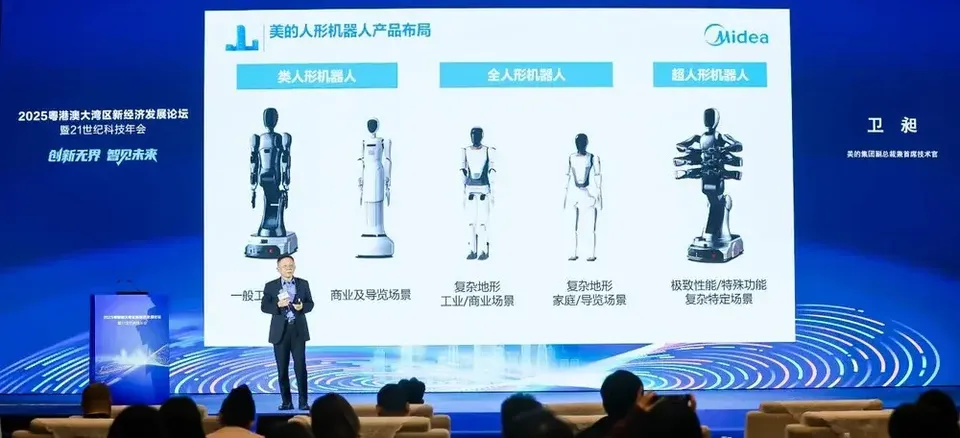
Wei Chang introduces the six-armed robot at the forum. Photo: Humanoids Daily . |
On December 5th, at the Greater Bay Area New Economic Forum 2025 in Guangzhou, Midea introduced MIRO U, a machine they call a "super humanoid robot." This is the world's first product with a wheeled design, legs, and six arms, designed to handle complex industrial tasks and automation with high efficiency.
This robot represents a significant departure from traditional humanoid designs. While still possessing a human-like head and torso, it sits atop a wheeled, leg-like frame and boasts six bionic arms, a design choice Midea claims "breaks the physiological limits of humans."
Miro U is an upgraded version of Midea's previous wheeled humanoid robot, and will soon be put into production. The older model worked alongside autonomous mobile machines (AMRs), one-armed quad-wheeled robots, the Kuka robotics system, and human workers.
Wei Chang, Vice President and Chief Technology Officer of Midea, confirmed that Miro U is the third generation of humanoid robots in the company's product line. The company developed this technology entirely in-house.
The robot's design logic is based on multidimensional collaboration. Miro U uses its lower arms to lift heavy components, while its upper arms perform delicate tasks such as assembling or tightening parts.
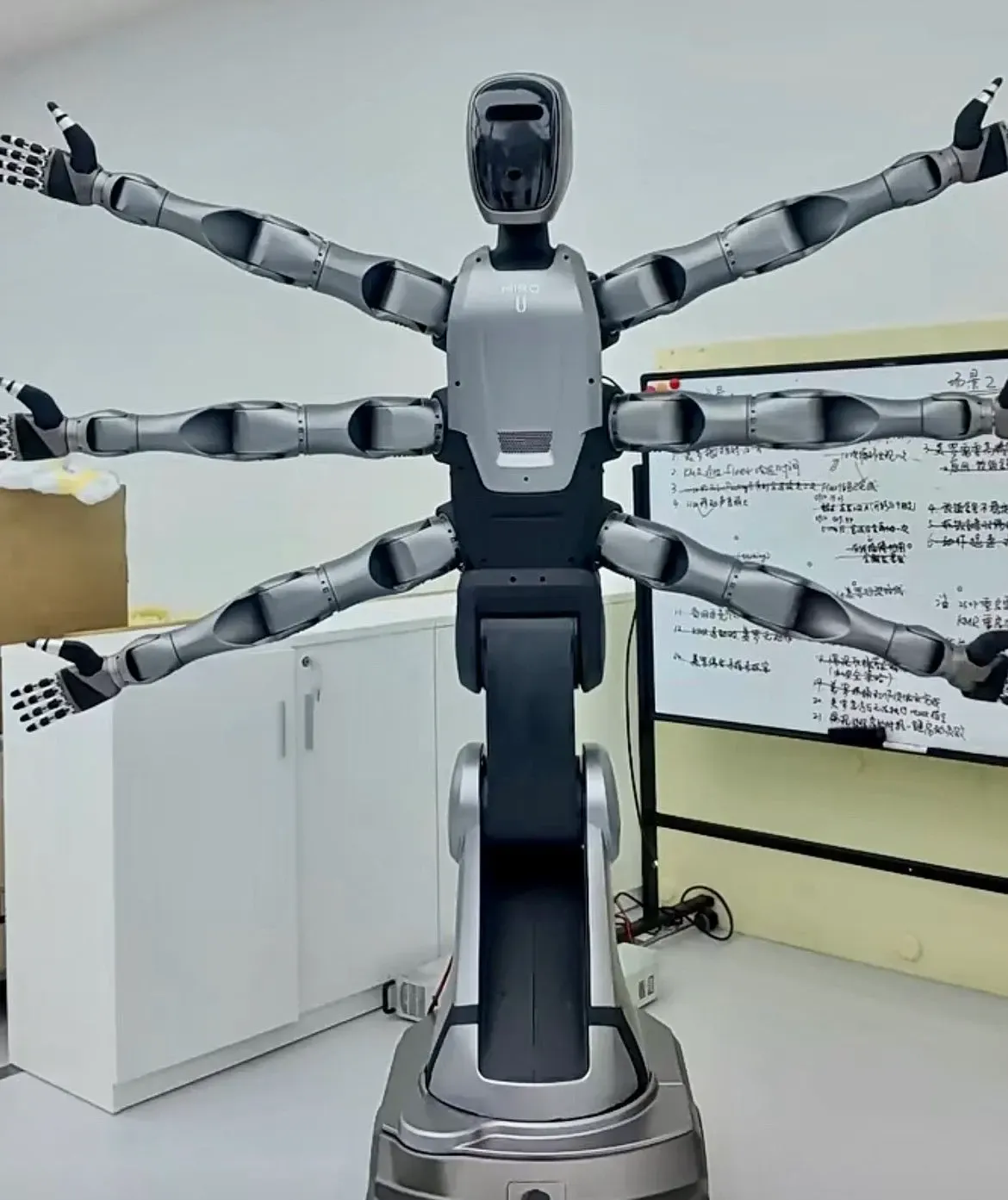 |
The Miro U is equipped with six mechanical arms, wheels for mobility, and a flexible, detachable head. Photo: Weibo. |
The robot is capable of rotating 360 degrees in place and lifting vertically with stability. This allows for directional flexibility, whereas humans have to rotate their entire body. Additionally, the end-effectors can be quickly detached and reattached, allowing for almost instantaneous switching between tools.
Midea is progressing rapidly from the prototype stage to real-world testing. The company confirmed that the MIRO U will be put into service at the Wuxi Premium Washing Machine Manufacturing Plant before 2026.
According to Humanoids Daily, this is not a general-purpose deployment as the robot is assigned a specific task. Midea says MIRO U will improve efficiency in switching and adjusting production lines by 30%. The robot does not need rest and can perform the work of three pairs of hands simultaneously. By automatically regulating the production beat rate, Midea expects to demonstrate the feasibility of complex automation in a flexible manufacturing environment.
Through this move, Mr. Wei clarified Midea's two-pronged robotics strategy. The Miro (industrial) line focuses on heavy-duty capabilities, high precision, and factory environments.
Meanwhile, the Meila (service) line is designed for commercial and home use. The company says robots in this line are in the final stages of testing and are expected to be able to perform tasks such as operating coffee machines or navigating retail spaces. Midea plans to introduce the Meila line into its stores to assist with customer guidance starting in 2026.
The company stated that it will continue to invest in artificial intelligence and robotics. The large-scale deployment of humanoid robots remains a key priority in Midea's long-term strategy.
In the billion-person market, Unitree has just launched its first wheeled humanoid robot, equipped with observation, manipulation, and self-learning capabilities. Dobot's new $1,000 robot dog is emerging as one of the smartest robotic pets on the market.
Source: https://znews.vn/trung-quoc-ra-mat-robot-6-tay-post1609317.html



























































































Comment (0)