

SGGP
Ho Chi Minh City – a city practically "born" amidst rivers, embraced by the waters of the Saigon River, Ben Nghe Canal, Thi Nghe Canal… These rivers and canals blend into the city, participating in its structure and development process.
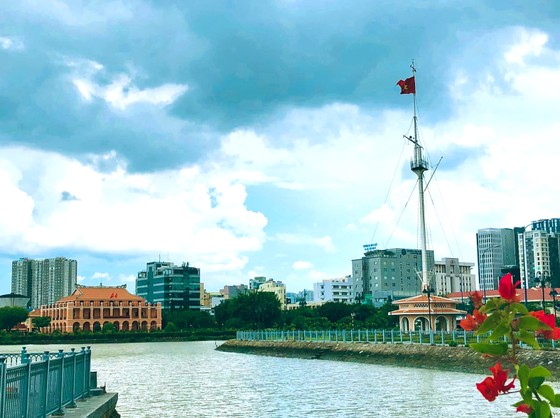 |
| The Thu Ngu flagpole stands over 150 years beside the Saigon River. |
Every architectural development of the existing city center is reflected on the waterways, like soft silk ribbons flowing through the urban landscape.
The early heritage of the city formed along the Saigon River still includes the Thu Ngu flagpole, marking the time when people migrated south to establish villages and settlements. Regarding the name "Thu Ngu flagpole," cultural researcher Nguyen Dinh Tu shared: "Thu" is understood as a guard post established at border areas with forests and mountains, places where the government had not yet gained administrative control. Thu posts were set up along streams, single-lane roads, and ferry crossings, with the purpose of controlling movement and collecting taxes. Thu Ngu has two meanings: firstly, a military officer in charge of a border guard unit; secondly, an official in charge of a Thu post, smaller than a Tuan Ty, responsible for tax collection."
According to numerous historical documents of the Southern region and in Truong Vinh Ky's book "Historical Memories of Saigon and its Surroundings" (1885), the following information is provided: The Department of Commerce (Direction du Port de Commerce), also known as the Department of Customs, was located on the site of what was formerly a guard post and a rest stop for high-ranking officials traveling from Hue to Saigon. Thus, before 1802, there was a garrison of the Nguyen lords at this river mouth, both maintaining security and collecting taxes. In the former Gia Dinh province, communication and official documents relied solely on river stations.
The Thu Ngu flagpole was built by the French in October 1865 at the confluence of the Ben Nghe canal and the Saigon River, opposite Nha Rong Wharf, now located at the beginning of Ham Nghi Street (2 Ton Duc Thang Street, Nguyen Thai Binh Ward, District 1). The flagpole is a technical component that functions to manage ship traffic in and out of the port. The architecture of the Thu Ngu flagpole is quite unique, consisting of three stepped levels. The bottom part is a raised platform, above which a building is constructed around the base of the flagpole, with the central section being higher and featuring an octagonal roof...
With its origins as a city formed from waterways, reflecting the confluence of rivers and seas, ships and the port system became a characteristic feature of trade in Ho Chi Minh City for a time. The Thu Ngu flagpole also served a role in river trade, with a coded message hanging at its top; during the day, it displayed cloth flags, colored flags, or a black painted ball; at night, a light, sometimes white, sometimes red, served as a signal for ships entering Saigon port from Nha Be.
With the development of modern urban infrastructure, the Thu Ngu flagpole, no longer serving its original function, still stands beside the heritage river – the Saigon River – telling the story of its early beginnings. While guiding a group of Dutch tourists on a city tour, Phan Hoang Han (34 years old, a freelance tour guide residing in District 3) shared: “Thanks to these tours, I’ve paid more attention to the city’s heritage. Many people say that the city is young, only a little over 300 years old, but in reality, there are so many heritage sites for us to explore. It’s just a small space by the Saigon River, but many of my tour groups say they really like it because the impression of the city's riverside past is so wonderful.”
In May 2016, the Thu Ngu flagpole was classified as a city-level historical relic by the Ho Chi Minh City People's Committee. For over 150 years, the flagpole has stood there, witnessing the changes and development of the city… This heritage remains, as a concrete testament, for people today and tomorrow to look back on, to further love and be proud of the land they live in.
In everyday life, many folk songs mention the Thu Ngu flagpole, such as: "Saigon land, handsome men and beautiful women / The Thu Ngu flagpole is very tall…" According to the research of cultural scholar Nguyen Dinh Tu, the Thu Ngu flagpole has witnessed many historical events. Right at the Ben Nghe estuary on February 15, 1859, French warships fired the first shots attacking Gia Dinh citadel. The people of Ben Nghe bravely rose up against the invaders, planting stakes in the river, tying up boats and using fire tactics to block the enemy troops.
Source













































































Comment (0)