

Amidst the biting cold of early December, ornamental plant traders are still scouring the region for yellow apricot blossom trees. This type of tree, which blooms for Tet (Lunar New Year), has never lost its value, but its price truly skyrocketed at the beginning of last year, when the chairman of a central province launched a campaign encouraging every office and every household to plant an apricot tree in front of their house. The idea was brilliant, and it caused the price of apricot blossom trees to double, triple, or even reach billions of dong. Many bricklayers, carpenters, and motorbike taxi drivers suddenly quit their jobs to become apricot blossom traders.

Illustration: THANH SONG
After negotiating the price, the team digs up the tree, shovels, and digs up the soil, removing the root ball. If the soil is fertile, it's done in a day; if it's rocky, it takes a day at most. Occasionally, problems can arise. For example, when digging up the topsoil, they might find a particularly beautiful root system and the homeowner demands more money. Sometimes, they might encounter an old root stuck in waterlogged soil that's rotting, and the buyer will frown and beg the homeowner to reduce the price. And rarely, they might encounter an unexpected situation that makes both sides hesitate, like the story of digging up Mr. Binh's apricot tree.
When the shovel was used to cut the gourd in preparation for circling it, a "pop" sound was heard.
- Damn it, another rock.
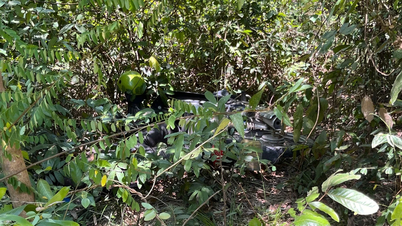
The digger cursed and grumbled, then brought the shovel down with another blow. A dark metal plate appeared in the ground.
- Copper? This time you've struck it rich, you should quit your job as a digger for good.
The man who had just put down the shovel squatted down in the hole he had dug, and when he brushed off the metal plate, he saw that it wasn't black but had a greenish-blue tint, speckled with rust.
- Oh no, son of a bitch.
He scrambled out of the pit, crawled on all fours, and ran onto the porch, his face pale. Two members of the tree-digging team rushed after him. Mr. Binh, hearing the commotion from inside the house, also hurried out.
- Oh my god, that's a box of bullets! I almost died. My soul almost left my body.
With a mixture of haste and gentleness, Mr. Binh went out into the yard, tilting his head to look into the hole in the ground. He was startled, but quickly regained his composure.
- That's a machine gun crate. Why is there an ammunition box here?
Mr. Binh's apricot blossom tree is a protected specimen, as bonsai enthusiasts would say, meaning it's an old tree with a thick, sturdy trunk and branches. It was planted during the liberation of his hometown, though no one knows who planted it, or if it grew naturally from seed. Half a century is as long as a human life, and in that same amount of time, the apricot blossom tree has aged considerably. In the old days, when times were tough, Mr. Binh and his son would often cut a few branches at Tet (Lunar New Year) to sell in the city to earn money for preparations. The cuts on the trunk have now healed, creating gnarled bumps that give it a very old, weathered look.
The age of the apricot tree coincides with the period from the restoration of peace to the present day. Whenever the old man met his fellow soldiers at home, he would often point to the apricot tree and count the years of peace. The apricot tree thus had a joyful commemorative mark. But who would have thought that beneath its roots lay an object that reminded them of a painful period?
If it could have exploded, it would have already exploded. Keep digging.
The buyer spoke in a commanding tone. It was difficult to find an old apricot blossom tree like this, one that could be called an ancient tree. And especially, when he had just dug up the soil, revealing a visually stunning base, with large, sturdy roots growing vigorously from the trunk down to the ground. "First the base, second the trunk, third the branches, fourth the variety"—all bonsai enthusiasts know this saying, it's the standard for judging an apricot blossom tree. A well-built base is always a good thing, and rightly so, because while branches can grow or be shaped, the root system is a gift from nature.
Yesterday, it took five attempts before Mr. Binh finally agreed. Two hundred million dong was the final price; no one in the whole area had ever sold or bought a plum blossom tree for that price. "Strong because of rice, bold because of money," he thought to himself. Trading in trees, not out of superstition, is like gambling; the more you fear losing, the easier it is to lose. He had already taken photos and videos of the tree to send to several wealthy bonsai dealers in Hue , and one customer had already offered half a billion dong. Wow, how could he make three hundred million dong in just one day? This would ensure a prosperous Tet holiday. Thinking about the profit, he disregarded everything else.
- What bullet? Let me go down and dig it up for you.
- No, no. If it explodes, you'll be in big trouble, and I'll be in even more trouble.
What does that mean? Does it mean the 300 million dong I was about to get is gone? And with the newly revealed wooden base, the price of the tree might even go up.
- Mrs. Thuong, where are you? Get me a cup and a plate.
Mr. Binh called into the house, asking for his wife. He was probably so panicked that he completely forgot his wife had gone to the market that morning. She was overjoyed; she had taken the twenty million dong deposit for the trees she kept in the cupboard, and had already taken a few bills to go to the market that morning. It's rare to get such a large sum of money; who wouldn't be happy?
Actually, Mr. Binh wasn't eager to sell the trees, because they held so many memories. It was his wife, Mrs. Thuong, who urged him to sell them now because they were fetching good prices. Last year, when the market wasn't booming, a tree of this size would have cost fifty million dong at most. If he didn't sell them now, they'd be worthless later. Just look at the banyan and fig trees; they were sky-high prices a few years ago, and now nobody wants them.
The apricot blossom tree stands right in the middle of the yard, like a screen, a common sight in the countryside. Its canopy spreads out in a perfect circle in all directions, its branches intertwined densely. This particular apricot blossom tree is remarkable; every year it blooms right around Tet (Vietnamese New Year) even without much care. The tree is large with many buds, beginning to burst open from mid-December and blooming brightly yellow until almost the end of January.
During Tet (Vietnamese New Year), visitors praised the land and the people for their good fortune, which allowed the apricot blossoms to bloom so beautifully. He placed a set of rattan and bamboo tables under the apricot tree to enjoy tea. On damp, misty spring mornings, the fragrance of the apricot blossoms was subtly sweet, a deep, rich scent unique to the yellow apricot blossoms with green shoots from Central Vietnam. No wonder the emperors in the capital loved them so much in the past, and now that very region is enthusiastically planting apricot blossoms in front of their houses.
Mr. Binh went inside to get a set of dishes and a stick of incense. He then came out and placed two yin-yang coins in his hand.
- You want to buy, and I want to sell. But you're afraid of dying, and I'm afraid of getting involved. Isn't that terrible? Maybe we should consult an oracle to see what heaven and earth think. An odd number means good fortune, an even number means bad luck. Please light an incense stick for me.
The couple had already planned out the 200 million dong they earned from selling the apricot tree last night. They would renovate the house to make it a decent place to live, as the old tiled roof was leaking and could be blown away by storms at any time. They would also raise the foundation and the yard a bit to protect against annual floods. Raising the yard would require moving the apricot tree, as they couldn't possibly bury its branches, so selling it was a reasonable decision. Another sum would be used to build a mausoleum for their grandfather on the village's allocated burial plot. Their grandfather was nearing the end of his life, his years were numbered, and as long as his eyesight was still good, they wanted to build a place for him to rest in so he would be happy. This way, they would achieve both goals; selling the tree meant selling decades of memories, but in return, they would have a decent place to live and fulfill their filial duty completely. "I'm sure you won't be sad, will you, husband?" Mrs. Thuong asked her husband, receiving a few nods in return.
Before Mr. Binh could even ask for the amulet, he saw Mrs. Thuong returning from the market with her basket. He put down his dishes, ran over, grabbed her, and pointed at her. After a brief whisper between the two, Mr. Binh's eyes lit up, as if all his fear and panic had vanished.
- Let's not buy or sell anything anymore. This was an unfortunate incident. Everyone needs money, but human lives are more important. Please understand, I'll take back your deposit for now. I'll call you to come and sell the trees when this matter is resolved.
Mrs. Thuong took out a stack of deposit money and gave it to the tree trader, telling him to count it. He didn't bother checking; he just stuffed it into his pants pocket.
- They say if you return the deposit, you have to pay double, sir. But never mind, we should be considerate of others. Remember to call me when you've finished dealing with that metal box. Don't sell it to just anyone.
Unlike his earlier reckless demeanor, he now seemed less eager to steal the apricot tree. Hundreds of millions of dong were nothing compared to a life. He told the workers to pack up their shovels, picks, and ropes and leave. The hole would be left as it was for the homeowner to deal with.
Mrs. Thuong carried out a plastic bag.
- I have some pig's intestines that I plan to make as a snack for you guys. Take them home and take care of them yourselves. And listen, don't tell anyone about the ammunition box. Otherwise, rumors will spread, and then no one will dare come here to visit during the holidays.
After the tree traders had disappeared from sight, Mr. Binh closed the gate and securely locked it.
- Have you ever heard anyone in the family talk about something being buried under the apricot tree?
- No way. I saw this apricot tree when I was little. Nobody has buried anything under it since then. - I mean, before that, in our grandparents' time.
- Let me think. Back then, I heard my grandparents were quite well-off, with vast fields and gardens, but they were classified as landlords. Later, the land was confiscated and redistributed to the villagers, leaving them with only this plot of land to live on. My grandfather died during that public denunciation campaign, and my grandmother lived for another ten years or so, but she didn't seem to be very mentally sound.
- Perhaps the grandparents put their valuables there and buried them because they were afraid of being discovered and confiscated. Later, she was too afraid of getting into trouble to tell anyone.
- What she said makes sense. But I suspect, I suspect, that period of 1972.
During the fiery summer of 1972, amidst fierce battles, the entire village evacuated just as the rice planting was finished. Months later, they returned to a golden, bountiful harvest. They heard that the smoke from the gunfire contained chemicals like fertilizer, making the rice thrive. Clusters of thatch grew everywhere on the hillsides, taller than a person's head, providing ample material to weave and re-roof houses. Grass also grew freely; every house's garden was overgrown with weeds, truly a deserted home. Mr. Binh was only ten years old at the time, but the image of his return to the village is deeply etched in his memory, never fading. Upon entering the house, he saw a camouflage canvas hammock left behind by American soldiers. His father told his wife and siblings to sit still while he went around the garden to check everything before they began tidying up. While clearing the grass in front of the house, they discovered a tiny apricot tree, no bigger than a toothpick, growing there, so everyone began tending to its roots.
It's highly likely that the ammunition crate was buried there by American soldiers.
- Why bury the ammunition crate so deep? It's at least a meter underground!
So what do you think?
- Gold and silver treasures are buried carefully.
Finding gold while digging is not uncommon. In the past, there have been instances in the area where people digging foundations for houses have unearthed ancient earthenware jars containing gold and silver. In the South, a farmer working in a field reportedly dug up a crate of ammunition filled with gold rings and necklaces – it was a seven-liter machine gun ammunition box, just like the metal container lying under the apricot tree. This type of container has a tightly sealed lid; in the past, those who owned one used it to store valuables, but now many people use it as a toolbox for repairing vehicles.
- Well, if you have the guts, go ahead and drag him up. I'm scared.
- He's a great guy. Let's go for it.
- Call Uncle An.
- Didn't you call yesterday? He said we have full authority. And he's right, because we live in the house and also take care of my father. Selling the apricot tree is to help with the family expenses, so we can't demand a share. Oh, but we don't know about that box yet, so don't rush into it.
- Sharing and dividing. Greed has already surfaced before anything has even happened.
Mrs. Thuong burst into tears.
- I'm poor, and I've run into you, who's also poor. Now that I'm about to get a little windfall, you're accusing me of being greedy. Go ahead, you and your brothers divide it among yourselves. I don't even want the money for the apricot blossom tree.
- I mean, he works at the provincial level, involved in the mine clearance project. He'll be able to get someone to come and check if there are any unexploded ordnance in the crate. He has to do it discreetly to avoid being caught.
That same afternoon, after the detection system found no danger, the ammunition crate was retrieved. Nervously, it was opened. Inside was only a neatly folded dark blue tarpaulin. Spreading the tarpaulin on the floor, it turned out not to be a tarpaulin at all, but a rectangular bag the size of a tabletop.
- We've seen this bag before. It's made entirely of nylon, so it won't get damaged no matter how long you keep it. American soldiers used to each keep one of these in their backpacks, just in case they died, they'd use it to hold their bodies.
Hearing the bomb disposal team member speak, everyone felt a chill run down their spines. However, it was clear that the small, flat bag couldn't possibly contain such a gruesome thing. Unzipping the bag, they found a bundle of parachute cord tied together like a puppet.
- There's another piece of paper here. It's all in English; Uncle An, if you know how to read it, try to see what it says.
Today, I received the news that you were born. Halfway around the world, I am overjoyed and incredibly happy. I braided a lovely doll for you, my daughter, with some parachute cord. But the fighting is so fierce here, I'm not sure I can bring this doll back to America for you. So I put it in a plastic bag and buried it, marking this day, this place, where I received the greatest joy of my life. Oh, but now that I have you, I certainly won't need that bag anymore. I must live and hope this terrible war ends soon so I can come back and see you. Later, I will plant a tree I just found, which the locals say is a plum tree. And soon I will give you a Vietnamese name, Mai, meaning Tomorrow. When we come back here to find it, the plum tree will surely be in bloom. With love, my child. Quang Tri, February 7, 1972, David Anderson.
***
This year, Mr. Binh's apricot blossom tree is still at his house, blooming with vibrant yellow flowers, drawing admiration from everyone who comes to celebrate Tet. Some people remarked, "It's already worth two hundred thousand dong, why not sell it?" Others advised him to leave it as it is, suggesting it might fetch several hundred million dong more. The couple just smiled.
Hoang Cong Danh
Source
































































Comment (0)