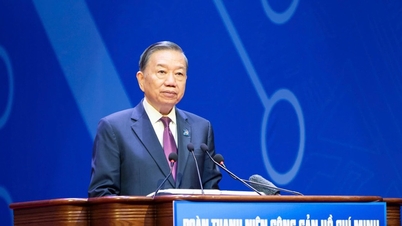
Here, the General Secretary emphasized that transforming the development model and establishing a new growth model first and foremost requires a strong shift in thinking: from extensive to intensive development; from reliance on resources and simple labor to reliance on knowledge, technology, and productivity; from management to development creation; from the State "doing things for" to "creating conditions for society and businesses to innovate." Along with this, it is necessary to fully utilize the role of all economic sectors, with the state-owned economy leading, creating, and paving the way; and the private economy being the most important driving force of the national economy...
It can be said that the two resolutions currently being drafted are two inseparable parts of the same problem, and the directions outlined by the General Secretary suggest a new development mindset for Vietnam in the coming period.
For many years, our economy relied primarily on expanding investment, exploiting resources, using unskilled labor, and taking advantage of low costs. This model was effective in the early stages of integration, but it has now approached its limits.
Currently, Vietnam is entering a period of population aging, labor productivity growth is slowing, resource reserves are shrinking, and environmental pressure is increasing. Meanwhile, the demand for quality growth is growing. If we continue on the old path, double-digit growth could easily become a resource-draining race.

In this context, the need for a radical shift in development thinking becomes even more urgent. Science , technology, innovation, and digital transformation are almost the only "lever" to enhance overall productivity, helping our economy climb to higher value chains in the global production chain.
Transforming the growth model cannot succeed if it only involves changing investment goals or priorities. New institutions are the decisive factor. The General Secretary's emphasis on shifting from "management" to "development creation" reveals a very specific requirement: the State needs to withdraw from its role of "doing things for others," focusing instead on building transparent, stable, and predictable rules of the game. In practice, many private businesses today have no shortage of ideas or aspirations for expansion, but are held back by lengthy procedures, high compliance costs, and unpredictable policy risks. In such an environment, innovation is unlikely to become an intrinsic driving force.
From an institutional perspective, clearly defining the roles of different economic sectors is crucial. In its role of "leading, creating, and paving the way," the state-owned economy needs to focus on key areas such as strategic infrastructure, economic security, and market sectors that are not yet performing well. Conversely, the private sector needs equal access to resources, especially long-term capital, land, and opportunities for innovation, along with firm guarantees of property rights and legitimate interests, to become the most important driving force of the economy.
The General Secretary has outlined the major directions; the remaining issue lies in the ability to translate this new development thinking into concrete, consistent reforms that have a widespread impact and can be effectively implemented in practice.



When the State truly acts as a facilitator, when the market is fully functioning, and when the private sector is given adequate space for innovation, high growth will not come at the cost of resources or macroeconomic stability, but will be the natural result of a development model based on knowledge, technology, and productivity. And this new development mindset will open up a trajectory of truly rapid, strong, and sustainable growth, helping Vietnam achieve its two centenary goals.
Source: https://daibieunhandan.vn/tu-duy-phat-trien-moi-cho-viet-nam-10402934.html