

The place where the last French soldiers withdrew from Vietnam.
Hai Phong , a land at the forefront of the waves and winds, the "eastern bulwark" of the Fatherland, holds a strategic position in the entire process of our nation's struggle to build and defend the country. The people of Hai Phong, with their fervent patriotism, courage, resilience, dynamism, and creativity, have witnessed and participated in many decisive and strategic battles in the wars of national liberation and defense of the Fatherland.
Following the 1954 Geneva Accords, Hai Phong became the last area in North Vietnam still under French colonial control. The 300-day struggle to take over the city demonstrated the Party's skill and political acumen, combining diplomatic, military, and mass mobilization efforts to force the French to withdraw peacefully, preserving the infrastructure and the lives of the people intact.
On July 20, 1954, the Agreement on Ending the War and Restoring Peace in Indochina was signed in Geneva. France committed to withdrawing its troops from the three Indochinese countries. The agreement stipulated a temporary military demarcation line for both sides to regroup at the 17th parallel: the People's Army of Vietnam north of the line, and the French army south of the line. The schedule for the withdrawal and relocation of French troops was stipulated as follows: 80 days around Hanoi, 100 days around Hai Duong, and 300 days around Hai Phong.
As the most strategically important location in the 300-day troop mobilization zone, with its system of seaports and airports such as Cat Bi Airport, Kien An Airport, and Do Son Airport, Hai Phong - Kien An became the only bridge connecting the South and the North during this period. This was where the French colonialists transported soldiers to the South, and where the US imperialists conspired to sabotage the Geneva Accords and plant spies before withdrawing from the North.
This struggle lasted for 300 days, until May 13, 1955, when the French troops withdrew from Hai Phong, marking the end of the struggle to implement the Geneva Accords in the city. This also marked the complete liberation of North Vietnam. From this point on, North Vietnam entered a new era – the restoration of its economy and culture, and the transition to socialism.
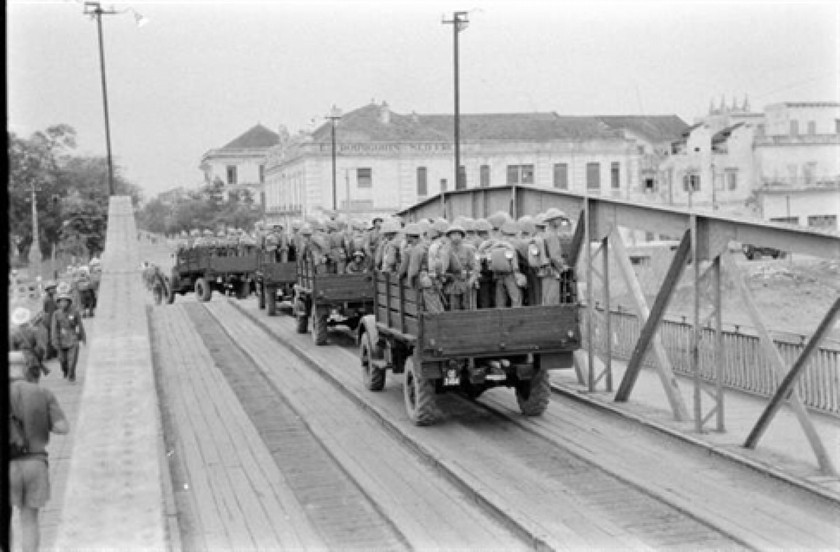 |
These rare photographs from the day of Hai Phong's liberation reveal a regular, elite, and continuously growing Vietnamese People's Army after overcoming many hardships. (Image source: Flickr) |
Hai Phong was free of enemy troops, and the North was completely liberated. The port city buzzed with excitement as a train carrying the red flag with a yellow star and a portrait of President Ho Chi Minh entered the port. Factories, offices, and ships simultaneously sounded their long horns, welcoming the glorious historical day of the port city and the nation. The victorious red flag with a yellow star proudly flew over Hai Phong, signaling the beginning of a new chapter in history. May 13, 1955, will forever be etched in the memory of the people of Hai Phong – the glorious and heroic moment of the city of "Courage and Determination to Win". In the People's Newspaper, he wrote with emotion and pride: “After enduring more than 80 years of humiliation, today Hai Phong has risen up and liberated itself. Throughout the streets, red flags with yellow stars flutter brightly like flowers blooming in spring. Tens of thousands of people, young and old, men and women, from all walks of life, spread out to welcome the soldiers and cadres. Everyone's faces are like spring flowers in bloom. The years of enduring hardship and fighting together have yielded glorious results. The North has been completely liberated. Hai Phong has been completely liberated.”
The victory of the struggle laid the foundation and created the conditions for building Hai Phong into one of the key industrial, economic, commercial, and defense centers of the North, making an important contribution to building a strong North, becoming a revolutionary base for the whole country, and a great rear area for the great front line in the South during the resistance war against the US to save the country.
With those outstanding achievements and victories, the Party Committee, the army and the people of Hai Phong, President Ho Chi Minh sent three letters of commendation and presented them with the rotating flag "Determined to defeat the American invaders," and the Party and State awarded them many prestigious medals.
During the years 1955-1965, Hai Phong was the center of patriotic emulation movements, the birthplace of the "Coastal Wave" emulation movement in industrial production, and the starting point of the emulation movement to build socialist labor teams and groups in the North. To support the Southern battlefield, K15 Wharf was built. This was the secret departure point of the "numberless" ships, the beginning of the epic on the sea: the legendary Ho Chi Minh Trail, becoming a symbol of national pride, embodying the will and aspiration for independence, freedom, and national unity. Many officers and sailors of these "numberless" ships were outstanding sons of Hai Phong. During these years, beloved President Ho Chi Minh visited Hai Phong nine times. His teachings will forever remain a precious legacy, guiding Hai Phong's development yesterday, today, and forevermore…
During the years 1965-1975, Hai Phong was a key target of American air and naval attacks. The Party Committee, military, and people of Hai Phong highly upheld the tradition of "Loyalty, Courage, and Victory" to fight and win, shooting down 317 American aircraft, breaking the enemy's blockade and mine-filled encirclement of the port, and ensuring the smooth flow of transportation and communication in all situations. In 1969, when the great President Ho Chi Minh passed away, Hai Phong was honored and proud to have successfully produced P.600 cement for the construction of his mausoleum. During the war years, tens of thousands of outstanding sons and daughters of Hai Phong "marched across the Truong Son Mountains to save the country," and countless others perished in the Truong Son Mountains, becoming one with the Vietnamese soil. The nation will forever be grateful for that noble sacrifice.
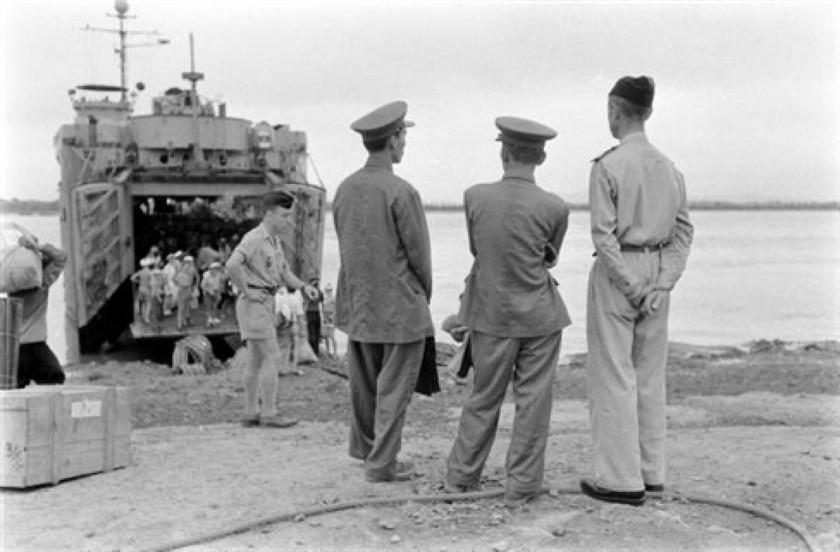 |
The last French soldiers boarded ships and left Hai Phong under the supervision of two officers of the Vietnam People's Army at Nghieng Wharf. |
Hai Phong takes the top spot in the Competitiveness Index ranking.
During the years 1976-1985, Hai Phong, along with the rest of the country, carried out two strategic tasks: national construction and defense. Hai Phong was the birthplace of the product-based contract system in agricultural production. These innovative steps and approaches of Hai Phong contributed to the formation of the Party's comprehensive reform policies.
From 1986 to the present, Hai Phong has undergone a strong transformation, implementing many breakthrough policies and leaving many outstanding marks in all fields. Particularly in the more than five years since the implementation of Resolution 45 of the Politburo, Hai Phong has achieved many outstanding results, consistently ranking among the top in the country in many aspects. In 2024, Hai Phong's economy rose to the 5th position nationwide; its economic growth rate was the highest among the 5 largest economies. Hai Phong is the only locality in the country to maintain a double-digit growth rate for 10 consecutive years; its budget revenue ranks 3rd nationwide; and it ranks 2nd nationwide in attracting foreign direct investment (FDI).
On May 6th, for the first time, Hai Phong City was recognized and evaluated by the business community as the top-ranked locality among the 63 provinces and cities nationwide. In the era of national development, the private sector is identified as the most important economic driving force of the national economy, a "lever for a prosperous Vietnam." Hai Phong City's mission is to lead the way in industrialization and modernization; to become a modern international port city, on par with leading cities in Asia…
In the coming period, Hai Phong is determined to unlock development drivers, focusing on implementing reforms and breakthroughs in the administrative apparatus; creating a modern, transparent, and open development institution; focusing on investing in modern urban and transportation infrastructure; supporting businesses in developing science, technology, innovation, digital transformation, and green transformation…
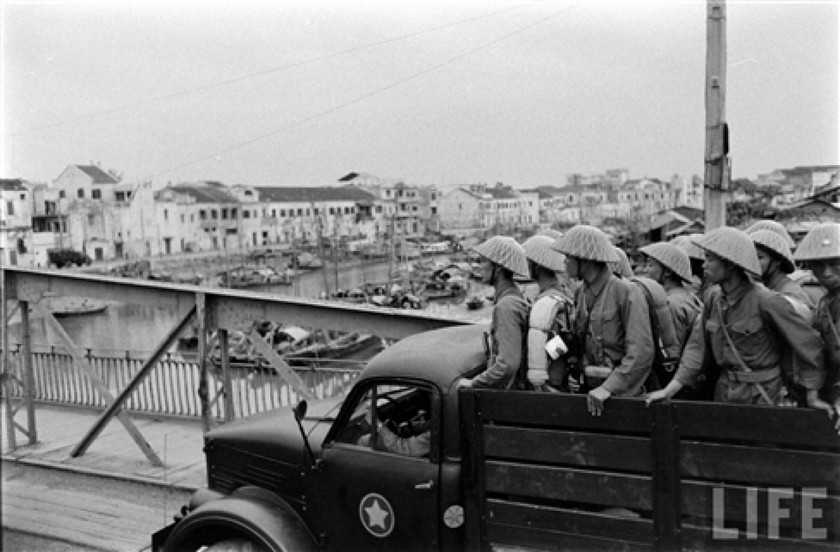 |
Wherever the French troops withdrew, our army immediately took over Hai Phong. |
The Provincial Competitiveness Index, conducted periodically since 2005, is one of the indicators used to assess the ability of local governments to build a favorable business environment and attract investment. Hai Phong, which ranked third last year, rose to first place on this list with 74.84 points. This is the third consecutive year that the city has been among the top three localities with the best economic governance quality. Hai Phong has also maintained a seven-year streak in the top 10 provinces and cities nationwide in the Provincial Competitiveness Index…
To commemorate the 135th anniversary of President Ho Chi Minh's birth (May 19, 1890 – May 19, 2025) and the 70th anniversary of the liberation of Hai Phong (May 13, 1955 – May 13, 2025), the Hai Phong Museum and Library, in collaboration with the Ho Chi Minh Museum, is organizing a thematic exhibition entitled "Hai Phong – Faith and Aspiration for Advancement".
Part I: Using our own strength to liberate ourselves (1888-1955) From a very early age, Nguyen Ai Quoc highly valued the importance of Hai Phong as the "Great Port of Tonkin," a crucial transportation hub on international maritime routes, and a national industrial center...
Part II: Hai Phong – A City of Courage and Victory (1955 – 1975) Throughout the 20 years of the resistance war against the American imperialist invasion (1955 – 1975), the Party Committee, army, and people of the city continued to uphold the tradition of courage and victory, successfully completing two strategic tasks: defeating the American invaders and building socialism, making a significant contribution to the liberation of the South and the reunification of the country.
After liberation, during the 10 years (1955-1965) of actively building and developing the economy, Hai Phong enthusiastically engaged in labor and production emulation, becoming the birthplace of the "Coastal Wave" emulation movement in industrial production. The Ca A small stone quarry became the "leading light" of the movement to build socialist labor teams, and was a cradle for nurturing students – the children of cadres from the South who relocated to the North for education.
During the 10-year period from 1965 to 1975, following President Ho Chi Minh's teaching, "Nothing is more precious than independence and freedom," the Party Committee, military, and people of Hai Phong united as one, "fighting well and producing well," wholeheartedly dedicating their human and material resources to support the great southern front, ensuring that "not a single grain of rice was lacking, not a single soldier was lacking."
With the spirit of emulation, "Hold the hammer firmly, hold the gun steady," the people of the city enthusiastically engaged in both production and defense of their homeland. Hai Phong was also the starting point for the "unnumbered" ships that created the legendary Ho Chi Minh Trail on the sea…
Part III: Hai Phong – Reaching New Heights (1975 – 2025) After nearly 40 years of implementing the Doi Moi (Renovation) policy, Hai Phong today is developing at an unprecedented pace with a new appearance and new momentum. As the first and only locality in the country to achieve double-digit growth for 10 consecutive years, it continues to be among the top in the country in terms of economic development. Hai Phong is and will reach new heights, deserving to be the most dynamic economic development center of the region, worthy of becoming a "model city in the country" as envisioned by our beloved President Ho Chi Minh.
With nearly 400 documents, images, and artifacts, the thematic exhibition highlights President Ho Chi Minh's affection and special attention to Hai Phong city, as well as the city's journey of construction, protection, and development. Since its liberation (May 13, 1955), from a traditional industrial and seaport city, Hai Phong has risen to become one of Vietnam's major economic centers, a key growth pole in the North, and is currently among the top 5 localities with the largest economies nationwide. The city's GRDP in 2024 is projected to be 6.32 times that of 2010 and 1.62 times that of 2020. Hai Phong is the only locality to have achieved double-digit growth for 10 consecutive years, with a growth rate of 11.01% in 2024, 1.55 times higher than the national average.
During the period 2021-2024, average growth reached 11.53% per year. The city's economic structure continues to shift towards modernization and urbanization, reducing the proportion of the agriculture, forestry, and fisheries sectors and increasing the proportion of the industry, construction, and service sectors. Within the economic sectors, the proportion of high-tech and modern fields is gradually increasing.
Source: https://baophapluat.vn/tu-hao-thanh-pho-anh-hung-post548103.html


![[Photo] Nhan Dan Newspaper celebrates the 96th anniversary of the founding of the Party.](/_next/image?url=https%3A%2F%2Fvphoto.vietnam.vn%2Fthumb%2F1200x675%2Fvietnam%2Fresource%2FIMAGE%2F2026%2F02%2F03%2F1770093917726_z7495755471262-66d965cdf06fce4e837f306802ae37b1-7408-jpg.webp&w=3840&q=75)




Comment (0)