

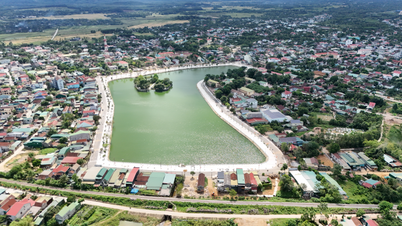
The milestones associated with the 220th anniversary of the provincial capital (1804-2024), the 30th anniversary of the establishment of Thanh Hoa City (1994-2024), and the 10th anniversary of its status as a Class I city (2014-2024) seem like invisible links in time, connecting memories and emotions across generations. Each person approaches the city with their own mindset, perception, and destiny. But ultimately, there is a burning love, gratitude, and a hope for even stronger breakthroughs for the city in the future...
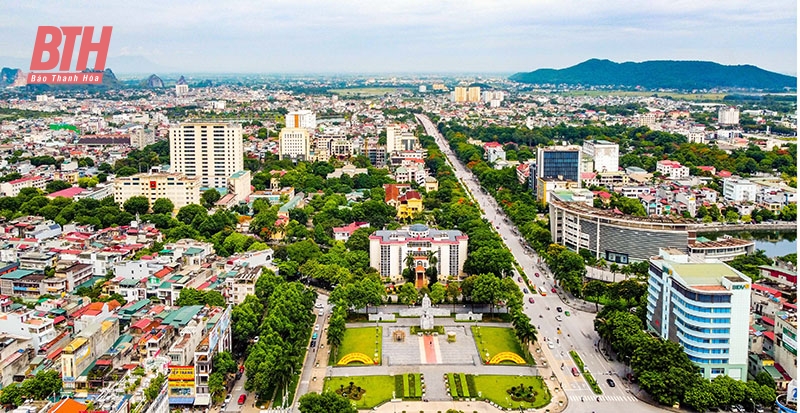
1. One winter morning, I chatted leisurely with photographer Tran Dam over a cup of coffee dripping slowly. I began the conversation: “The streets are bustling and vibrant with celebratory atmosphere these days, aren’t they, sir? Looking back at the milestones – 220 years as the provincial capital, 30 years since the establishment of Thanh Hoa City, 10 years as a Class I city – it’s clear that it’s been a long and arduous journey of construction and development, filled with countless efforts, ups and downs, and triumphs.”
After a long silence, Mr. Dam gazed intently at the street before him. Continuing his story about the town and his life, Mr. Dam said: “I began ‘registering’ as a citizen of Thanh Hoa town (later a city) in 1972. At that time, the city was heavily affected by the war against the American imperialists, the defense of Ham Rong Bridge, and most people had to evacuate. Life was very hard and difficult, but everyone believed that the future would be better, believing that one day the town would return to a peaceful rhythm of life.”
The images of Thanh Hoa town in the old days are vividly and sharply captured in slow motion through the stories told by photographer Tran Dam. He recounted how, in the past, the entire town had only a few public water taps; people would line up to collect water to take home. Every morning, dozens of people would stand around the taps waiting for their turn. Then he talked about the roads, how many routes were muddy and slippery up to ankle-deep in the rain, and how the town had to spend many years campaigning and mobilizing people to achieve the goal of 100% of households using two-compartment toilets. Seeing me smile, he immediately corrected me: "Even these small things show the great efforts and determination we have in building a cultured and civilized urban lifestyle and improving the quality of life for the people, not just trivial matters."
As a photographer, journalist, and poet, I see Mr. Dam as a witness to the city's history. He conveys his feelings, observations, and perceptions of the changes in Thanh Hoa City through his works. "Fortunately, life has left behind works and books as a legacy; although my health is declining, I can still continue writing and strolling around the city," Mr. Dam confided. I reminded him of his photo book "Where the Cranes Take Flight," which was released to readers in 2020.
This photo book is a publication celebrating the 21st Congress of the Thanh Hoa City Party Committee, term 2020-2025, containing the deep affection and subtle, unique perspective of photographer Tran Dam on the 220-year-old provincial capital. He shared: “To complete this book as it is today, in addition to professional activities, I had many working sessions and discussions with six former Secretaries of the Thanh Hoa City Party Committee. There were differing opinions, but they all agreed on the point: how to highlight the beauty that is both modern and deeply rooted in the unique historical and cultural heritage of Thanh Hoa City, something that not every city possesses.” With such meticulous and careful work, “Where the Cranes Take Flight” is considered a “photo exhibition on paper.” The diversity in the reflected reality, the vividness and subtlety in the colors and composition of the photos captivate readers from the very first images. Photographer Tran Dam has "borrowed the language of images" to introduce scenic spots, historical sites, and outstanding achievements in socio -economic and cultural development, so that everyone can contemplate, feel, and love even more a city that is on the verge of taking off.
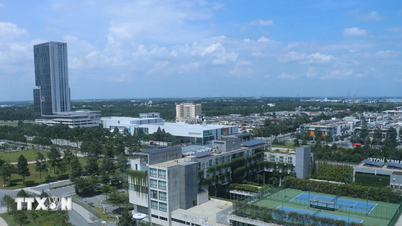
At this age, what Mr. Dam cherishes most is living happily, healthily, and usefully, witnessing the city's progress and development every day. Mr. Dam calmly said: “The city's appearance is becoming increasingly modern and attractive with numerous transportation and infrastructure projects being implemented and built. The income and living standards of the people are constantly improving. In the past, people lined up to carry water home, but now clean water reaches every house, and water outages are very rare. Roads, from main avenues to streets and neighborhoods, are clean, beautiful, and well-connected. The city's 'green lungs' are being renovated; culture and society are being cared for; good cultural traditions are being revived; many historical and cultural relics are being restored, preserved, and effectively utilized. Urban culture and civilization are being formed through many generations of city dwellers.”
Mr. Dam closely monitors information regarding the socio-economic development of the city, including its advantages, difficulties, goals, tasks, and solutions for continued rapid growth in the coming period. In 2024, the city's total production value is estimated at 81,220 billion VND, ranking second in the province (after Nghi Son town); accounting for 18.4% of the province's total production value. The growth rate of production value is estimated at 10.25%, an increase of two ranks compared to 2023, ranking fourth in the province. Average per capita income is estimated at 91.17 million VND, an increase of 5.5 million VND compared to 2023. Total state budget revenue is estimated at 4,158.8 billion VND, reaching 141% of the provincial budget estimate and 118% of the city's assigned budget estimate. The investment and business environment has improved; Many large-scale projects have been implemented, creating momentum for socio-economic development. Investment capital mobilized for development is estimated at VND 27,973 billion, an increase of 6.7% compared to the same period, accounting for 20.08% of the province's total investment capital. Notably, in 2024, the city commenced construction on 4 key projects according to Resolution No. 38/2024/NQ-HĐND of the Provincial People's Council; implemented 10 projects to celebrate the 220th anniversary of the provincial capital, the 30th anniversary of the city's establishment, the 10th anniversary of its status as a Type I urban area; and the 60th anniversary of the Ham Rong victory, with a total budget of VND 77.925 billion...
These achievements serve as a foundation for the Party Committee, government, and people of Thanh Hoa City to continue their efforts, leverage internal strengths, maximize external resources, and create new growth drivers for sustainable development. Naturally, alongside the recognition of the city's breakthroughs, Mr. Dam still has his own concerns: “The city possesses diverse and unique historical and cultural layers, yet we haven't effectively exploited and promoted them to serve tourism growth, especially the Ham Rong historical and cultural relic site. This is a challenge for all of us on our journey. Because history and culture are an intrinsic source of strength, failing to effectively utilize them means we are wasting our internal resources.”
2. Like Mr. Dam, I am not a "born child" of the city. Amidst the hustle and bustle of people coming and going every day, I came from the village to the city to pursue my dreams for the future. Despite the hardships, difficulties, and challenges, and sometimes the inevitable feelings of resentment and setbacks, I still feel fortunate and happy to be a part of the journey of building and developing my hometown city.
I remember I first became attached to the city around 2014, the time when I was about to graduate from university and move back to my hometown to look for job opportunities. This was also the year Thanh Hoa City joyfully received the Decision recognizing it as a Class I urban area. Before that, my knowledge of Thanh Hoa City was very limited. Previously, before the Nguyet Vien bridge was built, getting from my hometown to Thanh Hoa City meant crossing the Hoang Long bridge and then following National Highway 1A, a distance twice as long as it is now. My father worked far away in the border region, and my mother didn't know how to ride a motorbike, so it seemed our lives had no connection to the city. But then, I was fortunate enough to be attached to Thanh Hoa City for almost ten years.
Today, the city is bustling with preparations for the 220th anniversary of its establishment as the provincial capital (1804–2024), the 30th anniversary of Thanh Hoa City's founding (1994–2024), and the 10th anniversary of its status as a Class I city (2014–2024). To this day and forevermore, I will always be silently grateful to my hometown for its welcoming embrace and for giving me the opportunity to prove myself. I don't dare think I can do anything great to repay the city's noble gesture; with each passing day, I promise myself to strive harder, work harder, and contribute more so that the city understands our sincerity and good intentions, and to make a small contribution to the construction and development of the city and my hometown.
Thao Linh
Source: https://baothanhhoa.vn/tu-su-cung-pho-233978.htm

![[Photo] General Secretary and President To Lam presides over a working session with the Central Policy and Strategy Committee on the development of the materials industry.](https://vphoto.vietnam.vn/thumb/1200x675/vietnam/resource/IMAGE/2026/05/21/1779359935432_a3-bnd-3129-1412-jpg.webp)


































































Comment (0)